How to Build a Profitable 10-Item Restaurant Menu
A restaurant menu can look impressive and still lose money.
You may have 30, 40 or even 100 dishes on your menu. Customers may love the variety. Your kitchen may be busy every day.
But here is the uncomfortable question:
Do you know which items are actually making you money?
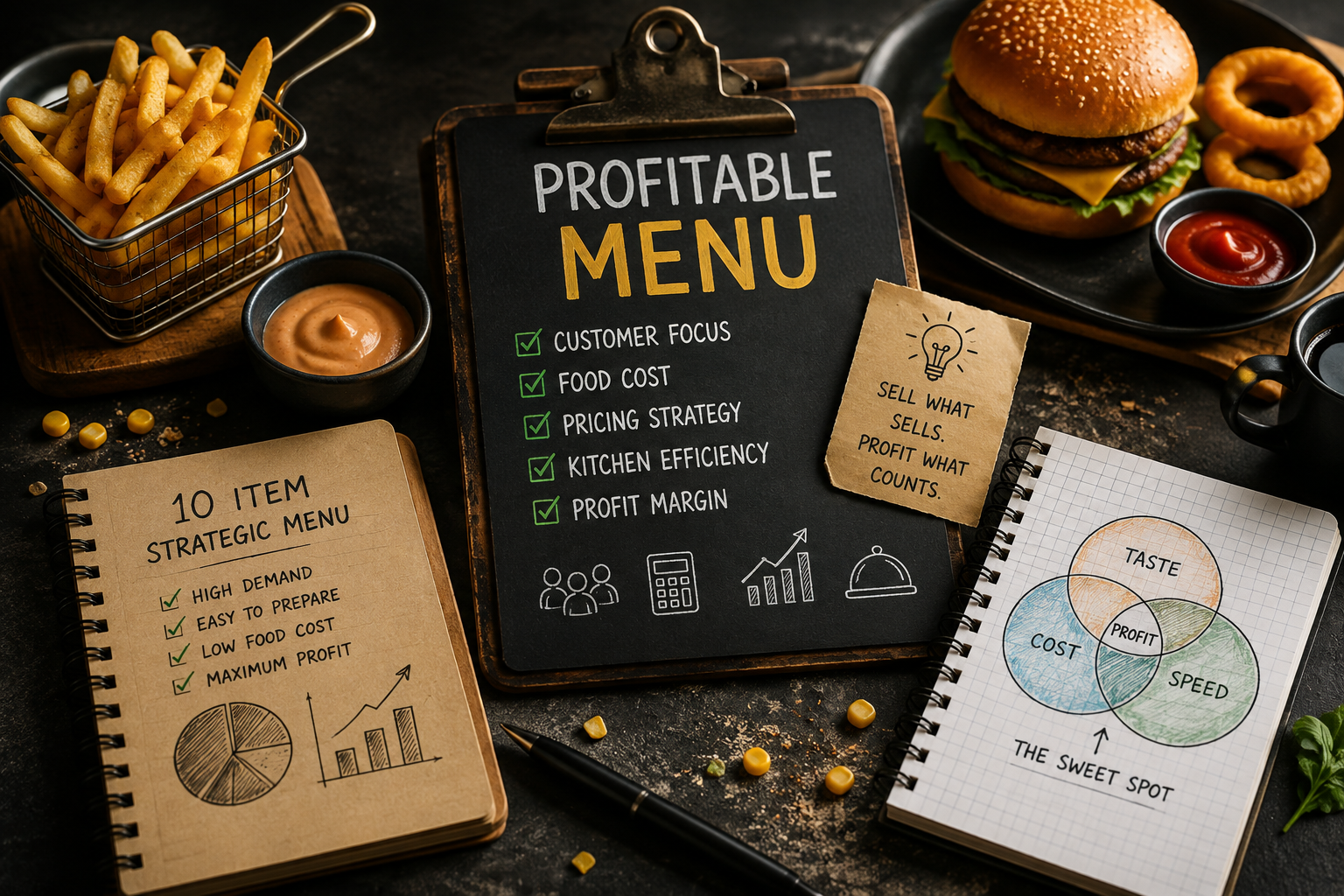
A profitable menu isn’t created by simply adding popular dishes or copying competitors. It is designed around customer demand + food cost + pricing + kitchen efficiency + profit contribution.
This is especially important for QSRs, cafés and small restaurants where limited kitchen space, staff and working capital can quickly turn menu complexity into hidden costs.
In this guide, I’ll show you how to build a focused 10-item menu that gives customers variety while keeping your operation simpler, faster and more profitable.
Think like a chef when creating the food. Think like a business owner when creating the menu.
Section 1 — Start With Your Target Customer
The biggest menu mistake is starting with the food.
Restaurant owners often begin with questions like, “What dishes should I add?” A better question is, “Who am I feeding?”
A college-area QSR, a family restaurant, an office-lunch outlet and a late-night takeaway business can all sell burgers—but their ideal menu, pricing and portion sizes may be completely different.
Before creating your 10 items, define your customer:
Who are they?
Students, families, office workers, tourists or late-night customers?
What do they want?
Convenience, value, indulgence, healthier choices, familiar comfort food or something new?
How much will they spend?
Your menu price range should match the customer’s spending behaviour—not simply your desired margin.
When do they buy?
Breakfast, lunch, dinner, snacks, takeaway or delivery?
Why should they choose you?
Your menu needs a clear reason for customers to remember your restaurant.
Chef RBS Tip
Before adding a new dish, ask:
“Does this product solve a customer need, fit my concept and make financial sense?”
If the answer is no, it probably doesn’t belong on your menu.
A profitable menu starts with the customer—and ends with a reason to come back.
Section 2 — Choose a Small Number of Core Products
A profitable restaurant menu does not need dozens of completely different products. One of the smartest ways to simplify operations is to build the menu around a small number of core products.
For a 10-item menu, each item should have a clear purpose. You might have a few signature products, supporting sides, beverages and one or two higher-margin items.
The key is to avoid creating a completely different ingredient list for every dish. When several menu items use the same proteins, sauces, vegetables, breads or base preparations, purchasing becomes easier and ingredients can be used more efficiently.
This approach can reduce inventory complexity, preparation time and waste while making staff training easier.
A smaller menu with strong products is often easier to operate than a large menu with too many ingredients and complicated preparation.
Section 3 — Build Ingredient Overlap Into Your Menu
One of the most effective ways to simplify a restaurant operation is to make ingredients work across multiple menu items.
For example, a QSR might use the same grilled chicken in a burger, wrap, rice bowl and salad. The same lettuce, cheese, sauces or vegetables can also appear across several products.
This creates ingredient overlap, which can make purchasing and inventory management easier. It can also reduce the number of ingredients sitting in storage and lower the risk of products expiring before they are used.
Ingredient overlap can also make preparation more efficient. A single well-controlled base preparation can become part of several menu items without requiring completely separate production processes.
The important point is to avoid forcing the same ingredient into products where it doesn’t make culinary sense. The overlap should support the menu rather than make every dish taste the same.
A smart menu makes the same ingredients work harder without making the customer feel that the choices are repetitive.
Section 4 — Balance High-Margin and High-Value Items
Not every item on your menu needs to have the same food cost percentage. What matters is how each product contributes to the overall business.
Some items may have a relatively low ingredient cost but require more preparation time. Others may have a higher food cost but sell in large volumes and generate strong contribution dollars.
When building a profitable restaurant menu, look at both food cost percentage and contribution margin. A $12 item with a 30% food cost leaves $8.40 after ingredient cost, while a $6 item with a 20% food cost leaves only $4.80.
This is why simply choosing the products with the lowest food-cost percentage isn’t always the best strategy.
A balanced menu can include signature products that attract customers, reliable high-volume items, profitable sides and beverages, and products that provide good value without placing excessive pressure on food costs.
The goal is to build a menu where different products support the profitability of the entire operation.
Section 5 — Design the Menu Around Kitchen Speed
A profitable menu must work not only on paper but also inside the kitchen. If a product takes too long to prepare, requires several cooking steps or needs ingredients that are difficult to handle during peak hours, it can create bottlenecks and increase labour costs.
For QSR operations, speed and consistency are especially important. Menu items should ideally use efficient preparation methods and share components wherever practical.
Consider how long each product takes from order received → preparation → cooking → assembly → handoff. A dish that looks profitable from its food-cost calculation may become less attractive when it requires significantly more labour and kitchen time.
Before adding an item to the menu, test it during a busy service period. Check preparation time, equipment requirements, staff workload and the consistency of the final product.
A profitable menu should be designed for the real kitchen—not just the recipe book.
Section 6 — Use the Same Base Ingredients in Different Formats
A strong QSR menu can become much more efficient when one preparation can be used in several different products.
For example, a restaurant might prepare one seasoned chicken base and use it in a burger, wrap, loaded fries and rice bowl. A common sauce or vegetable preparation can also be adapted across multiple menu items.
This approach can simplify purchasing, storage and preparation while allowing the customer to see enough variety on the menu.
It can also make staff training easier because the kitchen team becomes familiar with a smaller number of core preparations.
However, ingredient sharing should be planned carefully. Each product still needs to offer a distinct eating experience and should have its own standardised recipe and portion specification.
The best menus create variety for the customer while maintaining simplicity behind the counter.
Section 7 — Price Every Item for Profitability
A menu price should never be based only on what competitors are charging. Your price must cover the food cost, labour, packaging, overheads, delivery commissions and other operating expenses while still leaving a healthy profit.
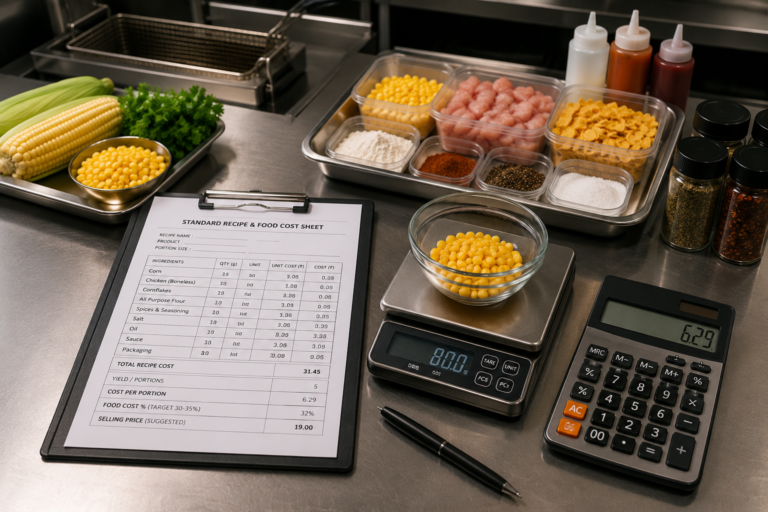
Start by calculating the standardised cost of every recipe. Then consider your target food-cost percentage and the selling price customers are realistically willing to pay.
For example, if a dish costs $3.00 in ingredients and your target food cost is 30%, a simple starting price would be:
$3.00 ÷ 30% = $10.00 selling price
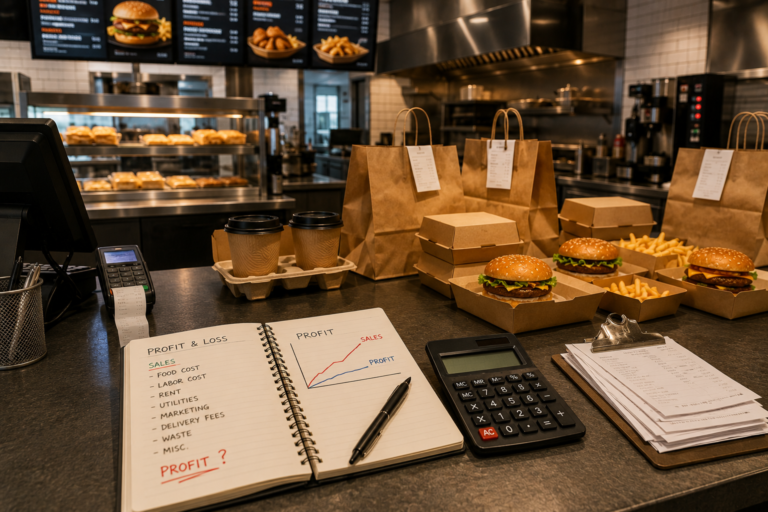
But food cost is only one part of the calculation. Packaging, labor, rent, utilities, marketing, delivery-platform commissions and food waste can significantly reduce the final profit.
Review your prices regularly because ingredient costs can change. A menu item that was profitable six months ago may no longer be profitable today.
Price your menu from your costs and profit goals—not from guesswork.
Section 8 — Use Menu Engineering to Identify Your Winners
Not every menu item contributes equally to your restaurant’s success. Some products sell frequently, while others may have a higher profit per portion.
Track each item’s sales volume, food cost, contribution margin and customer demand to understand which products are actually driving your business.
Your best-performing items should receive strong visibility on the menu. Consider placing signature or highly profitable products where customers are more likely to notice them.
At the same time, review products that have low sales and low profitability. They may need a recipe change, better positioning, a price adjustment or removal from the menu.
Menu engineering is not simply about making everything expensive. It is about understanding which products deserve more attention and which products create unnecessary complexity.
Your sales data should help decide what stays, what changes and what leaves the menu.
Conclusion — Build a Menu That Works for Both Customers and the Kitchen
A profitable restaurant menu is not simply a long list of dishes. It is a carefully planned system that balances customer demand, food cost, pricing, kitchen speed, ingredient utilization and operational efficiency.
Start with your target customer, keep the menu focused, create ingredient overlap, control portions and calculate the real cost of every product. Then use sales data to understand which items deserve more attention.
A smaller, well-designed menu can often be easier to operate, easier to train staff for and easier to maintain consistently.
The goal is simple: give customers enough choice while keeping the kitchen efficient and the business profitable.
Build the menu for the customer—but engineer it for profit.