How Restaurants Calculate Food Cost: A Simple Guide for Restaurant Owners
Food cost is one of the most important numbers in any restaurant or QSR business. It tells you how much of your sales revenue is being spent on the ingredients used to produce the food you sell.
A restaurant can have excellent sales and popular menu items, but if food costs are not properly calculated and controlled, profitability can quickly disappear.
Understanding food cost helps restaurant owners set better menu prices, control portions, identify expensive ingredients, reduce waste and understand which menu items are actually contributing to the business.
In this practical guide, Chef RBS explains how restaurants calculate food cost, how to calculate food cost percentage and how restaurant owners can use these numbers to make better pricing and menu decisions.
Section 1 — What Is Food Cost?
Restaurant food cost is the total cost of the ingredients used to prepare the food you sell. It normally includes the raw ingredients that go directly into a dish, such as meat, vegetables, grains, dairy products, sauces, spices and cooking ingredients.
For example, if a QSR sells a chicken burger for $10 and the ingredients used to make that burger cost $3, the food cost for that item is $3.
Food cost is important because the selling price is not the same as profit. From the $10 sale, the restaurant still has to pay for labor, rent, utilities, packaging, equipment, marketing, delivery costs and other operating expenses.
That’s why restaurant owners need to know the actual cost of every menu item rather than simply estimating ingredient costs.
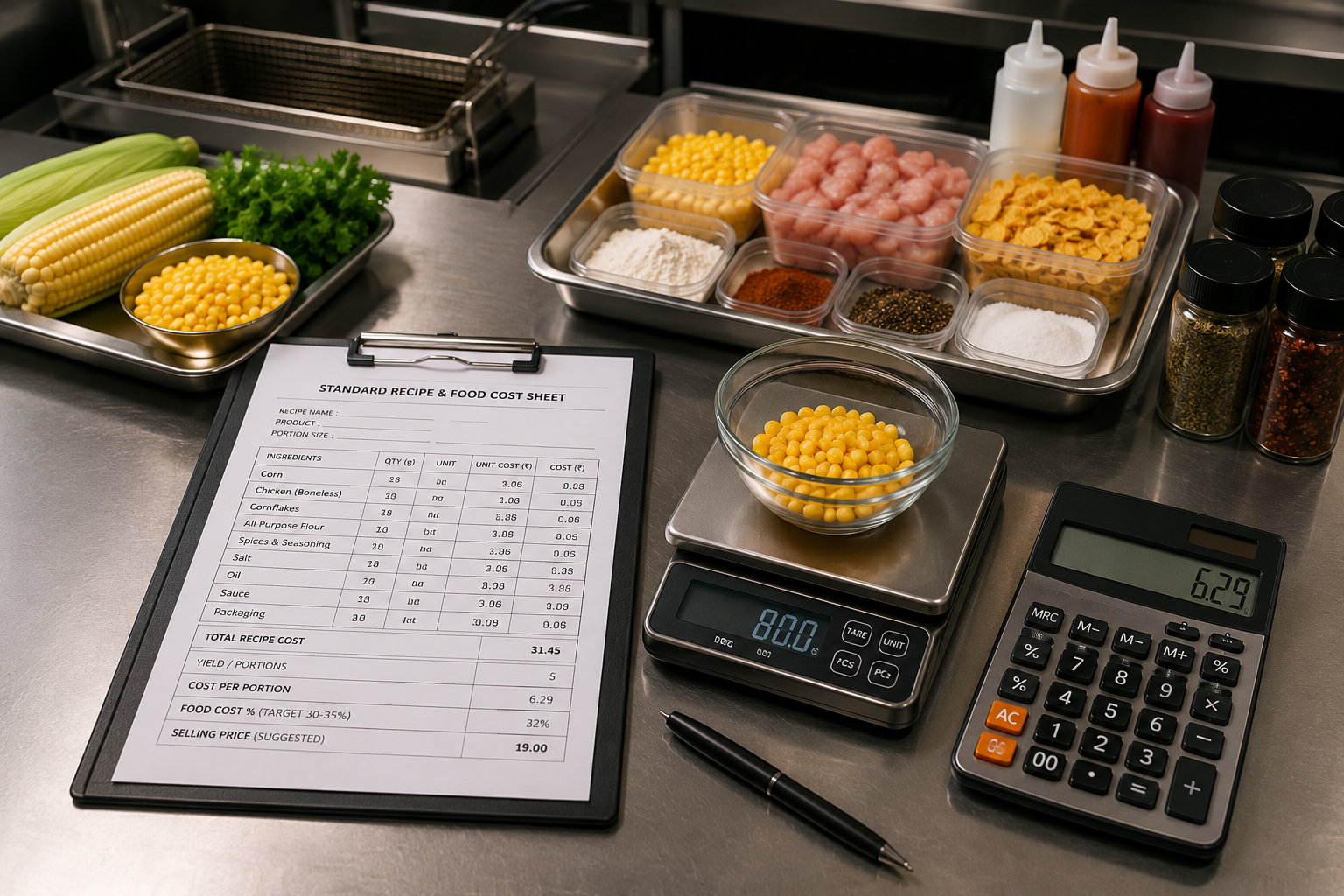
A standardized recipe is the foundation of accurate food costing. Every ingredient should have a defined quantity and cost so that the restaurant knows what each serving actually costs to produce.
Section 2 — How to Calculate Food Cost for One Dish
The easiest way to understand food costing is to calculate the cost of one standardized serving.
Start by listing every ingredient used in the recipe and the quantity required for one portion. Then determine the cost of that quantity using your actual purchase price.
For example, imagine a QSR chicken burger uses:
- Chicken — $1.20
- Bun — $0.50
- Cheese — $0.35
- Vegetables — $0.25
- Sauce — $0.20
- Cooking ingredients — $0.15
The total ingredient cost is $2.65 per burger.
If the burger sells for $10, the basic food cost percentage is:
Food Cost % = Food Cost ÷ Selling Price × 100
$2.65 ÷ $10 × 100 = 26.5%
This means ingredients consume 26.5% of the burger’s selling price before other business expenses are considered.
The calculation becomes reliable only when the recipe, ingredient quantities and purchase prices are accurate.
Section 3 — How to Calculate Food Cost Percentage for a Restaurant
For a restaurant, food cost percentage helps you understand how much of your food sales is being consumed by ingredients.
The basic formula is:
Food Cost % = Total Food Cost ÷ Food Sales × 100
For example, if a restaurant generates $20,000 in food sales during a month and the food used to produce those sales costs $6,000, the food cost percentage is:
$6,000 ÷ $20,000 × 100 = 30%
A restaurant owner can use this percentage to compare actual performance against the business’s target. However, the appropriate food cost percentage can vary significantly depending on the concept, menu, pricing, ingredients, location and operating model.
It’s also important to distinguish between theoretical food cost and actual food cost. Theoretical food cost is based on what should have been used according to standardized recipes and sales, while actual food cost reflects what the business actually consumed or purchased over a period.
Comparing the two can help identify problems such as over-portioning, waste, inventory discrepancies or purchasing issues.
Section 4 — Why Portion Control Matters
Even when your recipe is correctly costed, inconsistent portion sizes can push your actual food cost much higher than expected.
Imagine a restaurant sells 100 chicken bowls in a day. If the standard portion is 150 grams of chicken but staff regularly serve an extra 20 grams, the restaurant is giving away an additional 2 kilograms of chicken every day.
The same problem can happen with cheese, sauces, fries, rice, vegetables and other ingredients. Small over-portioning on every order can become a significant cost over an entire month.
Portion control is not about giving customers less food. It is about giving every customer the correct portion consistently.
Restaurants can improve portion control by using standardized recipes, weighing high-cost ingredients during recipe development, using portioning tools and clearly defining serving specifications for kitchen staff.
Consistent portions improve food-cost accuracy, product consistency and customer expectations at the same time.
Section 5 — Recipe Cost vs. Actual Food Cost
A recipe cost tells you what a dish should cost when it is prepared according to the standardized recipe. Actual food cost tells you what the restaurant actually consumed during a specific period.
These numbers can be different. A restaurant may calculate a burger at $2.65 per serving, but its actual food cost may be higher because of over-portioning, preparation waste, spoilage, incorrect orders, inventory errors or changes in ingredient prices.
This is why professional restaurants should not rely only on recipe costing. Comparing theoretical food cost with actual food cost can reveal where money is being lost.
For example, if your recipes indicate that ingredients should represent 28% of food sales but your actual results consistently show 34%, the 6-percentage-point difference deserves investigation.
The goal is not simply to achieve a low food-cost percentage. The goal is to understand why your actual cost differs from your expected cost and then correct the underlying problem.
Section 6 — How Ingredient Prices Affect Restaurant Food Cost
Ingredient prices can change regularly, which means the cost of a menu item can increase even when its recipe has not changed.
Chicken, cooking oil, dairy products, vegetables, grains and other ingredients may fluctuate in price because of seasonality, supply, transportation and market conditions.
If a restaurant continues using the same selling price while ingredient costs increase, the food-cost percentage can gradually rise and reduce the contribution from each sale.
This is why restaurant owners should periodically review their recipe costs using current purchase prices, rather than relying on an old costing sheet.
However, changing menu prices is not always the only solution. Restaurants can also review suppliers, purchasing quantities, ingredient specifications, portion sizes and menu engineering to protect margins without unnecessarily reducing the value offered to customers.
Good food costing is an ongoing process—not something you calculate once and forget.
Section 7 — How Food Waste Changes Your Real Food Cost
Food waste is one of the easiest costs to overlook because it doesn’t always appear as a separate expense on a restaurant’s menu.
Ingredients can be lost through trimming, spoilage, overproduction, incorrect preparation, expired stock, damaged products and food that is prepared but never sold.
For example, if a restaurant purchases 10 kilograms of vegetables but only 8 kilograms become usable product after trimming and preparation, the cost of the usable ingredient is higher than the original purchase price might suggest.
Waste can also occur after cooking. If a QSR prepares more food than it can sell within its required holding period, unsold product may have to be discarded.
The solution is to measure waste rather than simply assume it is unavoidable. Track what is being discarded, why it was discarded and how frequently it happens. Proper stock rotation, accurate forecasting, controlled batch sizes and standardized preparation can help reduce unnecessary food loss.
Reducing waste doesn’t mean compromising food quality. It means using your ingredients more efficiently.
Section 8 — Food Cost Is Not Your Profit Margin
One of the most common mistakes in restaurant costing is assuming that the difference between the selling price and food cost is profit.
If a dish sells for $10 and the ingredients cost $3, you have $7 left after food cost. But that $7 still has to contribute toward labor, rent, utilities, packaging, equipment, marketing, delivery fees, taxes and other operating expenses.
This is why restaurant owners should think about contribution margin, not just food cost percentage.
A menu item with a 30% food cost may look attractive, but its real contribution depends on its selling price, portion size, preparation time, packaging and sales channel.
Food cost is one part of restaurant profitability—not the definition of profit.
Understanding this difference helps owners make better decisions about menu pricing, promotions, portion sizes and which products deserve more attention.
Conclusion — Know Your Food Cost Before You Price Your Menu
Understanding food cost is essential for building a profitable restaurant or QSR. A menu price should never be based simply on what competitors charge or what customers are willing to pay.
Start with a standardised recipe, calculate the cost of every ingredient, monitor portion sizes and update costs when supplier prices change. Then compare your theoretical food cost with your actual results to identify waste, over-portioning and other hidden losses.
Most importantly, remember that food cost is not profit. Your selling price must provide enough contribution to cover labour, rent, utilities, packaging, marketing, delivery costs and other operating expenses.
A profitable restaurant doesn’t just sell more food—it understands the numbers behind every plate.
If you’re building or improving a QSR, accurate food costing can help you make better decisions about recipes, pricing, portions, menu design and purchasing.