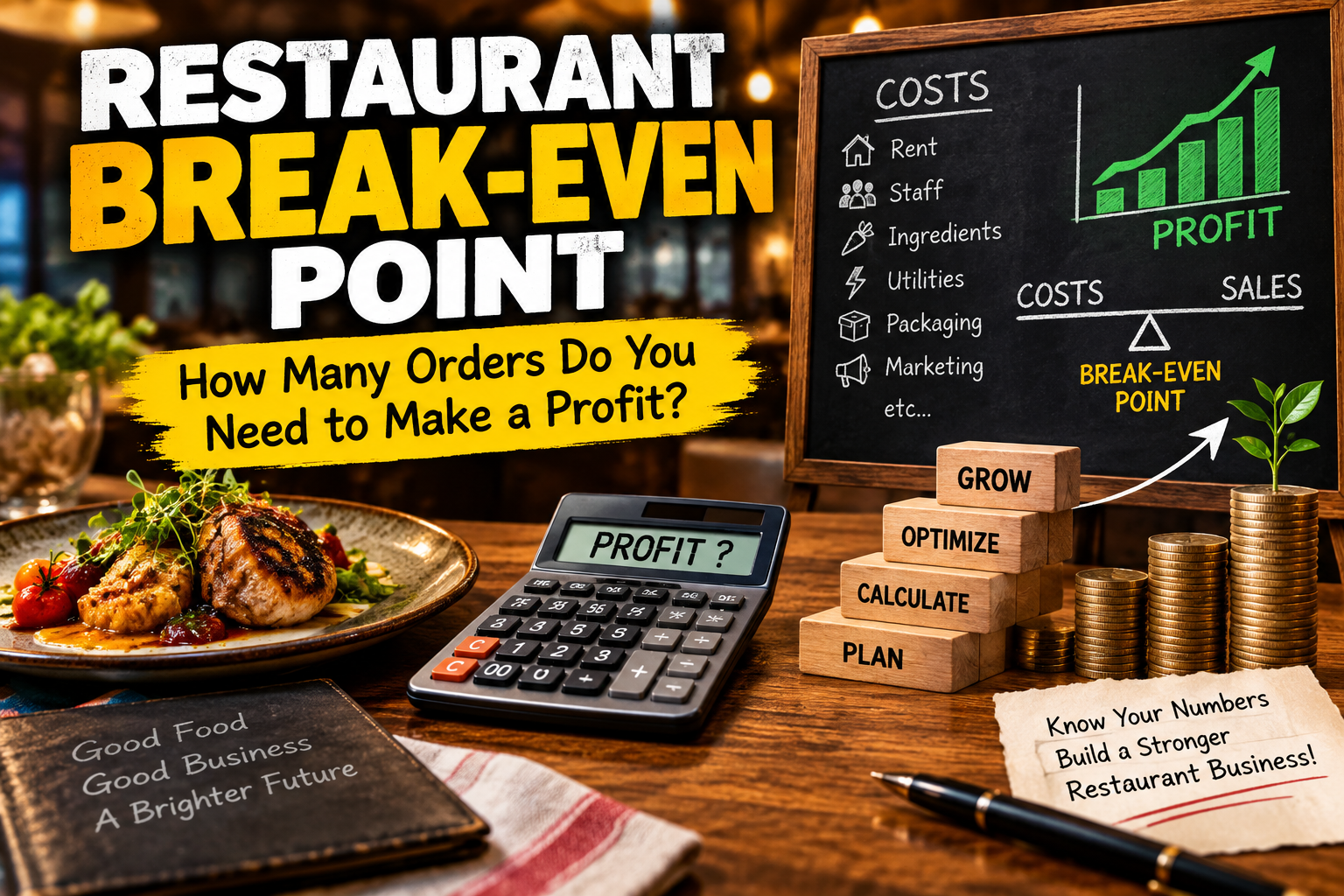
Restaurant Break-Even Point: How Many Orders Do You Need to Make a Profit?
A restaurant can be busy every day and still struggle to make a profit. Knowing your break-even point helps you understand how many orders or sales you need to cover your fixed and variable costs before your business starts generating profit.
In this guide, Chef RBS explains the restaurant break-even point in simple terms, shows how to calculate it, and explains how menu price, food cost, labour, overheads and contribution margin affect the number of orders you need to become profitable.
What Is the Restaurant Break-Even Point?
The restaurant break-even point is the level of sales or number of orders a business needs to generate to cover its costs. At the break-even point, the restaurant has neither a profit nor a loss.
Once sales move above the break-even point, the contribution from each additional order can begin generating profit after the relevant variable costs are covered.
Understanding this number helps restaurant owners set realistic sales targets and evaluate whether their pricing and cost structure can support a profitable business.
Fixed Costs vs Variable Costs
Fixed costs are expenses that generally remain the same regardless of how many orders you sell. Examples include rent, insurance, certain salaries, software subscriptions and some equipment-related costs.
Variable costs change as your sales volume changes. Food ingredients, takeaway packaging, delivery commissions and some production costs are examples of costs that can increase when you sell more orders.
Separating these costs is important because the break-even calculation depends on understanding how much of each sale is available to contribute toward your fixed costs.
The Restaurant Break-Even Formula
Break-Even Sales = Fixed Costs ÷ Contribution Margin
Break-Even Orders = Fixed Costs ÷ Contribution Per Order
Contribution per order is the amount left from each sale after subtracting the variable costs associated with that order.
For example, if your average selling price is $10 and your variable cost per order is $4, your contribution per order is $6. If your monthly fixed costs are $6,000, you would need approximately 1,000 orders per month to reach break-even.
Break-Even Example for a Small Restaurant
Imagine a small restaurant has monthly fixed costs of $6,000. Its average order value is $10, while the average variable cost per order is $4.
Contribution per order = $10 − $4 = $6
Break-Even Orders = $6,000 ÷ $6 = 1,000 orders per month
The restaurant therefore needs approximately 1,000 orders per month to cover its fixed costs.
If it operates 30 days a month, that is about 34 orders per day. Orders above this level can contribute toward profit, assuming the underlying costs and average contribution remain consistent.
Why Your Break-Even Point Matters
Your break-even point gives you a practical sales target instead of relying on guesswork.
It can help you understand whether your current menu prices are realistic, how many daily orders your restaurant needs, and how changes in costs can affect profitability.
If your break-even sales requirement is too high, you may need to review your pricing, portion sizes, food costs, labour structure, operating expenses or menu mix.
It is also useful when planning a new restaurant or QSR because it helps you estimate the sales volume required before the business can begin generating a profit.
5 Ways to Lower Your Restaurant Break-Even Point
1. Increase your contribution per order: Review menu pricing and variable costs so more money remains from each sale after direct costs.
2. Reduce food waste: Better purchasing, storage, preparation and portion control can reduce unnecessary variable costs.
3. Improve labour efficiency: Match staffing levels to actual sales patterns and improve kitchen workflow without compromising service or food quality.
4. Control overheads: Review rent, utilities, maintenance, subscriptions and other recurring operating expenses.
5. Focus on profitable menu items: Promote products that provide a healthy contribution while maintaining good customer demand.
How Menu Pricing Changes Your Break-Even Point
Your selling price has a direct effect on your contribution per order. If your variable costs stay the same, increasing the selling price increases the amount available to cover fixed costs, which can reduce the number of orders needed to reach break-even.
For example, if an order sells for $10 and has a variable cost of $4, the contribution is $6. If the selling price increases to $12 while the variable cost remains $4, the contribution becomes $8.
With fixed costs of $6,000 per month, the break-even point would change from 1,000 orders to 750 orders per month.
However, pricing should always consider customer demand, competition and perceived value. A higher price is not automatically better if it causes a significant drop in sales.
Break-Even Point for Delivery and QSR Businesses
Delivery and QSR businesses need to pay particular attention to contribution per order because commissions, packaging and promotional discounts can significantly reduce the amount retained from each sale.
A product that appears profitable for dine-in sales may produce a much smaller contribution through a delivery platform.
For example, if a $10 order has $4 in variable food and packaging costs and a 30% delivery commission, the amount available toward fixed costs is only $3 before considering other expenses.
This is why delivery businesses should calculate break-even using the actual economics of their delivery channel rather than relying only on the menu selling price.
Common Break-Even Mistakes Restaurant Owners Make
1. Confusing revenue with profit: High sales do not necessarily mean the restaurant is profitable.
2. Forgetting variable costs: Food, packaging and delivery commissions must be considered when calculating contribution per order.
3. Using unrealistic average order values: Base your calculation on actual sales data whenever possible.
4. Ignoring discounts and promotions: Frequent discounts can reduce the contribution generated by each order.
5. Not updating the calculation: Ingredient prices, labour costs, rent and other expenses change over time. Review your break-even point regularly.
6. Treating break-even as a profit target: Break-even only means covering your costs. A healthy business needs sales above break-even to generate a sustainable profit.
Use the Chef RBS Food Cost Calculator to Plan Your Break-Even Point
The Chef RBS Restaurant Food Cost Calculator can help you understand the contribution and profitability of individual menu items before you set sales targets.
Enter your ingredient cost, portions, selling price, packaging, labour and overhead costs. For delivery or takeaway sales, you can also include the delivery/app commission to see how it affects the amount remaining from each order.
Use these results together with your fixed monthly costs to estimate how many orders your restaurant needs to cover its costs and move beyond break-even.
Calculate Your Restaurant Food Cost →
Final Thoughts
Your break-even point is one of the most useful numbers in a restaurant because it turns your costs into a practical sales target.
Calculate it using realistic costs, review it whenever your prices or expenses change, and use it alongside food cost and menu profitability analysis.
The goal is not simply to reach break-even. The goal is to build a menu and operating model that consistently generates profit above that point.