When Hackers Control the Cold: How Cyberattacks Can Spoil Food in Refrigerators and Cold Storage
Cyberattacks on food storage temperatures are becoming a serious concern for supermarkets, restaurants, and the wider food industry.
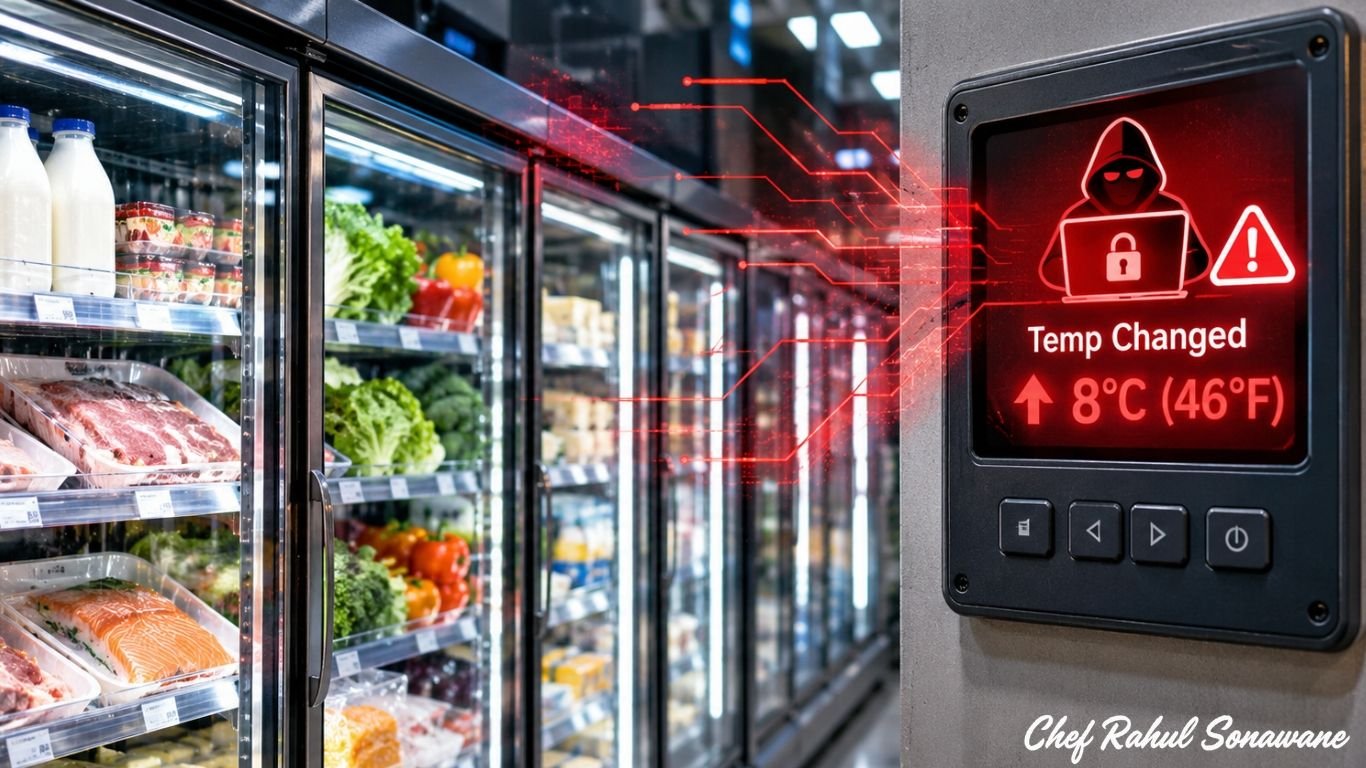
Imagine walking into a grocery store in the morning, opening up the refrigerated case and seeing that all of the milk, meat, fish, and other perishables have sat out at unsafe temperatures all night long.
The refrigeration units are still operating; the lights in the case are on; the store looks exactly as it did the day before.
However, something occurred behind the scenes.
This is no longer just a hypothetical situation from a science fiction movie. Cyberattacks on supermarket refrigeration systems in Europe have shown that digital attacks can cause physical cooling equipment to fail, disrupt food storage, and ultimately result in businesses discarding large amounts of food.
In October 2026, France’s National Cybersecurity Agency (CERT-FR) released a warning about compromised remote refrigeration controllers. Additional reports of similar issues were made by European supermarket chains in November.
Additionally, freezer failures at multiple U.S. military commissaries are currently being investigated as possible cyberattacks.
These events raise a very serious issue for the food industry:
What will occur when the systems used to keep food cold become the target of cyberattacks?
As a chef, I have always viewed temperature control as one of the most fundamental aspects of food safety. We monitor refrigeration, we verify the temperature of items received, we follow proper cooling methods, and we maintain cold storage because microorganisms do not cease to be a concern once food enters a refrigerator.
Food businesses now need to take into account another level of risk: the cybersecurity of the equipment that protects their food.
This article will explain how such attacks can occur, what temperature fluctuations do to food, why contaminated food may not appear or smell spoiled, and how restaurants, supermarkets, manufacturers, and consumers can prepare for a more connected food industry.
What Happened with the Recent Refrigeration Cyber Attacks?
In October 2026, CERT-FR (France’s National Cybersecurity Agency) released an alert regarding compromised remote controllers used in refrigeration systems.
The alert listed equipment from multiple manufacturers, such as
- Danfoss AK-SM and AK-SC series
- Copeland XWEB
- Dixell XWEB
These types of systems are used to monitor and manage refrigeration systems. Depending on how they are configured, they may allow for remote access to temperature monitoring and control functions.
CERT-FR warned that allowing refrigeration management interfaces to be directly exposed to the Internet poses significant security risks. CERT-FR also provided recommendations to those who were affected by this issue. Recommendations included removing any unnecessary exposure to the Internet; properly restoring any compromised equipment; and ensuring that remote access is secure.
Following the release of this alert, there were reports of refrigeration issues at supermarkets throughout France and other European countries. In addition to France, there were reports of additional attacks occurring in Belgium, Luxembourg, Sweden, Ireland, etc., in November 2026.
The reported consequences included increased refrigerator and freezer temperatures; disposal of food; and disruption of supermarket operations.
An investigation into freezer malfunctions at U.S. military commissaries is currently underway as a possible cyberattack. At this time, investigators have not released all of the details.
It is important to note that while some cybersecurity alerts have been confirmed, many incidents are still being investigated and reported. Not every refrigeration failure is a cyber attack, and investigators have not yet publicly identified a single attacker responsible for all of these incidents.
However, these incidents demonstrate a major vulnerability in our current food storage infrastructure.
A refrigeration system is no longer simply a mechanical device. It can now also be a connected, computer-controlled system.
How Can a Hacker Change a Food Storage Temperature?
To better assess the potential risk of hacking into a commercial refrigerator, we must first learn about the operation of today’s commercial refrigeration systems.
Commercial refrigeration systems are made up of both electrical and mechanical parts. Most larger commercial refrigeration systems utilize an electronic controller, sensor(s), a compressor, an evaporator, alarms, and monitoring software.
Many supermarkets and food manufacturers have multiple refrigeration units, and they can all be monitored from one central location.
A basic refrigeration control system would operate as follows:
- Temperature sensors measure the conditions inside a refrigerator or freezer.
- An electronic controller receives the sensor readings.
- The controller manages the refrigeration equipment according to its programmed settings.
- A monitoring system records temperatures and may send alerts when conditions move outside acceptable limits.
- With authorized technicians, some systems allow remote access for maintenance and troubleshooting purposes.
Remote access allows for ease of maintenance. For example, a refrigeration technician can diagnose a problem with a unit without traveling to the site.
However, once an attacker has gained unauthorized access to a poorly secured controller or remote management system, there is more at stake than just the computer screen.
Depending on the equipment and amount of access granted, an attacker could potentially do the following:
- Change refrigeration temperature settings.
- Alter operating schedules.
- Interfere with cooling control functions.
- Disable or manipulate alarms.
- Disrupt communication between sensors and monitoring systems.
- Staff may not know food storage conditions have been modified.
Each system is different; therefore, each attack will result in different outcomes. Not all digital temperature monitors have the ability to control a compressor. Some refrigeration systems are not connected to the Internet.
The main concern is that if the control system is compromised, it could have an effect on the actual physical storage environment of food.
How Does a Temperature Change Actually Spoil Food?
This is where cybersecurity can become a food science issue.
Refrigeration does not sterilize food. It can only slow down the growth of many microorganisms and help to maintain quality.
When the temperature rises, the conditions that had previously restricted microbial growth can become more favorable.
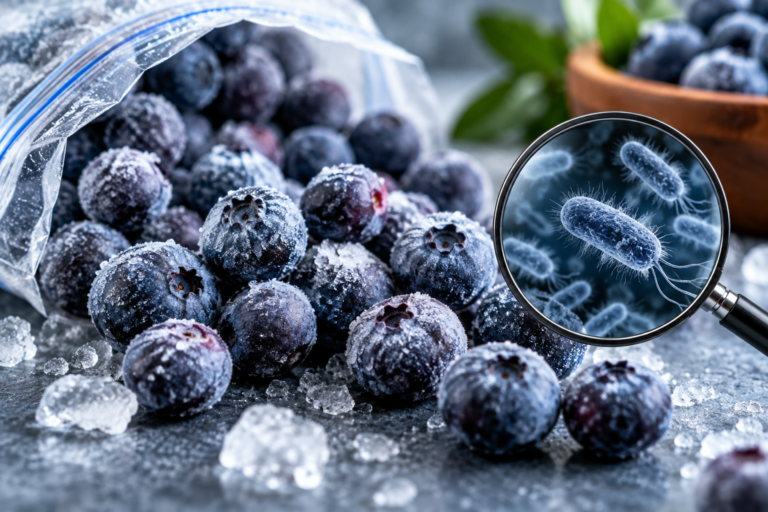
Bacteria, spoilage organisms, and pathogens can multiply and cause foodborne illness as temperature rises and conditions become more favorable for their growth.
How fast these changes will occur is influenced by several factors:
- The type of food.
- The initial level of microbial contamination.
- The temperature reached.
- How long the food remains at that temperature.
- The moisture, acidity, and composition of the food.
- Whether the food is cooked, raw, vacuum-packed, or ready to eat.
A short rise in temperature doesn’t necessarily mean that all foods are going to spoil. A longer rise in temperature, however, can create serious food safety problems.
What happens to different foods?
1. Meat and poultry
Raw meat and poultry can contain harmful microorganisms and therefore must be stored at controlled temperatures.
When the temperature in the storage area increases, bacteria such as Salmonella, Campylobacter, and certain strains of E. coli can multiply quickly in appropriate environments.
This can increase the chance of foodborne illness even more if proper handling and cooking are not followed.
2. Seafood
Seafood is highly perishable and therefore must be kept at the right temperature.
Some fish contain bacteria that can multiply in abused temperatures to form histamine. This cannot be killed by normal cooking.
This is why proper temperature control is so important from the time seafood is caught until it is consumed by the end user.
3. Milk and dairy products
Milk, cream, soft cheeses, etc., can be spoiled by temperature abuse.
Bacteria can multiply and can affect the taste, texture, and safety of the food. The product can become unfit for human consumption even though the product looks fine on the outside.
4. Cooked food and restaurant leftovers
Cooked rice, meat products, sauces, soups, and prepared meals can deteriorate if not cooled and stored correctly.
Bacteria like Bacillus cereus and Clostridium perfringens can multiply quickly when food is not cooled properly.
Some of the toxins produced by bacteria can still cause health problems even after the food has been reheated. Reheating food that has been temperature-abused is not recommended.
5. Frozen food
Freezing slows down the activity of microorganisms but does not prevent deterioration in the quality of food over time.
Once frozen, food can be kept in the freezer for some time. However, if the freezer is turned off for any length of time, the risk of food poisoning increases as the food starts to thaw.
Products that have been frozen and then thawed can be refrozen as long as there is still some ice present and the temperature has not risen above 40°F (4°C). However, texture and quality will deteriorate.
Each type of food has specific food safety procedures that must be followed by food businesses. This means that even if a product has been thawed, it cannot be refrozen in all cases.
The Dangerous Temperature Zone: Why Time Matters
One of the most critical elements of food safety is the concept of the temperature danger zone.
The Centers for Disease Control and Prevention lists the danger zone in which foods are most likely to grow harmful bacteria as 40°F to 140°F (4°C to 60°C).
The temperature danger zone for time and temperature control for safety foods for US commercial food operations, as specified in the FDA Food Code,e is 41°F to 135°F (5°C to 57°C).
Note that these figures represent different situations of food safety and therefore should not be used as operating limits for other situations of food safety.
For normal refrigerated storage:
- Keep refrigerators at or below 40°F (4°C).
- Keep freezers at or below 0°F (-18°C).
- Monitor actual food and equipment temperatures.
- Minimize the time perishable food spends outside safe temperature control.
Many bacteria can multiply very quickly in foods that are kept in the danger zone.
However, each of these factors is affected by many other variables such as food type, levels of contamination, history of temperature control, etc. Therefore, there is no single time that can render a food item safe or unsafe to consume.
This is why a temperature record is more useful than simply looking at the refrigerator display after an incident.
The current temperature of the refrigerator is 38°F, but that does not mean that the food was kept at 38°F throughout the night.
Understanding food safety temperature guidelines is essential for preventing bacterial growth and maintaining safe conditions throughout food storage and preparation.
Why Food Can Look Normal Even When It Is Unsafe
The misconception about food safety is that spoiled food always looks or smells bad.
That is not true.
The two main groups of microorganisms that are relevant are:
Spoilage microorganisms: cause changes to foods such as unpleasant odors, slime, discoloration, and unpalatable flavors.
Pathogenic microorganisms can cause illness without necessarily producing visible changes or unpleasant odours.
Food containing harmful bacteria can look, smell, and taste fresh.
This can be a major problem for a supermarket during a refrigeration cyber incident.
An employee might inspect a product on the shelf and determine that it looks okay. A restaurant worker might find that a refrigerator has cooled off and assume that food has been safely stored.
Neither observation establishes the complete temperature history.
The USDA states that most harmful bacteria do not affect the taste, smell, or appearance of foods in any way that would indicate their presence.
Do not taste food to find out if it is safe after a refrigeration failure.
Businesses should follow their food-safety incident procedures when there is uncertainty about the temperature history of food and discard products when safety cannot be established.
How Can a Cyberattack Affect the Food Supply Chain?
The risk of a single supermarket refrigerator breaking down is too great.
The modern food distribution system is a connected cold chain.
A cold chain is a temperature-controlled system used to process, store, transport, and distribute food products.
It can include:
- Food processing plants.
- Refrigerated warehouses.
- Distribution centres.
- Supermarket cold rooms.
- Restaurant refrigerators and freezers.
- Refrigerated trucks and delivery vehicles.
- Pharmaceutical and specialist food storage facilities.
The impact of a single major cold-storage facility failure can affect several businesses.
A single distribution centre may supply meat, seafood and dairy products to a number of supermarkets and restaurants. If the refrigeration system in such a facility is compromised, the results can be serious for businesses, leading to loss of stock, delayed orders and shortages of supply.
The consequences can include:
Food waste: Large amounts of perishable food may have to be dumped.
Financial losses: Businesses lose stock, sales,s and even customers.
Supply chain disruption: Restaurants and retailers cannot get replacement food.
Food safety risks: Food that has gone off could be sold to the public before anyone notices.
Operational disruption: This will include the need to shut down the refrigeration units, check stock, return the system to working order, and then check that all is safe to re-open for business.
For these reasons, the risk of refrigeration-related cybersecurity incidents must be managed within food safety and business continuity plans.
How Can Supermarkets and Restaurants Prevent Refrigeration Cyberattacks?
Food businesses must secure physical temperature control and digital security.
A well-maintained refrigerator is of little use if the system managing it is poorly protected.
The following measures are important.
1. Do not expose refrigeration controllers directly to the internet
Refrigeration controllers and management interfaces should not be exposed to the public internet.
The remote access to the refrigeration system must be secured and managed.
The French cybersecurity agency CERT-FR specifically warns of the risk of exposing refrigeration management interfaces to the internet.
2. Secure remote access
Refrigeration technicians and service providers require remote access to maintain equipment and diagnose faults.
Access by remote users, such as service providers, can be restricted by using a secure VPN connection, authentication by means of strong credentials, and individual user accounts.
Multi-factor authentication adds another layer of protection by requiring additional verification.
3. Update firmware and replace unsupported equipment
Older refrigeration controllers may contain security vulnerabilities.
Manufacturers may no longer provide updates for equipment that is no longer supported by them.
For this reason, businesses should keep an inventory of all of their equipment and create a plan to update or replace any systems that may be vulnerable.
By restarting a compromised controller, the same vulnerability may remain and can be exploited again.
4. Separate refrigeration systems from ordinary business networks
For the security of payment systems, office computers,s and refrigeration controls in a supermarket, for example, these systems should not automatically be able to access each other’s networks.
Network segmentation helps limit the movement of an attacker between different systems.
This is a recognised cybersecurity principle in industrial operational technology environments.
5. Keep independent temperature monitoring
This is one of the most important lessons for food safety professionals.
Do not rely entirely on the same digital system for both temperature control and temperature verification.
Use independent calibrated temperature monitoring where appropriate.
This can be as simple as having a refrigerator with an electronic controller connected and an appliance thermometer on the outside of the refrigerator that can be physically inspected by staff.
Use an appropriate independent monitoring system for commercial operations with written checks and alarms set up to escalate in the event of any problems.
6. Maintain manual operating procedures
Staff must be aware of how to operate the system when digital monitoring fails.
A business should have a written procedure for:
- Checking actual temperatures manually.
- Identifying affected food.
- Isolating questionable stock.
- Contacting refrigeration technicians.
- Escalating suspected cybersecurity incidents.
- Documenting the temperature history.
- Restoring safe operations.
A system that cannot be operated safely when its network connection fails is a business continuity weakness.
7. Train employees to recognise unusual conditions
Kitchen and store employees must be able to recognize unusual conditions such as unexpected temperature changes, alarms, abnormal behavior of the control panel,el and even failure of the refrigeration system.
This must be reported and investigated prior to restarting any equipment, in order to check whether any affected food has been compromised.
What Should a Restaurant Do If It Suspects a Refrigeration Cyberattack?
To help you respond to a cyber incident, we have split the response into two parts – food safety and the refrigeration system.
Assess the products as soon as possible;le, do not wait for the cybersecurity investigation to be completed.
A practical response should include:
Step 1: Protect the food.
Keep refrigerator and freezer doors closed where possible. If possible, do not transfer any products to another refrigerator, as it may not be suitable in terms of capacity and temperature.
Step 2: Verify actual temperatures.
Check air temperature and food temperatures with independent thermometers. Do not assume the controller display is correct.
Step 3: Identify the affected products.
Use temperature logs, alarm history, receiving records, production times, and last known safe readings to establish what has been affected.
Step 4: Isolate questionable food.
This stock must be clearly identified and not used, served,d or sold until a full and competent food safety assessment has been completed.
Step 5: Contact the appropriate specialists.
Notify the refrigeration service provider, the cybersecurity department/IT department of your organization, and preserve all relevant records of the incident. Follow the organization’s incident response plan.
Do not make uncontrolled changes to equipment, and do not erase system records until the investigation is complete.
Step 6: Restore the equipment securely.
Ensure the refrigeration system is repaired, checked, and securely configured before it is returned to use.
Step 7: Document the incident.
Record temperatures, dates/times, affected products, disposition of affected products, actions taken to prevent recurrence, and authorization to resume production.
Decisions relating to food safety must be based on evidence and relevant rules, not assumptions.
What Can Households Do to Protect Food at Home?
This is not just a problem for supermarkets and food factories.
The growing number of connected refrigerators and other smart home appliances is also an area for improvement for food storage safety in the household.
Here are practical precautions:
- Keep a separate appliance thermometer inside your refrigerator.
- Maintain refrigerator temperature at or below 40°F (4°C).
- Maintain freezer temperature at or below 0°F (-18°C).
- Periodically check the temperature of your refrigerator and freezer rather than relying on the temperature on the digital display of the appliance.
- Use strong, unique passwords for smart appliances and connected home accounts.
- Install manufacturer security updates when available.
- Avoid exposing the management systems of your appliances to unnecessary remote access.
- Keep refrigerator and freezer doors closed during power or equipment failures.
- Assess the food’s actual temperature and the length of time it has been exposed to the temperature problem.
- When food safety cannot be established, do not taste it to make the decision.
For perishable foods, the US food safety guidelines recommend not leaving them unrefrigerated for more than 2 hours. If the temperature is above 90°F (32°C), then they should not be left out for more than 1 hour.
A simple refrigerator thermometer can provide an important independent check on food storage in the refrigerator.
Could AI and Smart Refrigeration Make This Problem Worse in the Future?
The future of food storage is connected technology.
With the aid of artificial intelligence, remote monitoring, automated refrigeration controls, and much more, food businesses can operate much more efficiently.
For example, a smart refrigeration system may:
- Detect unusual temperature changes.
- Identify equipment performance problems.
- Predict compressor maintenance needs.
- Send alerts to managers.
- Monitor energy consumption.
- Record cold-chain conditions across several locations.
The technology to enhance food safety is available, and with the correct design and management of said technology, it can enhance food safety.
With more systems connected together, however, there are more systems to protect.
They do not need to contaminate the food itself but can interfere with systems used to preserve it in order to cause a physical food safety problem.
Just as AI will likely be used by both defenders and attackers in future cyber warfare, the same will apply to food safety in the future. There is no evidence that AI was used in any of the above-mentioned incidents in supermarket refrigeration.
The important lesson is that smart food technology needs smart security.
Future food businesses should look to cybersecurity when purchasing, installing, maintaining, and training staff on equipment to use.
A New Responsibility for Food Safety Professionals
Traditionally,y food safety training has focused on biological, chemical,al and physical hazards.
We teach employees how to prevent cross-contamination, how to cook food to safe temperatures, how to cool food correctly, how to clean equipment properly, and how to monitor food in refrigeration.
These fundamentals remain essential.
Connected food operations, however, can introduce another risk to food safety: the risk of the digital systems controlling physical food storage.
The physical food storage systems can be influenced by connected food operations and therefore can introduce another risk to food safety.
A chef may notice a refrigerator is not functioning as normal. An engineer could identify a fault with a controller. A cybersecurity specialist can identify unauthorized access to connected systems.
No single department can manage the risk in its entirety.
This is a good opportunity for the food industry to broaden its perception of food safety.
Chef RBS Verdict: Food Safety Must Extend Beyond the Kitchen
In past years, w e have been teaching food handlers how to check temperatures of refrigerators, how to keep foods cold, and how to handle foods safely.
Now we need to ask another question:
Can we trust the digital systems that tell us our food is being kept safe?
These refrigeration cyber incidents are why we need to look into this matter further.
A refrigerator can be mechanically sound and digitally compromised. The temperature display can read within safe limits,s but the food within the refrigerator may be deteriorating and require investigation.
This does not mean technology is bad and should be avoided. Food safety monitoring can be made more reliable using smart technologies.
However, such technology has to be supported by independent verification, proper design, trained employees,es and adequate emergency procedures.
Food businesses must protect the food, protect the equipment,ent and protect the systems connecting them.
Food safety is no longer only about what happens inside the kitchen.
It also depends on what happens behind the screen.
By Chef Rahul Sonawane (Chef RBS)
Chef RBS Kitchen | Food Science • Food Safety • Chef Secrets • Food Business
Frequently Asked Questions
Can hackers change the temperature of my refrigerator?
Yes. Recent incidents with commercial refrigeration controllers have shown that remote management systems can be compromised and can affect the refrigeration systems. Depending on the systems and the method of attack, different things are possible.
Can a cyberattack make food unsafe?
This would depend on the food in question, the temperature at which it was kept, and the length of time it had been at that temperature.
What is the safe refrigerator temperature?
Keep the refrigerator at 40°F (4°C) or below and the freezer at 0°F (-18°C) or below.
Can food still look fresh after a refrigeration cyberattack?
Bacteria can grow on food in the refrigerator and still look, smell, and taste fresh. Do not taste any food that may have been contaminated with harmful bacteria.
Can reheating food make it safe after temperature abuse?
Some microorganisms can produce toxins while still alive. These can withstand normal cooking or even reheating. Thus, food with an unsafe or unknown temperature history must be treated with the appropriate food safety procedures.
Are smart refrigerators safe to use?
Most importantly, you should maintain secure accounts, apply updates from the manufacturer, and check the temperature of your food with an appliance thermometer in the refrigerator and freezer on a regular basis.
What should supermarkets do after a refrigeration cyberattack?
Verify temperature, identify affected stock, isolate questionable food, call in refrigeration and cybersecurity experts, document the incident, and restore systems securely before returning to normal operation.
Sources and Further Reading
The following official and news sources were used to research this article:
- CERT-FR, France’s national cybersecurity agency: Security incident targeting remote refrigeration installation controllers
- Reuters: Cyberattack on supermarket refrigeration systems spreads across Europe, November 2, 2026
- Reuters: Pentagon investigates military base freezer malfunctions as suspected cyberattack, October 29, 2026
- CISA: Primary Mitigations to Reduce Cyber Threats to Operational Technology
- NIST: Guide to Operational Technology Security
- CDC: Preventing Food Poisoning
- FDA: Refrigerator Thermometers: Cold Facts about Food Safety
- FoodSafety.gov: Food Safety During Power Outages
- USDA FSIS: How do you know the temperature of your refrigerator?
- FDA: Cooling Cooked Time/Temperature Control for Safety Foods and the FDA Food Code
This article is intended for food-safety education. Businesses should follow their local food codes, manufacturer instructions, and applicable cybersecurity incident procedures.