Can Pumpkin Peels Keep Food Fresh? The Strange Science of Waste-Based Packaging
1. Can Pumpkin Peels Keep Food Fresh?
We usually think of a pumpkin peel as kitchen waste.
After cutting a pumpkin, the flesh goes into the recipe, and the peel often goes into the bin. But what if that peel could be used to help protect another food from spoiling?
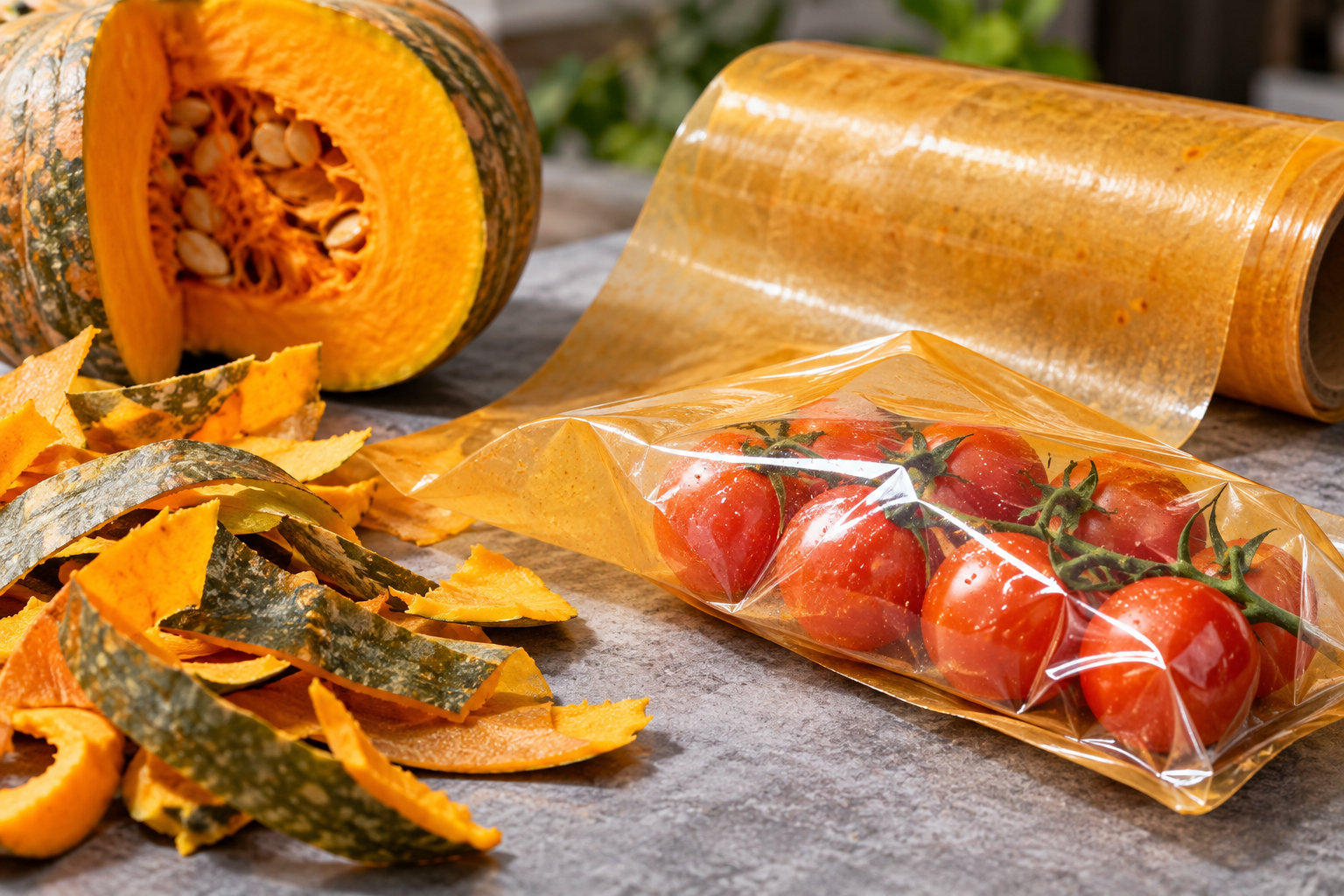
That is the unusual idea behind new research from Kyushu University in Japan. Researchers have developed a biodegradable food-packaging material using compounds made from discarded pumpkin peel. In tests with cherry tomatoes, the material helped slow microbial growth, moisture loss, and softening.
The science is more interesting than simply saying “pumpkin peel replaces plastic.”
The researchers first converted the pumpkin peel into tiny carbon-based particles called carbon quantum dots. These were then incorporated into a biodegradable film made from carboxymethyl cellulose and gelatin.
So the journey looks something like this:
Pumpkin peel → carbon quantum dots → biodegradable film → food protection
As a chef, I find this idea particularly interesting because it turns two problems into one research question: Can something we normally throw away help us reduce food waste and improve food packaging at the same time?
The technology is still being researched. It is not a replacement for supermarket packaging today, and more work is needed before practical use.
But the idea raises a much bigger question about the future of food:
What if some of tomorrow’s food-packaging materials are already sitting in today’s kitchen waste?
2. Why Pumpkin Peel?
Pumpkin peel is easy to overlook.
In a kitchen, the flesh is usually the valuable part. The peel is removed, discarded, or sometimes composted. But from a food-science perspective, a peel is not simply “waste.” It is part of the plant’s protective structure, and it contains useful carbon-based material.
That is what attracted the researchers.
Instead of treating discarded pumpkin peel as the end of the ingredient’s life, they investigated whether it could become a raw material for another food-related application.
The researchers processed pumpkin peel to produce carbon quantum dots, extremely small carbon-based particles with unusual properties.
The Kyushu University research describes how these pumpkin-peel-derived carbon quantum dots were incorporated into a biodegradable food-packaging film. These particles were then incorporated into a biodegradable film made from carboxymethyl cellulose and gelatin.
The interesting part is that the pumpkin does not become the packaging in its original form.
It goes through a transformation.
The peel provides the starting material. Scientists then use processing and material science to turn that material into something with properties that can potentially help protect food.
As a chef, this is the part I find most useful to understand.
Food waste does not always have to become another food. Sometimes its value may be in the material it can provide for the food system around it.
And that takes us to the next question:
What exactly can this pumpkin-based film do to food?
3. Can the Packaging Actually Keep Food Fresh?
This is where the research becomes more interesting.
The researchers tested the biodegradable film on cherry tomatoes, looking at several changes that normally happen as fresh produce ages.
Compared with the control conditions, the pumpkin-peel-based film helped reduce microbial growth, weight loss, and softening of the tomatoes during the study.
Why does that matter?
Fresh produce continues changing after it is harvested. It can lose moisture, become softer, and eventually develop conditions that allow microorganisms to grow. Packaging can influence that process by changing the environment around the food.
The pumpkin-derived material appears to provide a film that can help slow some of these changes.
But there is an important point here.
The research does not mean that wrapping food in pumpkin peel will make it last indefinitely. The experiment was conducted under specific research conditions, using cherry tomatoes as the test food.
For chefs, that distinction matters.
When we talk about food preservation in a professional kitchen, we are dealing with a complete system: temperature, humidity, handling, packaging, oxygen exposure, sanitation, and time all matter.
A new packaging material could become another useful tool in that system.
The exciting question is whether researchers can eventually make these materials work reliably across different foods and real-world storage conditions.
And there is another unusual property of this material that makes the research even more interesting.
4. The Packaging Can Glow Under UV Light
There is another detail in this research that sounds almost futuristic.
The carbon quantum dots made from pumpkin peel have optical properties. Under ultraviolet light, the material can fluoresce blue, and the researchers note that the color can change depending on the particle size.
That means the material is doing more than simply acting as a physical barrier around food.
The researchers suggest that, in the future, this property could potentially be used to create visible text, illustrations, or other information on packaging when exposed to UV light.
Imagine opening a food package under a special light and seeing information appear that is invisible under normal lighting.
That sounds like science fiction, but this particular idea is still only a future possibility, not a commercial food-packaging system.
And this is where food packaging gets much more interesting.
Traditionally, we think of packaging as something passive. It holds the food, protects it from damage, and gives us information through a printed label.
But researchers around the world are now exploring active and intelligent packaging that can interact with the food environment, respond to changes, and potentially provide useful information.
The pumpkin-peel film is an early example of how a material originally considered food waste could become part of that future.
5. But Is It Safe for Food?
This is the question I would ask before getting excited about any new food-packaging material.
A packaging material can be biodegradable, innovative, and environmentally interesting, but that does not automatically make it suitable for direct food contact.
The pumpkin-peel research is still at the research stage. The study demonstrated the material’s potential as a biodegradable packaging film and tested its effects on cherry tomatoes, but it does not establish that this material is already approved for widespread commercial food packaging. The researchers themselves point to the need for further development and practical application.
That distinction is important.
Before a material moves from a laboratory into a restaurant, factory, or supermarket, researchers and regulators would need to consider questions such as
- Does anything migrate from the packaging into the food?
- Does the material remain stable during storage?
- How does it behave with different types of food?
- What happens under different temperatures and humidity conditions?
- Can the material be manufactured consistently?
- Can it meet food-contact safety requirements at a commercial scale?
These are not small details.
In professional kitchens, we already understand that the container is part of food safety. A perfectly prepared ingredient can still become a problem if it is stored incorrectly or placed in unsuitable packaging.
So I would look at this pumpkin-based material as promising research, not a finished packaging solution.
That is actually what makes the research more credible.
Good food innovation does not need to claim that it has solved everything.
It needs to show what works, what has been tested, and what still needs to be proven.
6. What Could This Mean for the Future of Food Packaging?
The most interesting part of this research is not simply replacing one piece of packaging with another.
It is the idea of designing packaging from the leftovers of the food system itself.
Think about the cycle:
Pumpkin is grown → pumpkin is processed → peel becomes waste → peel is converted into a useful material → the material helps protect fresh food.
That is very different from the traditional linear model of:
raw material → packaging → food → packaging waste
If technologies like this eventually become practical, food processors could potentially look at their by-products differently.
A peel, seed, shell, or other processing residue may contain compounds that are useful somewhere else in the food chain. The challenge is finding a safe, economical, and scalable way to recover that value.
For chefs, this way of thinking is already familiar.
We routinely look at ingredients through the question:
“What else can I do with this?”
A carrot peel can become stock. Vegetable trimmings can become a base for sauces. Bread that is no longer fresh can become crumbs. Fruit scraps can sometimes become preserves or infusions.
The new research takes that thinking one step further.
Instead of asking only how we can use more of the ingredient, scientists are asking whether we can also use more of the material left behind after processing it.
That could eventually make food production more circular.
But the key word is eventually.
The pumpkin-peel film is still a research-stage technology. Its future will depend on safety, cost, manufacturing, performance, and whether it can work reliably with different foods.
The idea is promising.
The commercial answer is still being written.
7. Could Food Waste Become Smart Packaging?
This is where the idea gets bigger than pumpkin.
The researchers are showing that a food-processing by-product can be turned into a functional packaging material, rather than simply being treated as waste. The pumpkin peel is being used as a source for carbon quantum dots, which become part of the biodegradable film.
That raises an interesting possibility for the wider food industry.
What if different food-processing wastes could become raw materials for different packaging technologies?
Fruit peels could potentially provide useful compounds. Vegetable residues could become sources of fibers or other materials. Agricultural by-products could be processed into packaging components instead of being discarded.
This does not mean every food waste stream can automatically become packaging.
Each material has a different chemical composition, and every proposed application would need its own research, safety testing and manufacturing process.
But the principle is powerful:
The food industry could potentially turn one side stream into a resource for protecting another food.
For a chef, I think that is a more meaningful way to look at sustainability.
It is not simply about finding something labeled “eco-friendly.”
It is about asking whether we can design the entire food system to create less waste at every stage, from ingredient preparation to packaging and storage.
And if a future package could both protect food and carry useful information about what is happening inside it, packaging could become much more than something we throw away after opening.
It could become an active part of the food system.
8. What Happens to the Packaging After Use?
A sustainable package should not be judged only by what happens while it is protecting food.
We also need to ask what happens after the food is gone.
This is one reason biodegradable materials are attracting attention. A package made from biodegradable materials has the potential to behave differently from conventional plastics at the end of its useful life.
The pumpkin-peel research is interesting because the film is built from carboxymethyl cellulose and gelatin, with pumpkin-peel-derived carbon quantum dots incorporated into the material. The researchers describe the resulting film as biodegradable.
But biodegradable does not mean that a package simply disappears anywhere, under any conditions.
Its breakdown depends on the material and the environment. Temperature, moisture, microorganisms, and disposal conditions can all affect what happens after use.
That is an important lesson when we talk about sustainable food packaging.
“Biodegradable” is not the same as “no environmental impact.”
The better question is
What happens to the material across its entire life cycle, from raw material to manufacturing, food storage, and final disposal?
That is the level at which future packaging technologies will need to be evaluated.
And this brings us to perhaps the most interesting part of the pumpkin story: whether something this unusual could ever become practical outside a laboratory.
9. Could This Ever Become Commercial Packaging?
The short answer is possibly, but there is still a lot to prove.
A laboratory material only becomes useful to the food industry when it can be produced consistently, safely, and at a reasonable cost.
For a packaging material like this, manufacturers would eventually need to solve several practical problems:
- Can enough pumpkin-processing waste be collected?
- Can the material be produced consistently from batch to batch?
- Can the film withstand normal handling and transportation?
- Does it protect different foods, not just cherry tomatoes?
- How long does it remain effective during storage?
- Can it be manufactured economically?
- How should it be disposed of after use?
- Can it meet the food-contact requirements of the markets where it is sold?
These questions are just as important as the laboratory results.
There is also a practical supply-chain issue that is easy to overlook.
A research laboratory can work with carefully prepared raw material. A commercial food company has to deal with seasonality, transportation, storage, contamination, processing variation, and cost.
That is why a promising research material can take years to become a commercial product.
For me, the exciting part is not whether pumpkin-peel packaging will replace plastic next year.
It is that researchers are demonstrating a different way of thinking:
Food waste can potentially become a starting material for another part of the food system.
If that principle can be made economical and safe at scale, the impact could extend far beyond pumpkins.
10. What Could Chefs Learn From This?
For me, the biggest lesson is not about pumpkin.
It is about how we look at waste.
In a professional kitchen, waste is often treated as a cost. Every peel, trimming, and discarded ingredient represents money that was already spent.
But food science can change the question from
“How do we dispose of this?”
to:
“What useful material is still here?”
Pumpkin peel is one example.
A chef may look at it and think about stock, purée, garnish, or another culinary use. A food scientist may look at the same peel and see a source of compounds that could become part of a packaging material.
Neither approach is necessarily better.
They simply look at the same ingredient from different angles.
That is where I think the future of food becomes exciting.
The next generation of food professionals may need to understand not only cooking and food safety but also ingredients, packaging, materials, waste streams, and how these systems connect.
Imagine a food factory where the by-product from one production line becomes the raw material for another.
Or a restaurant that separates its food waste according to what could be reused, fermented, extracted, or converted into another useful material.
That is much more interesting than simply telling people to “waste less.”
It is about designing waste out of the system wherever possible.
And research like this gives us a glimpse of what that future could look like.
11. What Happens Next?
The pumpkin-peel packaging research is still an early step, but it points toward a much broader direction in food science.
The future of food packaging may not be based on finding one perfect replacement for plastic.
Instead, we may see many different materials designed for different jobs, using resources that were previously treated as waste.
One material might help control moisture. Another might provide strength. Another could respond to changes in the food environment. Some could potentially be made from agricultural or food-processing by-products.
The important shift is in the way we think about the food system.
Today, we often separate food production, packaging, and waste management into different stages.
Future technologies may connect them more closely:
Food production → by-product → new material → food protection → responsible disposal
That is still a developing idea, not a finished industrial model.
But the research from Kyushu University shows that something as ordinary as discarded pumpkin peel can become the starting point for surprisingly sophisticated material science.
And that may be the most exciting lesson of all:
Sometimes the next food innovation is hiding in the part of the ingredient we were about to throw away.
12. Could Pumpkin Peel Become the Packaging of Tomorrow?
A pumpkin peel normally has a short journey.
It is removed, discarded, and forgotten.
This research suggests a very different possibility: that discarded pumpkin peel could become a starting material for a biodegradable food-packaging film with properties that may help protect fresh produce.
The technology is still being developed. It has not replaced conventional food packaging, and more research is needed before it can be considered a practical commercial solution.
But the idea is powerful.
The future of sustainable food production may not simply be about finding new ingredients. It may be about connecting ingredients, waste, packaging, and preservation into one circular system.
As chefs, we already understand the basic philosophy.
We look at a carrot peel, herb stem, or vegetable trimming and ask:
“Is there still something useful here?”
Scientists are now asking a similar question at a completely different scale.
“Can the material we call waste become part of the technology that protects our food?”
Maybe the next generation of food packaging will not begin with petroleum.
Maybe, in some cases, it could begin with something we once threw into the bin.
And that is what makes this research worth watching.