Can Food Really Be Made From Plastic? The Strange Science Behind Future Food
1. Can Food Really Be Made From Plastic?
What if a plastic bottle could someday become part of a meal?
It sounds like science fiction, but researchers are exploring a very different way of thinking about food production. Instead of treating plastic waste only as something to recycle or throw away, scientists are investigating whether its carbon can be converted into useful food-related compounds using biotechnology.
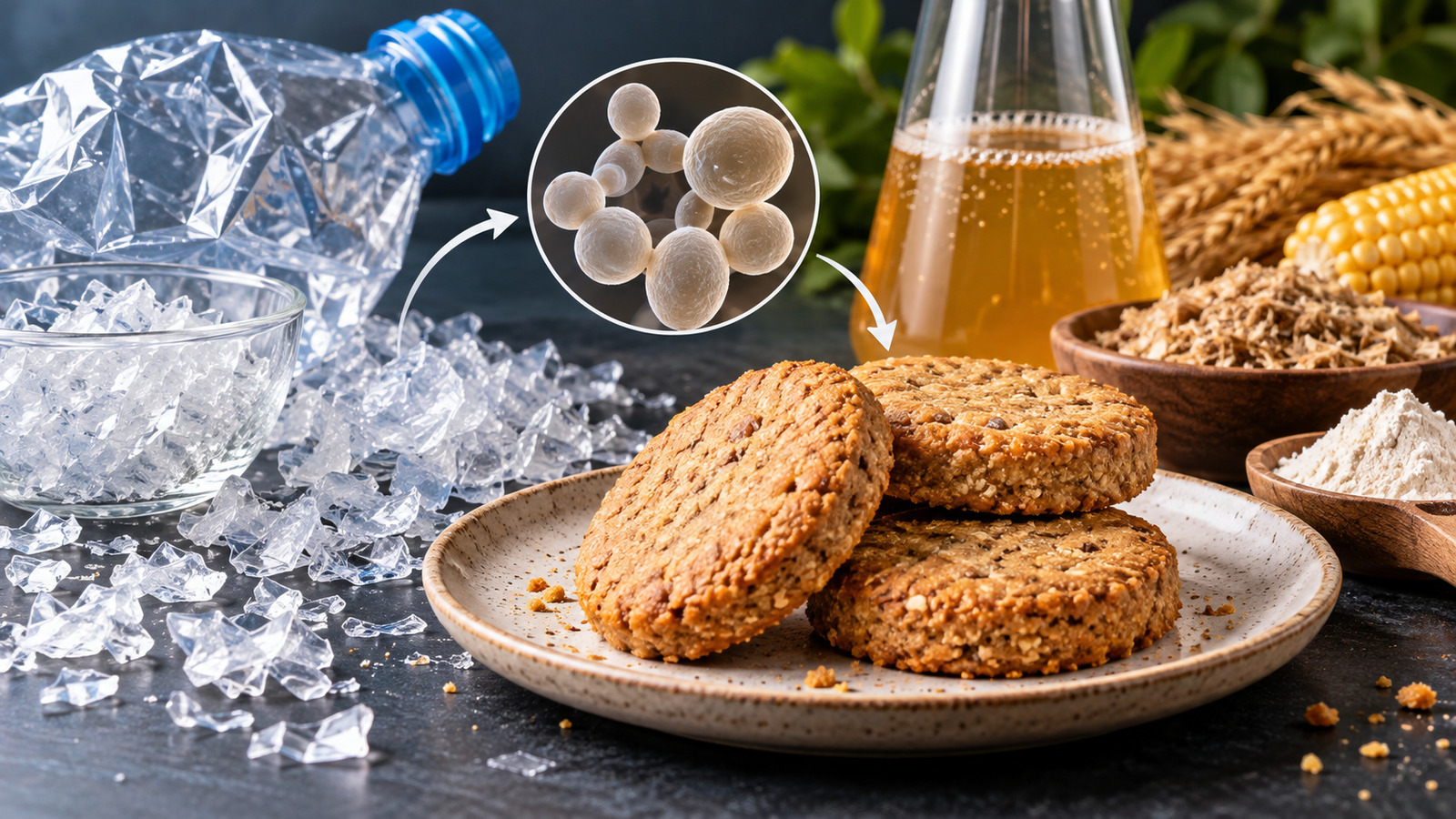
One recent prototype takes this idea even further. Researchers developed a system using PET plastic and agricultural waste as carbon sources, then used engineered microorganisms to produce compounds such as proteins, fats, and other ingredients. Those materials were eventually incorporated into a prototype food product.
But this does not mean that plastic itself has become edible.
The interesting science happens in between.
The plastic is first broken down into smaller molecules. Microorganisms can then use those molecules as a starting material to produce new compounds. In other words, the goal is not to eat plastic. It is to redirect carbon from waste into a controlled biological production system.
As a chef, that immediately raises bigger questions.
How can something that started as plastic become a food ingredient? Where do the protein, fat, and flavor come from? How would scientists prove that the final product is safe? And could a system like this ever move from a laboratory or space mission into an ordinary food factory?
In this article, we’ll follow that unusual journey from plastic waste to biotechnology to future food and separate what scientists have actually demonstrated from what remains a possibility.
2. What Does “Food Made From Plastic” Actually Mean?
The phrase “food made from plastic” can be misleading.
Scientists are not taking a piece of plastic, grinding it up, and putting it into a cookie. The process is much more controlled and much more interesting.
PET, or polyethylene terephthalate, is the type of plastic commonly used in bottles and food packaging. Researchers can break PET down into smaller chemical building blocks. These smaller molecules can then become a carbon source for specially engineered microorganisms.
That is where biotechnology enters the picture, connecting this research to the wider world of food science.
Instead of using the carbon only to make more plastic or allowing it to remain as waste, researchers are investigating whether microorganisms can transform it into useful compounds. Different microorganisms can be designed or selected to produce different outputs, including proteins, fats, organic acids, vitamins, and flavor-related compounds.
The important point is that the final food ingredient is biologically produced after the plastic has been broken down. The original PET structure is not simply being served as food.
That makes the idea less about “eating plastic” and more about changing where the raw material for food production comes from.
Traditionally, food production depends heavily on crops, livestock, fisheries, and other biological resources. This research asks a very different question:
Could some future food systems use carbon that already exists in waste as one of their raw materials?
That question becomes particularly interesting when we look at places where bringing large amounts of conventional food is difficult, such as long-duration space missions.
2: How Does the Plastic Become Usable by Microbes?
PET plastic is extremely useful because it is strong, lightweight, and resistant to many forms of degradation. Those same properties make it difficult for microorganisms to use directly.
The researchers behind the µBites project therefore start with a chemical step rather than feeding intact plastic to yeast.
They use a process called oxidative hydrothermal dissolution. In simple terms, water and oxygen are used at high temperature and pressure to break tough materials such as PET and agricultural biomass into smaller molecules that microorganisms can access.
This is an important distinction.
The yeast is not eating a plastic bottle.
The plastic has already been chemically transformed into smaller building blocks before the microorganisms enter the process. Those compounds can then serve as raw material for microbial production.
Think of it somewhat like breaking down a large ingredient before cooking. A chef might not be able to use a whole ingredient in a particular preparation, but once it is processed into the right form, it becomes useful for the next stage.
Here, the “next kitchen” is a microbial one.
The researchers then use different yeast strains to transform these available molecules into compounds such as proteins, fats, acids, vitamins, and flavor-related ingredients.
That is where the idea becomes much more interesting than simply recycling plastic.
The goal is not to make plastic edible. The goal is to use its carbon as a starting material for biological production.
And that raises the next question:
Why use microbes at all?
3. Why Use Microbes to Make Food?
This is closely related to fermentation, one of the oldest ways humans have used microorganisms to transform food. Bakers use yeast to make bread rise. Fermentation uses microorganisms to transform milk, vegetables, grains, and other ingredients. Some of the foods we eat every day exist because microbes are remarkably good at changing one substance into another.
The new idea is to give those microorganisms a very different starting material.
In the µBites research, scientists worked with engineered yeast strains, each designed to produce different useful compounds from the available carbon sources. The reported outputs included proteins, fats, acids, vitamins, and flavor compounds.
This matters because a microorganism is essentially a tiny biological production system.
Instead of building a separate factory for every ingredient, scientists can potentially use different microbial strains as miniature factories. One organism may be optimized to produce a protein. Another could produce a fat. Another could contribute compounds associated with flavor or nutrition.
From a chef’s perspective, this is fascinating because food is not just about calories or protein.
A successful food needs the right combination of:
- Protein and other nutrients
- Fat for richness and mouthfeel
- Flavor compounds
- Texture
- Aroma
- Stability
- Food safety
That means producing a protein from waste is only one part of the challenge.
The much harder question is
Can scientists turn these separately produced compounds into something that actually behaves like food?
That is where the µBites project becomes especially interesting.
4. From Microbial Ingredients to an Actual Food
Producing individual food compounds is only the beginning.
A food product still needs to behave like food. It needs structure, moisture, flavor, texture, and a form that people can actually prepare and consume.
In the µBites prototype, researchers combined the microbial products with other ingredients, including fiber, starch, and sweetener, and used 3D printing to form the resulting mixture into cookie-like products.
The American Chemical Society reports that the prototype used PET plastic and agricultural waste as carbon sources in this food-production system.
This is an important part of the story because it shows that the researchers were not trying to make one microorganism produce an entire meal.
Instead, they were building a food system:
Waste-derived carbon → microbial production → individual food compounds → formulation → finished food prototype
That’s much closer to how a modern food factory works.
A food manufacturer rarely starts with one raw material and ends with a complete finished product. Different ingredients are selected for different jobs. One provides structure, another contributes fat, another sweetness, another flavor, and others provide nutrition or improve stability.
The unusual part here is where some of those building blocks originate.
Instead of beginning entirely with conventional agricultural ingredients, researchers are investigating whether waste carbon can enter the production chain.
And that brings us to perhaps the most important question for a chef:
If scientists can produce the ingredients, can they also produce something that tastes good?
5. Would People Actually Eat It?
This is where the science meets the reality of food.
A laboratory can produce proteins, fats, acids, or flavor compounds. A food scientist can formulate them into a structured product. But making something technically possible is not the same as making something people want to eat.
For chefs, flavor and texture are not finishing touches. They are part of the product itself.
A food can have the right nutritional profile and still fail if it is too dry, too dense, too soft, bitter, bland, or unfamiliar.
The µBites project is particularly interesting here because the researchers created a cookie-like prototype, rather than stopping at the production of individual ingredients. However, when the research was reported, formal taste testing was still awaiting institutional approval. That means we should not treat the project as proof that consumers already enjoy eating food produced from plastic-derived carbon.
That distinction matters.
We know the researchers demonstrated a prototype food-production pathway. We do not yet have evidence that this represents a commercially successful food product.
From a chef’s perspective, the next stage would involve questions such as
Does it have an appealing aroma?
Does the texture work?
Does the flavor remain stable during storage?
Can the ingredients be used consistently at scale?
Would people accept the story behind the product?
The last question may be particularly difficult.
Imagine telling a customer:
“This cookie contains ingredients produced using carbon that originally came from a plastic bottle.”
Scientifically, that could be fascinating.
Emotionally, it could produce a very different reaction.
And that brings us to one of the biggest challenges facing future food technology: food acceptance is not determined by science alone.
6. The Biggest Challenge May Not Be the Technology
Even if scientists can turn waste-derived carbon into useful food compounds, that does not automatically make the technology ready for supermarkets.
Food has a much higher standard than simply being technically possible.
Before a product like this could become an everyday food, researchers would need to establish that the complete production process is safe, consistent, and controllable. That includes the starting material, the chemical breakdown process, the microorganisms, the resulting compounds, and the final food product.
There is another challenge that is uniquely important in food:
Would consumers accept it?
People make food choices with their senses, habits, and expectations. The words “plastic-derived” may create an immediate emotional reaction, even if the final ingredient contains no intact plastic.
This is why communication will matter as much as biotechnology.
A future food company may need to explain not simply where an ingredient came from, but what happened to it along the way.
There is a major difference between saying:
“We made food from plastic.”
and saying:
“We used biotechnology to recover carbon from waste and transform it into food ingredients.”
Technically, those statements describe very different ideas.
The first creates a mental image of eating plastic.
The second describes a controlled production process.
For a chef, this distinction is important because trust is part of the food experience. Customers want to understand what they are eating, how it was produced, and why they should trust it.
And this is where the story becomes much bigger than one experimental cookie.
It raises a question about the future of food itself:
Could waste become one of the raw materials used to make tomorrow’s ingredients?
7. Could This Actually Help Feed People in Space?
The reason this research becomes especially interesting when we talk about space is simple:
You cannot easily send unlimited food to Mars.
A spacecraft has limited storage, limited energy, and limited opportunities for resupply. Every kilogram sent from Earth has a cost.
NASA’s Mars to Table Challenge explores food-production systems designed to support future long-duration missions with limited resources and minimal dependence on Earth.
A system based on waste-derived carbon could theoretically approach the problem from a different direction.
Instead of thinking:
Earth → food → spacecraft → waste
Scientists are exploring whether part of the system could eventually become:
Raw materials → biological production → food → waste → recovered resources → new production
That is a very different way of thinking about a kitchen.
On Earth, a chef usually works with ingredients that arrive from farms, fisheries, factories, or suppliers.
A future space food system may need to work more like a closed-loop kitchen, where waste is not automatically the end of the process.
This is one reason the µBites research is more interesting than the headline “cookie made from plastic” suggests.
The cookie is only the visible part.
The bigger experiment is whether waste, microorganisms, biotechnology, and food formulation can work together as one production system.
And if that works in an extreme environment like space, some of the ideas could eventually influence how we think about food production on Earth.
8. Could This Technology Ever Reach Ordinary Food Production?
Space may be the immediate motivation, but the underlying idea has a much broader question behind it.
Modern food production depends heavily on agricultural land, water, energy, transportation, and large amounts of raw material. At the same time, society produces enormous quantities of waste.
A technology that could safely convert some waste-derived carbon into useful food ingredients would potentially connect waste management and food production in a completely different way.
But there is a big difference between scientific possibility and commercial practicality.
For this type of system to become useful on Earth, researchers and food companies would need to solve several problems:
- Can the process operate economically at a large scale?
- Can the quality of the ingredients remain consistent?
- Can contaminants in the starting materials be controlled?
- Can the final ingredients meet food-safety and regulatory requirements?
- Can the process use less energy than conventional food production?
- Can manufacturers produce flavors and textures consumers actually want?
- Will consumers accept ingredients made from waste-derived carbon?
These questions are still open.
That is why I would not describe this technology as the next replacement for farms or conventional food factories.
It is better understood as an emerging research direction that could eventually become one part of a more circular food-production system.
And that distinction is important.
The exciting part of food science is not pretending that the future has already arrived.
It is understanding which pieces of the future are already being demonstrated and which pieces still need to be solved.
9. The Chef’s Perspective
As a chef, I find this idea interesting for a reason beyond the headline.
In a professional kitchen, we are constantly thinking about yield, waste, and how to get more value from every ingredient.
Vegetable trimmings become stocks. Bones become broths. Stale bread can become crumbs. Fruit that is no longer attractive enough for display can become sauces, purées, or desserts.
The principle is familiar:
Don’t waste useful material if it can safely become something valuable.
What makes this research different is the scale of the idea.
Instead of simply finding another use for a food ingredient, scientists are asking whether biotechnology can recover useful carbon from non-food waste and move it into a food-production system.
That is a much bigger leap.
But I would still keep a chef’s caution here.
A food system should never chase novelty at the expense of safety, flavor, nutrition, consistency, or consumer trust. If a future ingredient cannot meet those standards, it does not matter how clever the technology is.
For me, the most exciting part is therefore not the idea of eating something that once came from plastic.
It is the possibility of designing food systems where waste is treated as a resource instead of automatically becoming the end of the production cycle.
That is a concept chefs, food manufacturers, and food scientists can all understand.
And perhaps one day, the most sustainable ingredient in a kitchen will not necessarily come from a farm.
It might come from a process that we have not yet learned to imagine as a kitchen at all.
10. The Future of Food May Start With Waste
Food made from plastic sounds like science fiction, but the science behind the idea is more precise than the headline suggests.
Researchers are exploring how PET plastic and agricultural waste can be broken down and used as carbon sources for engineered microorganisms. Those microorganisms can produce compounds that may become part of a food formulation.
The µBites prototype shows how far this concept has already moved from theory, while also showing how much work remains before such technology could become an everyday food system.
The bigger idea is not that we will soon be eating plastic.
It is that the definition of a food-production raw material may change.
Future food systems could combine biotechnology, fermentation, waste recovery, precision manufacturing, and traditional food science in ways that are difficult to imagine today.
For chefs, that future raises fascinating questions about flavor, texture, nutrition, safety, and consumer trust.
For scientists, it raises an even bigger question:
Can we build food-production systems that create more value from the resources we currently throw away?
We do not know yet where this technology will lead.
But one thing is clear: the next food revolution may not begin with a new recipe.
It may begin with a completely different idea of what an ingredient can be.