Why Does Restaurant Food Taste Better Than Homemade?
You follow the recipe. You buy good ingredients. You measure everything carefully. Yet somehow, the dish you make at home doesn’t taste quite like the same food you order at a good restaurant.
So what are professional chefs doing differently?
The answer usually isn’t a secret ingredient or an expensive piece of equipment. In a professional kitchen, chefs pay close attention to details that are easy to overlook at home pan temperature, seasoning, browning, moisture, timing and how a dish is finished.
After years of working in professional kitchens, I’ve learned that great restaurant food is often the result of controlling these small details consistently.
The good news?
You don’t need a restaurant kitchen to use these techniques.
Once you understand what is happening to your ingredients during cooking, you can start applying the same principles at home, and you’ll begin to understand why your food tastes different, not just what recipe to follow.
What Actually Makes Restaurant Food Taste Better?
A restaurant dish can look simple on the plate, chicken, vegetables, rice, pasta or a sauce, but the final flavour is usually the result of several small decisions made during cooking.
Professional chefs are constantly managing a few fundamental variables:
Heat. Seasoning. Browning. Moisture. Fat. Acidity. Aroma. Timing.
These variables interact with each other.
For example, a steak may have excellent seasoning, but if the pan isn’t hot enough to develop good browning, it can still taste flat. A sauce may contain plenty of salt, but without enough acidity or reduction, it may lack balance. Vegetables can be perfectly cooked but lose their appeal if they’re sitting in excess moisture instead of developing color and roasted flavor.
That’s why copying a restaurant recipe doesn’t always reproduce the restaurant result.
The recipe tells you what to use. Professional technique determines what those ingredients become.
And that’s where the real difference begins.
A simple way to think about it
When I train kitchen teams, I like to break cooking down into five questions:
1. How hot should the cooking surface be?
2. When should each ingredient be seasoned?
3. How much browning do I actually want?
4. Where should the moisture go?
5. When is the dish truly finished?
Master those decisions and you don’t just become better at following recipes you become better at cooking without depending on recipes.
The Pan Is Part of the Recipe
One of the biggest differences between home cooking and professional cooking happens before the food even goes into the pan.
Chefs don’t simply turn on the burner, add oil and start cooking. They think about the relationship between the pan, the heat, the ingredient and the timing.
Why does preheating matter?
When food hits a properly heated cooking surface, several things can happen quickly: surface moisture begins to evaporate, proteins and sugars can brown, and the ingredient can develop a deeper colour and more complex flavour.
Put the same ingredient into a pan that is still too cool, and the result can be very different.
Instead of getting that desirable sear, the ingredient may release moisture and begin to steam, simmer or cook unevenly.
That’s one reason restaurant food can develop a more pronounced roasted or seared flavour.
But hotter isn’t always better.
This is where many home cooks go wrong.
A professional chef isn’t trying to keep the pan as hot as possible. The goal is to use the right heat for the job.
A high initial heat may be useful for searing. Once the desired colour develops, the heat may need to come down so the inside can cook without burning the outside.
For a delicate ingredient, starting aggressively hot could do more harm than good.
Good cooking isn’t about maximum heat. It’s about controlled heat.
The overcrowding problem
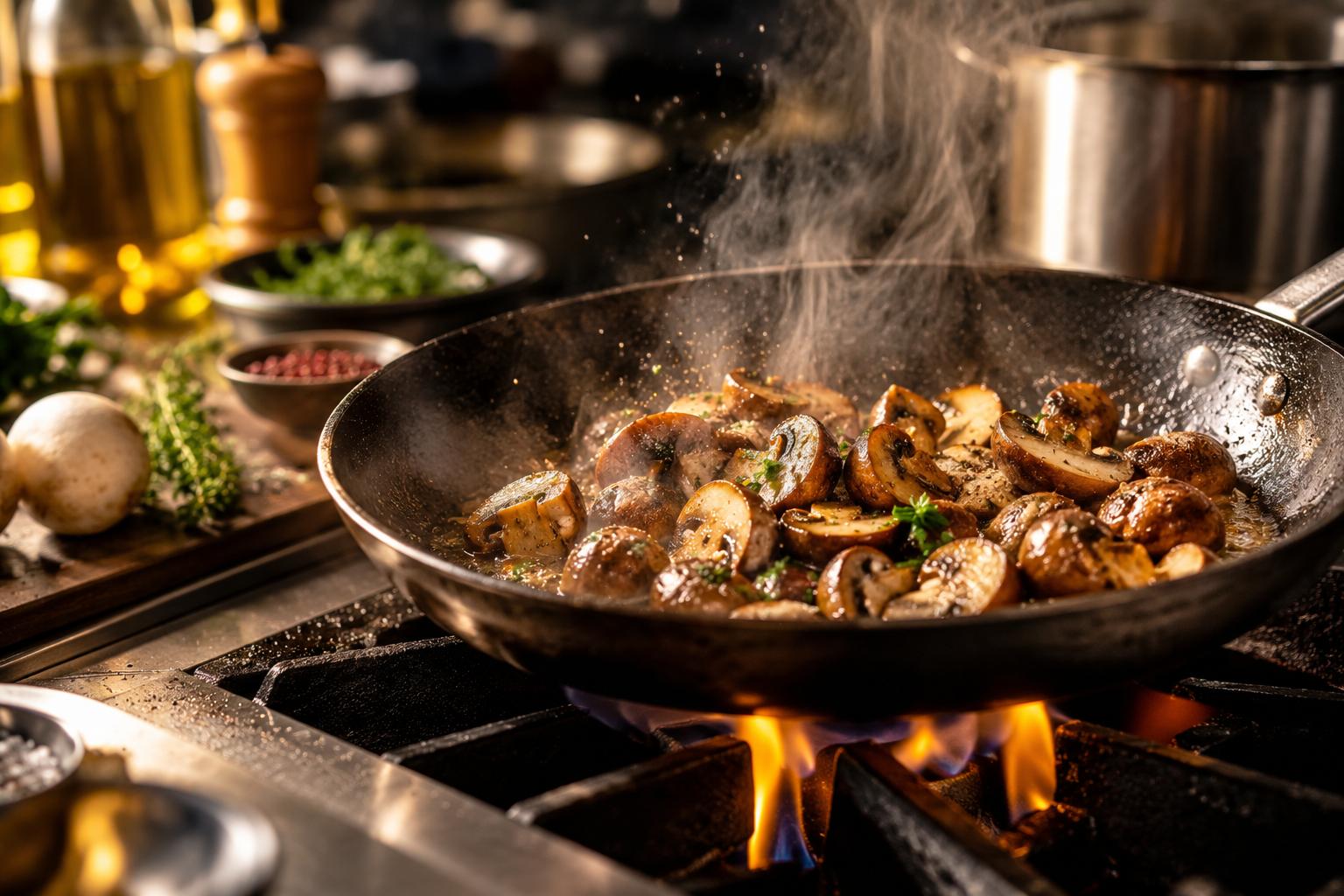
Imagine dropping a large amount of cold, wet mushrooms into a small skillet.
The pan temperature falls. The mushrooms release water. Instead of quickly browning, they sit in their own moisture.
Give those same mushrooms enough space and sufficient heat, and their surfaces can brown much more effectively.
This principle applies to many foods:
- Chicken pieces
- Mushrooms
- Vegetables
- Potatoes
- Seafood
- Ground meat
Sometimes the simplest restaurant trick is simply giving the food enough room to cook properly.
What chefs are really controlling
When a chef adjusts the burner, moves ingredients around the pan or chooses a larger skillet, they’re controlling the cooking environment.
They’re asking:
Do I want browning, gentle cooking, moisture retention, reduction or a combination of these?
That question is far more useful than simply asking whether the recipe says “medium-high heat”.
Chef RBS Tip
Preheat the pan, but don’t blindly follow the idea that hotter is always better.
Learn to recognise what your food is telling you.
If ingredients are releasing lots of water and refusing to brown, the pan may be overloaded or not hot enough.
If the outside is burning before the inside is cooked, your heat may be too aggressive.
The goal isn’t to cook faster. The goal is to control the transformation of the food.
Why Chefs Season Food in Stages
If you’ve ever followed a recipe exactly and still thought, “Why does this taste flat?”, the problem may not be the amount of seasoning. It may be when the seasoning was added.
Professional chefs rarely think of seasoning as a single step at the end of cooking.
They build flavour throughout the dish.
Salt Is More Than “Making Food Salty”
Salt can change how we perceive other flavours. But that doesn’t mean the answer is simply to add more.
The goal is to get the seasoning into the right relationship with the ingredients.
Think about cooking a simple chicken dish.
You might season the chicken before searing it, adjust the sauce while it reduces, and then taste the finished dish before serving.
Each stage gives you an opportunity to correct the balance.
Why Timing Matters
Different ingredients behave differently during cooking.
A sauce can lose water as it reduces, concentrating its seasoning. Pasta or rice can absorb seasoned cooking water. Meat can release juices during cooking. Vegetables can develop sweetness and browning as their moisture changes.
So if you add all your salt at the very end, you may be trying to correct a flavour problem that should have been managed earlier.
This is why professional kitchens taste repeatedly.
Not because chefs don’t know their recipes but because ingredients aren’t perfectly identical every time.
A tomato can be sweeter than yesterday’s tomato.
A stock can be more concentrated.
A piece of chicken can be larger.
A sauce may reduce more than expected.
Cooking is a moving process.
Seasoning in Layers
A simple professional approach is:
Season → Cook → Taste → Adjust → Finish
For example:
Chicken: season before cooking.
Cooking liquid: season appropriately before ingredients absorb it.
Sauce: taste after reduction.
Finished dish: make the final adjustment for salt, acidity and aroma.
This doesn’t mean adding salt at every stage. It means thinking about seasoning as part of the entire cooking process.
Don’t Forget Acidity
Here’s another reason restaurant food can taste more vibrant.
Sometimes a dish doesn’t need more salt it needs acidity.
A small amount of lemon juice, vinegar or another acidic ingredient can brighten a rich or heavy dish and make its flavours feel more defined.
That’s why chefs often taste a dish and ask:
Does it need more seasoning or does it need more balance?
Those are two very different questions.
Chef RBS Tip
Before reaching for more salt, taste the food and ask yourself:
Is it actually under-seasoned, or is it simply missing acidity, aroma, browning or richness?
Learning to make that distinction is one of the biggest steps from following recipes to actually understanding food.
Browning: Where the Flavour Starts
There is a moment when food stops tasting simply “cooked” and starts tasting deep, roasted and complex.
Often, that moment is browning.
Think about the difference between a pale piece of chicken and one with a properly browned surface. Or lightly cooked onions compared with onions that have developed a deep golden colour.
The ingredients haven’t necessarily changed, but the flavour has transformed.
What Happens When Food Browns?
When the surface of food becomes hot enough and relatively dry, complex chemical reactions occur. One of the most important is the Maillard reaction, which occurs between amino compounds and reducing sugars and produces hundreds of flavour and aroma compounds.
It’s responsible for many of the flavours we associate with:
- Seared meat
- Toasted bread
- Roasted coffee
- Fried potatoes
- Toasted nuts
- Golden-brown vegetables
This is one reason browning can make food taste dramatically more complex.
Why Moisture Can Get in the Way
Here’s a mistake that happens frequently at home:
You put too much food into the pan.
The ingredients release moisture, the temperature of the cooking surface drops, and instead of developing a good browned surface, the food can begin cooking in steam and liquid.
That’s why crowding a pan can be the enemy of browning.
Sometimes cooking in two batches produces a better result than trying to cook everything at once.
Don’t Confuse Browning With Burning
There’s an important difference.
Browning develops desirable roasted flavours.
Burning can produce bitter, unpleasant flavours.
The chef’s job is to push the food far enough to develop complexity without taking it too far.
That requires controlling:
Temperature + time + moisture.
What About the Brown Bits Left in the Pan?
After searing meat or vegetables, you may notice a layer of browned material attached to the bottom of the pan.
Don’t automatically throw it away.
Those concentrated browned residues are commonly called fond. Adding a suitable liquid and scraping the pan can release those flavours and form the foundation of a sauce.
This simple technique is called deglazing.
A splash of stock, wine, water or another appropriate liquid can transform what looked like something stuck to the pan into the beginning of a flavourful sauce.
A Simple Experiment You Can Try
Next time you cook mushrooms, try two batches.
Batch 1: Put too many mushrooms into a small pan.
Batch 2: Give the mushrooms plenty of space in a properly heated pan.
Cook both until done.
Look at the difference in colour, aroma and texture.
You may discover that the “secret” wasn’t another ingredient at all.
It was how you cooked the ingredient.
Chef RBS Tip
Don’t chase colour just for appearance.
Brown food when browning improves the flavour you want.
And remember:
A good chef doesn’t simply ask, “Is it cooked?” They also ask, “What flavour am I developing?”
That mindset is one of the biggest differences between simply following a recipe and actually understanding cooking.
Why Great Chefs Balance Salt, Acid, Fat and Aroma
A dish can be perfectly cooked and still taste disappointing.
The chicken may be tender. The vegetables may have a beautiful sear. The sauce may be rich and well-seasoned.
Yet something feels missing.
That missing element is often balance.
Professional chefs don’t think about flavour as simply “more seasoning”. They think about how different sensations work together.
Salt Brings Flavours Forward
Salt is one of the most important tools in cooking, but more isn’t necessarily better.
Used correctly, salt can make other flavours feel clearer and more pronounced. Used excessively, it can overwhelm the dish.
That’s why experienced chefs don’t simply follow a fixed amount of salt without tasting. They adjust according to the ingredients, cooking method and concentration of the dish.
Acid Creates Contrast
This is one of the most useful restaurant techniques to understand at home.
Rich foods can sometimes feel heavy. A small amount of acidity can provide contrast and make the dish feel brighter.
Depending on the recipe, that might come from:
- Lemon juice
- Lime juice
- Vinegar
- Tomatoes
- Yoghurt
- Pickled ingredients
For example, imagine a rich, creamy sauce that tastes heavy.
Adding more salt may not solve the problem.
A small amount of acidity might.
The goal isn’t to make the dish sour. It’s to create balance.
Fat Carries Flavour and Adds Texture
Butter, oils, ghee and other fats contribute more than richness.
Fat can influence:
- Mouthfeel
- Aroma
- Browning
- Spice extraction
- Sauce texture
- The way certain flavours linger
This is why chefs may finish a sauce with a small amount of butter or flavoured oil.
But here’s an important professional distinction:
Using more fat doesn’t automatically make food better.
The right amount, added at the right stage, can have a much greater impact than simply adding more.
Aroma Changes How We Experience Flavour
Before the first bite, you’ve already started experiencing the food.
Think about the smell of:
- Freshly toasted spices
- Garlic hitting hot oil
- Fresh herbs
- Browned butter
- Roasted onions
- Citrus zest
These aromas contribute significantly to our overall perception of flavour.
That’s one reason chefs often add certain herbs, spices, oils or citrus at the end of cooking rather than exposing everything to prolonged heat.
The Missing Piece May Not Be Salt
Here’s a useful exercise the next time your food tastes flat.
Instead of immediately adding more salt, ask:
Does it need salt?
Or does it need:
More browning?
A little acidity?
More aroma?
More richness?
A touch of sweetness?
More reduction?
This simple habit can completely change the way you approach cooking.
Chef RBS Tip
When a dish tastes “almost right”, don’t automatically add more seasoning.
Taste first. Diagnose the problem. Then make the smallest adjustment that fixes it.
That’s how chefs learn to build balanced flavour instead of simply making food stronger.
Mise en Place: The Secret Behind Consistent Restaurant Cooking
Walk into a professional kitchen before a busy service and you may notice something interesting.
The cooking hasn’t really started yet—but everything is already happening.
Ingredients are portioned. Vegetables are cut. Sauces are prepared. Proteins are ready. Garnishes are organised. Equipment is in position.
This is called mise en place, a French culinary term that essentially means “everything in its place.”
It sounds like simple organization.
But in a professional kitchen, it is actually a cooking technique.
Why Mise en Place Matters
Imagine you’re sautéing chicken at home.
The pan is already hot.
You add the chicken.
Then you realize the garlic isn’t chopped.
You start chopping.
By the time the garlic reaches the pan, the chicken may already be overcooked or the oil may be getting too hot.
A professional kitchen tries to eliminate that problem before cooking begins.
When everything is prepared beforehand, the chef can concentrate on what actually matters:
Heat. Timing. Texture. Color. Seasoning.
Preparation Gives You Control
Mise en place becomes especially important when several ingredients need to enter the pan at different times.
Consider a simple stir-fry:
Oil → aromatics → protein → vegetables → sauce → finishing ingredients
If everything is ready, each ingredient can go into the pan at the right moment.
If you’re still measuring sauce while the garlic is cooking, you’re no longer controlling the process—the pan is controlling you.
It Also Prevents Overcooking
Professional chefs aren’t necessarily moving faster because they’re rushing.
They’re faster because the decisions were made before the cooking started.
This is particularly important for delicate ingredients.
A few extra seconds can change:
- Garlic from golden to bitter
- Herbs from fresh to dull
- Seafood from tender to rubbery
- Vegetables from crisp to soft
- Sugar from caramelized to burnt
Preparation creates the breathing room needed to make those decisions properly.
Mise en Place Doesn’t Mean Preparing Everything Hours Ahead
This is an important distinction.
Mise en place doesn’t mean cutting every ingredient in the morning and leaving everything sitting around all day.
Good preparation also considers:
- Food safety
- Ingredient freshness
- Oxidation
- Moisture
- Temperature
- When an ingredient actually needs to be prepared
For example, some herbs are best prepared close to service, while certain sauces, stocks and marinades may benefit from being prepared earlier.
Good mise en place is preparation with purpose.
Try This Before Your Next Dinner
Before turning on the stove, place all the ingredients you will need within easy reach.
Measure your spices.
Prepare your vegetables.
Portion your protein.
Have your cooking liquid ready.
Read the recipe completely.
Then start cooking.
You may be surprised by how much calmer the entire process feels.
And more importantly, you’ll have much greater control over the result.
Chef RBS Tip
Don’t start cooking when you’re hungry. Start preparing when you’re calm.
Professional cooking isn’t just about what happens in the pan.
A large part of good cooking happens before the burner is turned on.
The Last 30 Seconds: How Chefs Finish Food
There is a stage of cooking that many home cooks overlook.
The food is technically cooked—but the chef isn’t finished.
That final moment can determine whether a dish tastes fresh, balanced and complete or simply “done.”
Professional kitchens often separate cooking the food from finishing the food.
What Does “Finishing” Mean?
Finishing means making the final adjustments after the main cooking process has done its job.
Depending on the dish, that might mean adding:
- A squeeze of lemon
- Fresh herbs
- A little butter
- Extra-virgin olive oil
- Freshly ground pepper
- Citrus zest
- A finishing sauce
- Toasted spices
- Grated cheese
These aren’t random decorations.
They can change the way the finished dish smells, tastes and feels in your mouth.
Why Add Some Ingredients at the End?
Heat is useful, but heat can also change delicate flavors.
Fresh herbs, citrus zest and some aromatic oils contain volatile compounds that can be lost or altered during prolonged cooking.
That’s why a chef may cook with one set of ingredients and finish with another.
Think about the difference between:
Garlic cooked slowly in oil
and
Fresh herbs added just before serving.
They contribute completely different kinds of flavor.
One provides depth developed through cooking.
The other provides freshness and aroma.
Finishing Butter Can Transform a Sauce
A classic professional technique is to finish certain sauces with a small amount of cold butter.
As the butter is incorporated, it can add richness and help create a smoother, more luxurious mouthfeel.
But the technique isn’t simply:
“Add butter because restaurants use butter.”
The quantity and temperature matter.
Too much can make a sauce heavy.
Too much heat can cause the emulsion to break.
Technique matters more than the ingredient itself.
Acidity Can Wake Up a Finished Dish
Sometimes a dish tastes rich but dull.
A small amount of lemon juice or vinegar can provide the contrast it needs.
This is particularly useful with:
- Creamy sauces
- Rich meats
- Fried foods
- Stews
- Beans
- Hearty vegetables
The goal isn’t to make the food sour.
It’s to give the existing flavors definition and contrast.
Freshly Ground Ingredients Matter Too
A restaurant may grind pepper, grate cheese or zest citrus immediately before serving.
Why?
Because aroma is part of flavor.
The longer some aromatic compounds are exposed to air, heat or time, the more their character can change.
That’s why freshly grated Parmesan can smell very different from cheese that has been sitting grated in the refrigerator, and freshly ground pepper can have a much more pronounced aroma than pre-ground pepper.
The Final Taste Is a Chef’s Quality Check
Before a dish leaves the kitchen, a chef may ask:
Does it need salt?
Does it need acidity?
Does it need more sauce?
Is the texture right?
Is the aroma fresh?
Is the temperature appropriate?
This final check is one of the simplest professional habits you can adopt at home.
Chef RBS Tip
Before you put the plate on the table, stop for five seconds and taste it.
Don’t ask only:
“Is it cooked?”
Ask:
“What does this dish need right now?”
Sometimes the answer is nothing.
Sometimes it’s a squeeze of lemon, a little fresh herb, a touch of butter or simply a better balance of seasoning.
Those final seconds can make the difference between food that is merely finished and food that feels finished.
Timing Is an Ingredient: Knowing When Food Is Truly Finished
One of the hardest things to learn in cooking is that “cooked” doesn’t always mean “ready to serve.”
A chef learns to think beyond the burner.
The food may continue changing after you remove it from the heat. A steak can continue cooking internally. A sauce can become thicker as it cools. Rice can continue absorbing moisture. Fried food can gradually lose its crispness.
That means timing is part of the recipe, even when the recipe doesn’t give you a separate instruction for it.
Carryover Cooking: The Food Keeps Cooking
When you remove a thick piece of meat from a hot pan or grill, its internal temperature doesn’t necessarily stop rising immediately.
Heat that has built up in the hotter outer portions continues moving toward the cooler center.
This is called carryover cooking.
That’s one reason professional chefs don’t always wait until meat reaches its final target temperature while it’s still sitting over the heat.
They consider what will happen after it leaves the pan.
Resting Isn’t Just About Meat
Resting is useful for more than steaks.
Think about:
Rice:
Freshly cooked rice can redistribute moisture as it rests.
Sauces:
A sauce can continue thickening as its temperature falls.
Roasted vegetables:
Their texture can change slightly as steam escapes.
Baked foods:
Some baked dishes need time to set before slicing.
Understanding this prevents a common mistake:
Trying to judge the final result while the food is still changing.
Fried Food Has a Different Problem
Crispy food is extremely sensitive to time.
A perfectly fried piece of chicken or French fry can become noticeably less crisp if it sits in a humid environment.
That’s why professional kitchens try to coordinate:
Frying → draining → finishing → serving
The longer that sequence takes, the more texture can change.
This is also why a restaurant can have excellent fried food in the kitchen but disappointing fried food after a long delivery journey.
Timing Changes With the Ingredient
There is no universal rule such as:
“Always rest for 10 minutes.”
The correct timing depends on the food.
A thin piece of chicken behaves differently from a large roast.
A delicate sauce behaves differently from a thick stew.
A small portion of rice behaves differently from a large pot.
Professional cooking therefore involves observation rather than blindly following a clock.
Look, Listen, Smell and Feel
Chefs develop sensory cues that tell them what’s happening.
They look for:
- Color
- Browning
- Texture
- Bubbling
- Steam
They listen for:
- Sizzling
- Changes in frying sounds
- Reduction
They smell for:
- Browning
- Toasting
- Burning
- Fresh aromatics
And they use touch where appropriate to judge texture.
A timer is useful.
But a timer cannot see your food.
Chef RBS Tip
Use cooking times as guidelines, not guarantees.
Your pan, burner, ingredient size, starting temperature and cooking environment can all change the result.
Learn to combine the recipe’s timing with visual, sensory and temperature cues.
That’s when cooking starts becoming a skill rather than simply following instructions.
The important lesson
A professional chef isn’t only controlling how food cooks.
They’re also controlling when the food is ready to eat.
And that small distinction can have a surprisingly large effect on the final plate.
The Biggest Restaurant Secret Isn’t an Ingredient
After looking at everything we’ve covered – heat, seasoning, browning, preparation, finishing and timing – you may notice something.
None of these techniques requires a secret ingredient.
You don’t need an expensive imported spice, a commercial kitchen or a restaurant-sized piece of equipment to start cooking better food.
What professional kitchens have is something much more valuable:
Control.
A chef controls the heat instead of simply turning the burner on.
A chef seasons according to how the food develops instead of blindly adding a fixed amount.
A chef watches for browning rather than simply waiting for a timer.
A chef manages moisture instead of allowing ingredients to steam unintentionally.
A chef prepares ingredients before the pan gets hot.
A chef tastes before the plate leaves the kitchen.
And a chef understands that the food can continue changing even after the heat is turned off.
The Recipe Is Only the Starting Point
Two people can use exactly the same recipe and produce two completely different dishes.
Why?
Because a recipe can tell you:
what ingredients to use, how much to use and approximately how long to cook them.
But it can’t completely account for:
- The actual temperature of your pan
- The size of your ingredients
- How much moisture they contain
- How powerful your burner is
- How quickly your sauce is reducing
- How aggressively you stir
- When you decide the food is ready
That’s why professional cooking is more than recipe-following.
It’s observation, adjustment and consistency.
What I Learned From Professional Kitchens
One of the biggest lessons I’ve learned working in professional kitchens is that good chefs don’t constantly ask:
“What does the recipe say?”
They also ask:
“What is happening to the food right now?”
Is the pan hot enough?
Is the chicken browning or releasing too much moisture?
Is the sauce reducing too quickly?
Does the dish need salt—or acidity?
Is the food actually finished, or does it need another minute?
Those questions turn a recipe into a cooking process.
And once you understand that process, you become much less dependent on recipes.
The 7 Principles to Remember
If you remember nothing else from this article, remember these:
1. Control the heat.
Don’t automatically cook everything on high.
2. Season in stages.
Taste and adjust as the dish develops.
3. Create purposeful browning.
Color can mean flavor, not just appearance.
4. Balance the flavour.
Salt isn’t the only answer—think about acidity, richness and aroma.
5. Prepare before you cook.
Mise en place gives you control.
6. Finish with intention.
Fresh herbs, acidity, butter, oils and other finishing ingredients can transform the final bite.
7. Respect timing.
Food can continue cooking and changing after it leaves the heat.
The Bottom Line
Restaurant food doesn’t taste better simply because restaurants have access to secret recipes.
Very often, the difference is what happens between the ingredients and the plate.
Learn to control that process, and even a simple home-cooked meal can become dramatically better.
That’s the real chef’s secret.
A Simple Restaurant-Chef Experiment You Can Do Tonight
You don’t have to take a chef’s word for it.
One of the easiest ways to understand professional cooking is to run the experiment yourself.
Try the mushroom test.
Take about 250 g of mushrooms and divide them into two equal portions.
Batch A — The crowded pan
Put a small amount of oil into a pan and add all the mushrooms at once.
Keep them fairly crowded and cook them normally.
You’ll notice that the mushrooms release moisture and the pan can become wet. They may soften before developing much colour.
Batch B — Give them room.
Heat the pan properly.
Add a little oil and place the mushrooms in a single, uncrowded layer.
Let them cook without constantly moving them.
Give the surface time to develop a good golden-brown colour before turning or stirring.
Now compare them.
Look at both batches.
Then smell and taste them.
Ask yourself:
Which has a deeper colour?
Which has a stronger roasted aroma?
Which has a more concentrated flavour?
Which has the better texture?
The ingredients were essentially the same.
The biggest difference was how the cooking environment was controlled.
Why This Matters
This small experiment demonstrates a principle professional chefs use every day:
Technique can change the result even when the ingredients don’t change.
And you can repeat the same idea with chicken, potatoes, onions, vegetables and many other foods.
That’s when cooking becomes interesting.
You stop simply asking:
“What recipe should I follow?”
And start asking:
“What can I change in the cooking process to improve the result?”
Chef RBS Challenge
Try this experiment the next time you cook.
Don’t change the recipe. Change one cooking variable.
Then taste the difference.
That is how you begin thinking like a chef.
Frequently Asked Questions
Why does restaurant food taste better than homemade?
Restaurant food often tastes different because professional kitchens control heat, seasoning, browning, moisture, timing and finishing more consistently. Chefs also taste and adjust food throughout the cooking process rather than relying only on a written recipe.
Do restaurants use more butter and salt?
Some restaurant dishes may use more fat or sodium than a typical home-cooked meal, but that isn’t the fundamental reason restaurant food tastes better. Technique, proper seasoning, browning, reduction and balance can have a major impact on flavour.
Why does my food taste bland even when I follow the recipe?
A recipe cannot account for every variation in ingredients and cooking conditions. Your food may need better browning, more seasoning, acidity, aroma or reduction rather than simply more salt. Taste the dish during cooking and diagnose what is missing.
What is the secret to restaurant-style flavour?
There isn’t one secret ingredient. Restaurant-style flavour comes from controlling several things at once: heat, seasoning, browning, moisture, fat, acidity, aroma and timing.
How can I make homemade food taste more like restaurant food?
Start with the fundamentals: preheat appropriately, avoid overcrowding the pan, season in stages, develop good browning, prepare ingredients before cooking, taste as you go and finish the dish thoughtfully.
What is the most important cooking technique chefs use?
There isn’t one technique that applies to every dish. Learning to control heat and observe how food changes during cooking is one of the most transferable professional skills you can develop.
Why does browned food taste better?
Proper browning can create new flavour and aroma compounds through reactions such as the Maillard reaction. This is why properly browned meat, vegetables, bread and other foods can develop deeper, more complex flavours.