Are AI Food Photos Ruining Restaurant Menus? What Real Food Photography Gets Right
Open a restaurant menu today and you may see food that looks almost too perfect to be real. The chicken has an impossible shine, the cheese stretches perfectly, every garnish sits exactly where it should and the colours look brighter than they ever do on a busy kitchen pass.
Sometimes that image is real. Sometimes it is AI generated.
As a chef, food stylist and photographer, I find this trend fascinating because photographing food is not simply about making it look beautiful. A good food photograph should communicate what the customer can actually expect to receive.
AI can create an attractive plate in seconds, but food has physical behaviour. Oil reflects light differently from water. Steam changes the appearance of a hot dish. Fried food loses its crisp surface. Cheese stretches, melts and sets according to temperature. These small details are what make real food look believable.
So are AI food photos ruining restaurant menus? Not necessarily. But when an image promises something the kitchen cannot deliver, technology can quickly become a trust problem.
Section 2: Why Food Is Different From Other AI Images
Why Food Is Different From Other AI Images
An AI-generated picture of a building can look impressive even if a window is slightly strange. A fashion image can have an unrealistic fabric texture and still look convincing at first glance.
Food is different.
We have spent our entire lives looking at food. We know what a tomato looks like when it is cut. We know how melted cheese behaves. We know that fried chicken should have irregular crispy surfaces, that gravy should have movement and that freshly cooked rice should not look like tiny plastic beads.
That familiarity makes people surprisingly good at spotting food that does not behave like food.
Recent U.S. reactions to AI restaurant menu images show exactly this problem. Some images have gone viral because diners immediately noticed strange textures, excessive symmetry, impossible ingredients and surfaces that look more like plastic than something they would want to eat.
As a chef, I think there is a simple reason for this:
We don’t just look at food. We understand food through our senses.
A photograph of a crispy samosa suggests crunch. A photograph of biryani suggests aroma and warmth. A photograph of a properly grilled steak suggests tenderness, browning and heat.
The photograph is silent, but our brain fills in the experience.
When the visual information contradicts what our brain knows about food, the reaction can change from appetite to suspicion.
That is where AI food photography becomes much more complicated than simply creating a beautiful picture.
What Real Food Does That AI Struggles to Fake
Food is constantly changing, even after it reaches the plate.
That is one of the biggest differences between food photography and photographing an object such as a watch or a chair.
A freshly fried piece of chicken starts losing heat the moment it leaves the fryer. Steam escapes. The surface slowly changes. Oil moves across the crust. A sauce begins to thicken. Cheese stretches while it is hot and becomes firmer as it cools.
A real food photographer has to work with that clock.
In professional food photography, we often choose the exact moment when a dish looks its best. The angle of the light, the position of the food, the amount of sauce, the garnish and even the temperature of the dish can make a major difference.
AI does not have to deal with any of those physical limitations. It can create a plate that looks perfect indefinitely.
But that freedom can also create the problem.
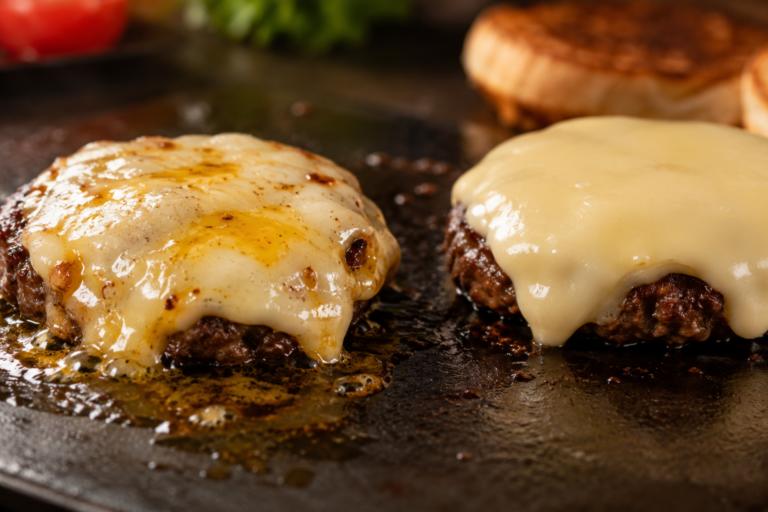
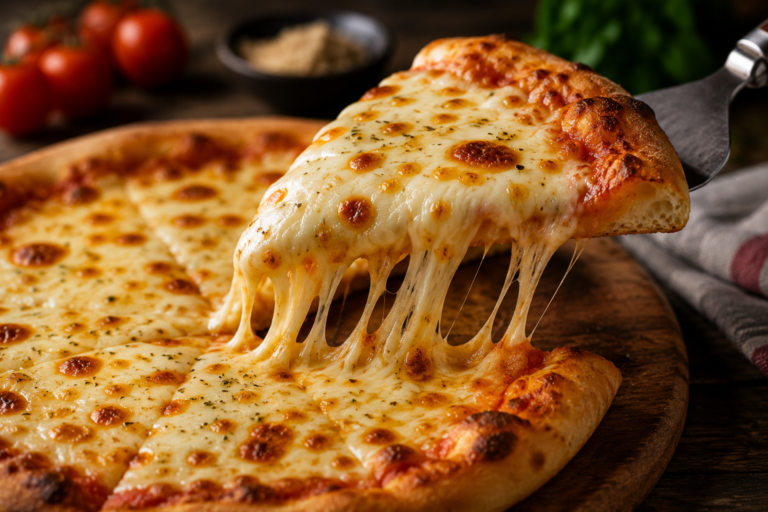
Imagine a burger advertised with an enormous layer of perfectly flowing melted cheese. A customer orders it and receives a burger where the cheese is barely melted.
The customer may not think, “The restaurant used AI.”
They simply think, “This isn’t what I expected.”
That gap between the photograph and the actual plate is where the real problem begins.
A restaurant photograph is not just decoration. It is a visual promise.
Why AI Food Images Can Look “Too Perfect”
There is a strange moment when an image looks beautiful but still doesn’t make you hungry.
I have experienced this many times while working with food photography. The most attractive photograph is not always the most appetizing one. Sometimes a little imperfection makes food look more real.
Real food has irregularity.
One French fry may be darker than another. A piece of fried chicken may have a rougher crust on one side. A few grains of rice may stick together. A sauce may spread unevenly across a plate. Fresh herbs rarely land in perfectly identical positions.
Those imperfections are not mistakes. They are visual evidence that the food was actually cooked.
AI image generation tends to favour visual perfection because it is designed to create an image that looks aesthetically pleasing. The result can be a plate where everything is unusually symmetrical, every ingredient has exactly the right shape and every surface has an almost unnatural shine.
At first glance, that can look impressive.
Look for a few seconds longer, however, and something can feel wrong.
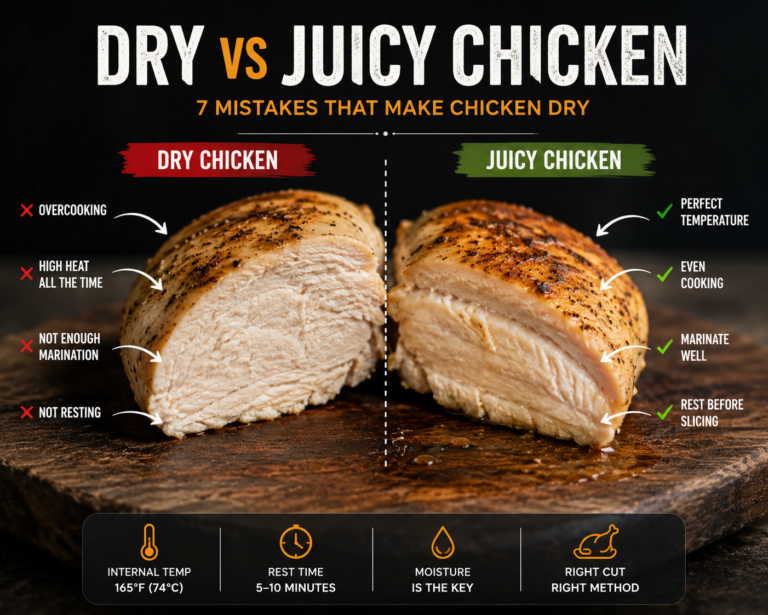
The chicken skin may look like polished leather. The cheese may stretch in ways that real melted cheese would not. A sauce may appear to have the consistency of paint. Fried food can lose the tiny irregular bubbles and roughness that tell us it has actually been fried.
Food doesn’t need to be perfect to look delicious. It needs to look believable.
That distinction is becoming increasingly important as restaurants experiment with AI generated menu imagery.
The Problem With Food That Looks Better Than It Tastes
There is nothing wrong with making food look beautiful. In fact, presentation is part of the dining experience.
The problem starts when the photograph becomes more impressive than the food the kitchen can actually produce.
I have worked in professional kitchens where a dish might be photographed dozens of times before the right image is selected. But the important question is never simply, “Does this photograph look good?”
The better question is:
“Can my kitchen consistently reproduce what this photograph promises?”
That is a very different standard.
If a menu photograph shows a burger with a thick, glossy sauce flowing perfectly over the edges, the customer expects something close to that experience. If the photograph shows an enormous portion of crispy chicken and the actual serving is much smaller, disappointment is almost guaranteed.
This matters even more with delivery food. The customer may never see the kitchen, the chef or the preparation process. The menu photograph becomes one of the strongest signals they have before placing the order.
A beautiful but unrealistic image can therefore create a short-term advantage and a long-term problem.
The customer clicks because the food looks incredible.
The customer receives something different.
The review follows.
From a chef’s perspective, I would rather have a photograph that makes the real dish look honest, delicious and achievable than an impossible image that creates expectations my kitchen cannot meet.
The best food photograph does not sell a fantasy. It makes the real food irresistible.
What Professional Food Photography Actually Controls
Real food photography is not simply putting a plate on a table and pressing the shutter.
There is a lot of decision making behind one strong food photograph.
Light controls whether food looks fresh, juicy, crisp or flat. Side lighting can reveal the texture of fried food, while softer front lighting can make a sauce look smooth and rich.
Temperature matters too. A hot bowl of soup behaves differently from one that has been sitting for twenty minutes. Steam can add a powerful sense of freshness, but it disappears quickly.
Texture is another major factor. Crispy food needs to show its rough, irregular surface. A grilled piece of meat needs visible browning. Fresh vegetables need to retain their natural structure rather than looking overly smooth.
Garnishing also has a purpose. Good food styling is not about covering a dish with random herbs. Every element should support the food and help the viewer understand what they are looking at.
And then there is timing.
Sometimes you have only a few minutes to photograph a dish at its best.
This is why professional food photography is closer to cooking than many people realise. You are managing heat, moisture, texture, colour, composition and timing at the same time.
AI can reproduce the appearance of these things remarkably well, but creating an image that looks believable requires understanding why those physical details exist in the first place.
That is the difference between making food look beautiful and making people believe they can almost taste it.
What Customers Actually Want From a Menu Photo
When someone opens a restaurant menu, they are not analysing photography. They are making a decision.
“Does this look good enough to order?”
A useful food photograph answers that question quickly.
Customers want to understand the food. They want to see the portion, the main ingredients, the texture and the overall character of the dish.
This is particularly important in the United States, where restaurant customers increasingly discover food through digital menus, delivery platforms, social media and online reviews.
A photograph that is too polished can sometimes work against the restaurant. If the customer cannot tell whether the food is real, familiar or achievable, the image loses some of its power.
I believe the strongest restaurant food photograph has three jobs:
Make me hungry.
Show me what I’m actually ordering.
Make me trust the restaurant.
The third one is easy to overlook.
Food photography is part of a restaurant’s communication with its customer. When the photograph accurately represents the dish, it helps establish a realistic expectation before the order is placed.
That is why I don’t see the future of food photography as a simple competition between AI and cameras.
The real competition is between attention and trust.
AI is exceptionally good at getting attention.
Real food photography, when done properly, can deliver both attention and trust.
When AI Food Photography Can Actually Be Useful
I don’t think restaurants should simply reject AI.
Used properly, it can be a very useful creative tool.
A restaurant owner may want to explore different visual concepts before investing in a professional photo shoot. A designer may need a temporary background for a promotional campaign. A chef may want to visualise a new plating concept before preparing the actual dish.
AI can be excellent for those jobs.
It can help answer questions such as:
- What might this dish look like in a premium restaurant setting?
- Would a dark or light background work better?
- How could a seasonal promotion be presented?
- What type of composition might work for a social media campaign?
For concept development, mood boards and creative experimentation, AI can save considerable time.
The problem is not using AI to create an idea.
The problem is presenting an invented dish as if it were the real product a customer is going to receive.
There is an important difference between inspiration and representation.
If I am designing a campaign concept for a restaurant, an AI image can help communicate the visual direction. But when a customer is deciding whether to spend money on a particular dish, I believe the photograph should represent the actual food as honestly as possible.
In other words, AI can help create the vision.
The real dish should create the proof.
How to Tell If a Restaurant Food Image Looks AI-generated
You don’t need to be a photographer or an AI expert to notice that something is wrong with a food image.
Start by looking at the ingredients.
Does every ingredient have a perfectly identical shape? Are herbs repeated in exactly the same pattern? Does a slice of tomato look unnaturally smooth?
Next, look at texture.
Crispy food should have irregular edges. Grilled food should have natural browning. Melted cheese should follow the structure of the food underneath it rather than behaving like a perfectly shaped ribbon.
Then look at sauces and liquids.
Real sauces respond to gravity. They spread, pool and cling to surfaces. AI can sometimes create sauces that appear to float or form shapes that would be extremely difficult to produce in a real kitchen.
Finally, look at the overall plate.
Real food usually has small variations. AI generated food can sometimes appear almost unnaturally perfect, with every component positioned as though it was measured with a ruler.
None of these signs proves that an image was generated by AI. But when several unusual details appear together, they are good reasons to question whether the photograph represents a real dish.
And for a restaurant customer, that question matters.
If I cannot trust the photograph, why should I trust the promise behind it?
The Chef RBS Test: Would I Serve This Photograph?
When I look at a food photograph, I don’t first ask whether it is beautiful.
I ask a much simpler question:
Would I be happy if this exact plate arrived at my table?
That question changes the way you evaluate an image.
Look at a fried chicken photograph. Can you almost hear the crunch? Does the coating have the irregular texture you would expect from something that came out of a fryer?
Look at biryani. Can you distinguish individual grains of rice? Does the chicken look cooked rather than polished? Does the potato look like something that has actually absorbed flavour during cooking?
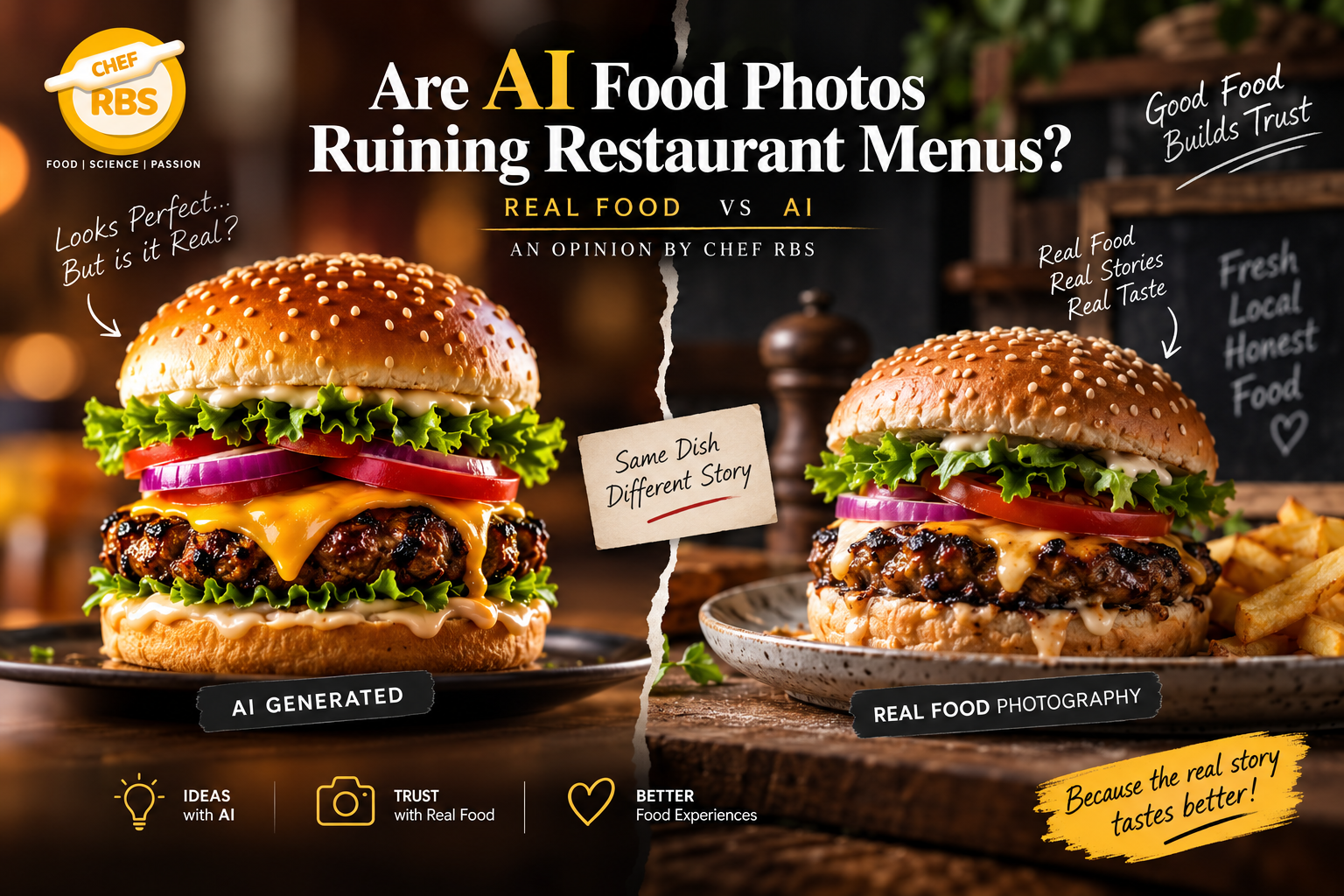
Look at a burger. Does the bun have believable softness? Does the filling have weight? Does the cheese look like melted cheese rather than a perfect yellow shape?
These details are important because food photography works best when it activates our memory of eating.
As a chef, I have learned that texture often sells food better than perfection.
A few uneven fried edges can make a dish look hotter and crispier. A little natural sauce movement can make food look juicier. Real browning can communicate flavour before the customer takes a single bite.
That is why my rule is simple:
If the photograph looks perfect but the food doesn’t look edible, something has gone wrong.
Technology should help us communicate food better. It shouldn’t make us forget what real food actually looks like.
What Restaurants Should Do Instead
If you run a restaurant, you don’t have to choose between technology and traditional food photography.
The smarter approach is to use each for what it does best.
Use AI to explore ideas, develop campaign concepts, test layouts and create visual directions.
Use real photography to show the food customers can actually order.
Before photographing a menu, I would focus on a few basics:
Cook the actual dish. Photograph the product as closely as possible to the way it will be served.
Control the light. Good natural or carefully positioned artificial light can reveal texture without making food look artificial.
Show realistic portions. Don’t photograph a portion that the restaurant cannot consistently reproduce.
Capture food at the right moment. Crispy food should be photographed while it is crisp. Melted cheese should be photographed while it is properly melted. Fresh garnishes should look fresh.
Keep the styling believable. A little imperfection can make a dish look more appetizing than an overly arranged plate.
Update photographs when the recipe changes. If the actual product changes, the menu image should change too.
Most importantly, look at the photograph from the customer’s perspective.
Ask yourself:
“If someone orders this because of this photograph, will they receive something that feels true to what they saw?”
If the answer is yes, the photograph is doing its job.
The Future of Food Photography
I don’t think AI is going to eliminate food photographers.
I think it is going to change what clients expect from them.
Basic background generation, visual concepts and quick promotional experiments are becoming easier. That means the value of a professional food photographer will increasingly come from something AI cannot simply invent: understanding the food itself.
A chef knows when a sauce has the right consistency. A food stylist knows how quickly a fried crust loses its visual appeal. A photographer knows how light reveals texture. When those skills come together, the result is more than a beautiful picture.
It is a believable picture of food.
I also expect restaurants to become more selective about how they use AI. For a social media concept or an imaginative campaign, synthetic imagery can be perfectly useful. For a menu where a customer is deciding what to order, authenticity becomes much more valuable.
The restaurant industry has always sold an experience before the first bite. Photography is part of that experience.
AI may make it easier to create an image.
It does not automatically make the food behind that image better.
And ultimately, customers still have to eat the food.
AI Food Photography vs Real Food Photography: Which Is Better?
The answer depends on what the image is being used for.
| Use case | Better choice |
|---|---|
| Restaurant menu | Real food photography |
| Delivery menu | Real food photography |
| New dish concept | AI can be useful |
| Social media concept | AI can be useful |
| Advertising a dish customers can order | Real food photography |
| Mood board or campaign planning | AI can be useful |
| Showing an actual restaurant product | Real food photography |
AI is incredibly useful when the goal is imagination, experimentation or speed.
Real photography becomes more valuable when the goal is accuracy and trust.
For restaurants, I would not ask, “Which technology is better?”
I would ask:
“What does my customer need to believe about this image?”
If they need to understand what they are actually going to receive, show them the real food.
If you are developing an idea that does not exist yet, AI can help you visualise it.
That distinction keeps technology useful without allowing it to replace authenticity.
The Bottom Line
AI has changed how quickly we can create food imagery, and I don’t think that change is going away.
But speed is not the same as authenticity.
For restaurants, the strongest food image is still the one that makes a customer hungry and gives them a realistic idea of what will arrive on the table.
AI can help with ideas, concepts and creative exploration. Real food photography can show the texture, colour, portion and character of the actual dish.
As a chef and food stylist, my view is simple:
Use AI to imagine. Use real food to prove.
The future of restaurant marketing doesn’t have to be AI versus photographers. The best results may come from using both technologies intelligently, while keeping the actual food at the centre of the story.
Because no matter how impressive the picture becomes, the customer eventually takes a bite.
And that is where the photograph has to meet reality.
5 Questions Restaurants Should Ask Before Using an AI Food Image
1. Is this the actual food we sell?
If customers cannot receive something reasonably close to the photograph, don’t use it as the main menu image.
2. Does the portion look realistic?
An image can make a small serving look enormous. Make sure the photograph reflects the portion customers will actually receive.
3. Do the ingredients look real?
Check cheese, sauces, meat, vegetables, fried coatings and garnishes carefully. These details strongly influence whether an image feels believable.
4. Can the kitchen reproduce the presentation consistently?
A beautiful photograph is useless if the dish looks completely different every time it leaves the kitchen.
5. Does the image build trust?
Ask someone who has never seen the dish to look at the photograph. Does it make them hungry and confident about ordering?
If the answer to those questions is yes, the image is doing more than attracting attention. It is communicating the real product.
That is what good restaurant photography should do.
Frequently Asked Questions
Are AI food photos real?
Not necessarily. AI can generate highly realistic food images without a real dish ever being photographed. Restaurants should clearly distinguish creative concept imagery from photographs representing actual menu items.
Can customers tell if a food photo is AI generated?
Sometimes. Unnatural textures, impossible ingredient shapes, excessive symmetry, strange sauces and unrealistic food surfaces can make an image look synthetic. However, visual clues alone do not always prove that an image was AI generated.
Should restaurants use AI food images on menus?
AI can be useful for concepts and creative campaigns, but real photography is generally better when the image is intended to represent the actual food customers will receive.
Why does real food photography look different from AI food photography?
Real food changes with heat, moisture, gravity and time. Professional photographers work with those physical characteristics to capture the food at its most appealing moment.
Can AI replace food photographers?
AI can automate parts of the creative process, but professional food photography still requires knowledge of food, styling, lighting, composition and the physical behaviour of ingredients.