How Long Does Cooked Chicken Last in the Fridge? A Chef’s Food Safety Guide
Introduction
How long does cooked chicken last in the fridge? It is a simple question, but the answer depends on more than just counting the days.
Cooked chicken is one of the most common leftovers in home kitchens. You might roast extra chicken for dinner, save grilled chicken for lunch, or order more food than you can finish. Knowing how to cool, store, and reheat it properly is just as important as cooking it well.
According to FoodSafety.gov, cooked meat and poultry leftovers should generally be refrigerated at 40°F (4°C) or below and used within 3 to 4 days.
But as a chef, I know the practical questions usually come after that:
When should I put the chicken in the refrigerator? Should I use a shallow container? Can I freeze it? Does reheating it make it safe again? And can I trust the smell?
In this guide, I’ll explain the basic food-safety rules and the practical kitchen habits that help keep cooked chicken safe, useful, and enjoyable instead of turning leftovers into a guessing game.
2. The 3- to 4-Day Rule for Cooked Chicken
For most cooked chicken leftovers, the basic U.S. food-safety guidance is simple: use them within 3 to 4 days when stored properly in a refrigerator at 40°F (4°C) or below. USDA guidance gives the same 3- to 4-day window for cooked meat, poultry, and seafood.
That means if you cooked chicken on Monday and refrigerated it promptly, Thursday is generally within the recommended window. Friday is already beyond the usual 3 to 4 day recommendation.
But there is an important detail:
The clock starts with safe handling after cooking.
If cooked chicken sits at room temperature for too long before refrigeration, putting it in the refrigerator later does not reset the clock or make it safe again.
FoodSafety.gov recommends refrigerating perishable food within 2 hours, or within 1 hour when the surrounding temperature is above 90°F (32°C).
Chef RBS Tip
Don’t think of the refrigerator as a machine that makes food safe again.
Its job is to slow bacterial growth.
Good food safety starts immediately after cooking: control the time, cool the food properly, and keep the refrigerator cold.
3. When Should Cooked Chicken Go Into the Refrigerator?
One of the most common mistakes with leftovers is waiting too long before putting them away.
You do not need to wait until cooked chicken has completely cooled to room temperature. In fact, leaving it out for a long time creates a food-safety problem.
For perishable foods such as cooked chicken, the general rule is to refrigerate within 2 hours. If the surrounding temperature is above 90°F (32°C), the window drops to 1 hour.
What I Do in a Professional Kitchen
I don’t leave a large container of hot chicken sitting on the counter for hours.
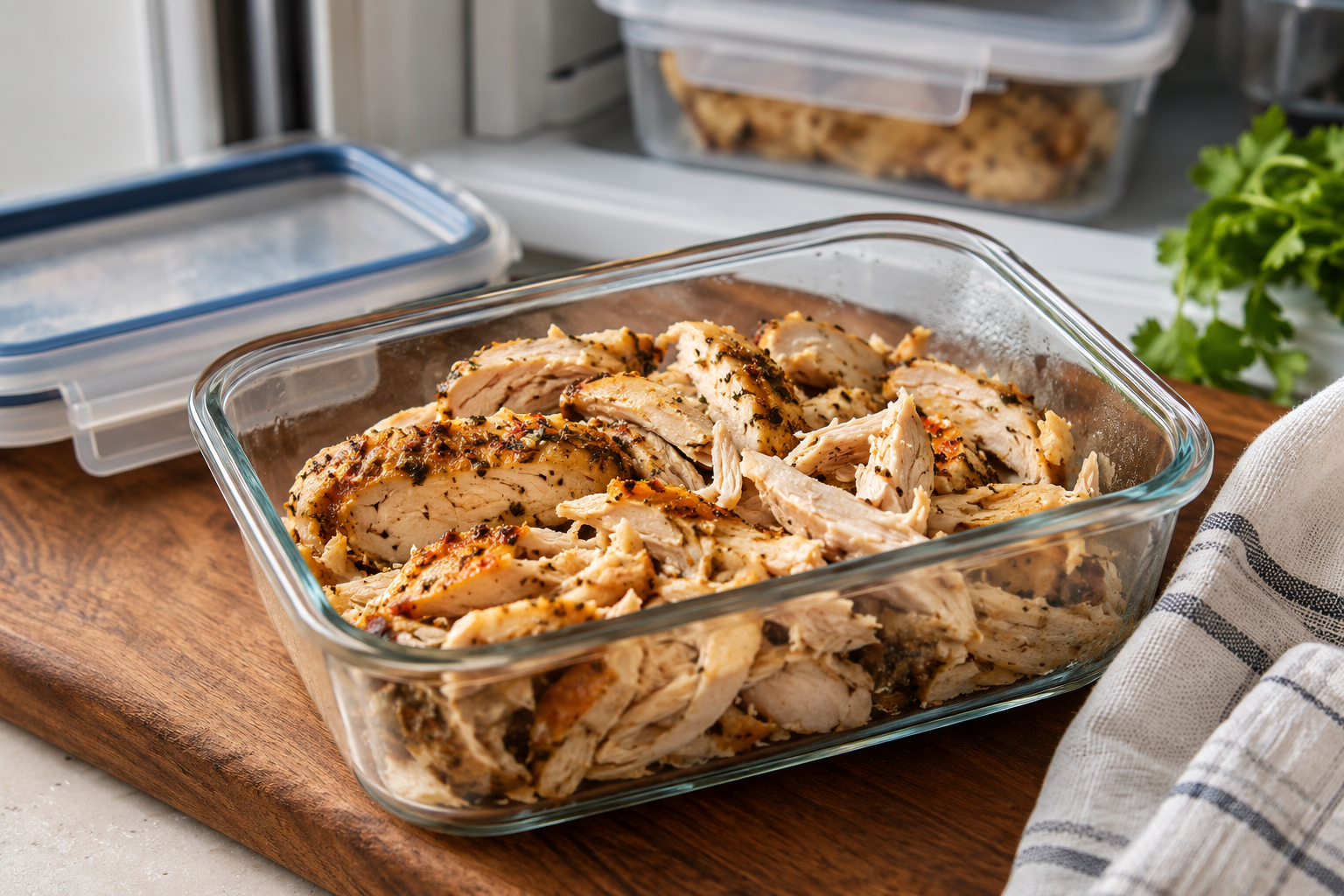
If I have a substantial quantity, I divide it into smaller, shallow containers so it can cool more efficiently before or while being refrigerated.
This is especially important after cooking a large batch.
Don’t Leave a Huge Pot of Chicken to Cool Slowly
A large, deep container holds heat for much longer than a shallow container.
For example, putting several kilograms of cooked chicken into one deep container and leaving it on the counter is very different from dividing it into several smaller containers.
The goal is to control the cooling process, not simply wait for the food to become cold.
Chef RBS Tip
When dinner is finished, think about leftovers immediately.
Eat what you need, portion what you want to save, and refrigerate it promptly.
Good storage starts with good timing.
4. Use Shallow Containers for Faster Cooling
The way you store cooked chicken can affect how quickly it cools.
If you have a large amount of cooked chicken, avoid putting the entire batch into one deep container. A deep container can hold heat for longer.
Instead, divide the chicken into smaller, shallow containers.
This increases the surface area and helps the food cool more efficiently.
Why This Matters
Imagine two situations:
Option 1: A large quantity of hot chicken packed into one deep container.
Option 2: The same chicken divided between several shallow containers.
The second approach gives the heat more opportunity to escape and makes temperature control easier.
This becomes especially important when preparing food in larger quantities.
Don’t Pack Containers Too Tightly
Leave enough space for the food to cool properly, and use clean, food-safe containers with appropriate lids.
Once the chicken has cooled and is safely refrigerated, keep the refrigerator at 40°F (4°C) or below.
Chef RBS Tip
This is one of those small professional-kitchen habits that can make a big difference at home.
Don’t just ask where you will store the chicken. Think about how you will cool it before storing it.
The storage container is part of the food-safety process.
5. Can You Tell If Cooked Chicken Is Safe by Smell?
This is where many people make a dangerous assumption.
You might open the container and smell the chicken. If it smells normal, you may think it is safe.
Smell is not a reliable food-safety test.
Some harmful bacteria can grow without creating an obvious bad smell, taste or visible change. That means chicken can look and smell normal and still be unsafe if it has been stored incorrectly or kept for too long.
What Should You Check Instead?
Think about the storage history, not just the smell.
Ask:
- When was the chicken cooked?
- How long did it stay at room temperature?
- Was it refrigerated promptly?
- Was the refrigerator cold enough?
- How many days has it been stored?
These questions tell you much more than smelling the chicken.
If cooked chicken has been left at unsafe temperatures or stored beyond the recommended period, don’t taste it to find out whether it is safe.
What About Slimy or Unusual Chicken?
A strange smell, slimy texture, mold or other obvious changes are reasons to discard food.
But the absence of these signs does not prove that the food is safe.
Chef RBS Tip
In a professional kitchen, we don’t rely on our nose to decide whether a leftover is safe.
Time and temperature records are much more reliable than smell.
When you are unsure about how the chicken was stored, the safest decision is to discard it rather than take a chance.
6. Can You Freeze Cooked Chicken?
Yes. Freezing is a useful option when you know you will not eat the cooked chicken within the recommended refrigerator window.
USDA guidance lists cooked meat and poultry as best used within 3 to 4 days in the refrigerator, while properly frozen leftovers can maintain good quality for longer.
Freeze It Before It Becomes a Problem
Don’t wait until the fourth day and then decide what to do with the chicken.
If you already know you will not use it soon, portion it and freeze it while it is still within the safe storage period.
Use airtight, freezer-safe packaging and remove as much excess air as practical.
Portion Before Freezing
This is one of my favorite kitchen habits.
Don’t freeze one large block of chicken if you will only need a small amount later.
Divide it into portions suitable for:
- One dinner
- Sandwiches or wraps
- Salads
- Rice bowls
- Soups or curries
That makes thawing and reheating much easier.
Label It
Write the date on the package before putting it into the freezer.
When you have several containers in the freezer, this simple habit prevents the classic problem of finding an unidentified container months later and wondering, “When did I freeze this?”
Chef RBS Tip
Freezing is a planning tool, not a rescue button.
If food has already been mishandled or stored unsafely, freezing it does not make it safe. Freeze properly handled chicken while it is still within its safe storage period.
7. How Should You Reheat Cooked Chicken?
Reheating leftovers is not simply about making chicken hot again.
You want to heat it thoroughly while avoiding the common problem of turning already-cooked chicken dry and tough.
For food safety, USDA guidance recommends reheating leftovers to 165°F (74°C).
Reheat Only What You Need
If you have a large container of cooked chicken, take out the portion you plan to eat rather than repeatedly heating and cooling the entire batch.
This also helps maintain better texture.
Add a Little Moisture
Lean chicken can dry out during reheating.
Depending on the dish, a small amount of stock, water, sauce or another suitable liquid can help.
For example:
- Add a little stock when reheating chicken in a pan.
- Cover chicken with a suitable sauce when reheating it as part of a curry.
- Add a small amount of water when reheating a rice and chicken dish.
Use Gentle Heat When Practical
Very aggressive heat can make cooked chicken tough before the center is properly heated.
A covered pan over moderate heat can work well for many dishes.
Microwaves are also convenient. Arrange the chicken evenly and stir or rotate when appropriate so the food heats more uniformly.
Chef RBS Tip
Reheat for the dish you are making, not just for temperature.
A piece of roasted chicken may benefit from gentle reheating with a little stock, while chicken going into a curry or soup can be reheated directly in the sauce.
Good reheating protects both food safety and texture.
8. Can You Reheat Cooked Chicken More Than Once?
This is a common question when you have leftovers from a large batch.
The important issue is not simply how many times the chicken has been reheated. The bigger concern is how the food has been handled during cooling, storage, and reheating.
Repeatedly taking the entire container out of the refrigerator, leaving it at room temperature, reheating it and then cooling it again creates more opportunities for unsafe temperature control.
A Better Kitchen Habit
Instead of reheating the whole batch, take out only the portion you plan to eat.
Keep the remaining chicken refrigerated and properly covered.
This is especially useful when meal-prepping several portions at once.
Reheating Does Not Fix Poor Storage
Another important point is that reheating is not a way to rescue chicken that has already been stored incorrectly.
If cooked chicken has been left at unsafe temperatures for too long, heating it again should not be treated as a guarantee of safety.
Food safety begins with proper cooling and storage, not just the final reheating step.
Chef RBS Tip
When preparing leftovers, I prefer this simple system:
Cook → portion → cool safely → refrigerate or freeze → reheat only what you need.
It keeps the process easier to manage and usually gives you better texture too.
9. What About Chicken That Has Been Left Out Overnight?
This is one of the situations where I would not take a chance.
If cooked chicken has been left at room temperature overnight, it is well beyond the recommended time for leaving perishable food unrefrigerated.
Even if the chicken looks normal and smells fine, that does not make it safe to eat.
The safer approach is to discard it rather than trying to reheat it, fry it again, or use it in another dish.
Don’t Rely on Reheating
This is an important food-safety principle.
Reheating is designed to bring properly stored leftovers back to a safe eating temperature. It should not be treated as a way to rescue food that has already spent too long at unsafe temperatures.
Chef RBS Tip
In a professional kitchen, food safety has to come before food cost.
If you know the chicken was left out overnight, don’t try to save it.
A few portions of leftover chicken are never worth risking someone’s health.
10. What If You Are Not Sure When the Chicken Was Cooked?
This is one of the easiest situations to avoid if you develop a simple kitchen habit: label your leftovers.
If you open the refrigerator and find a container of cooked chicken but cannot remember whether you cooked it yesterday or four days ago, you are already making a decision with missing information.
USDA and FoodSafety.gov guidance recommends using refrigerated cooked meat and poultry within 3 to 4 days.
Write the Date.
You don’t need anything complicated.
A small piece of masking tape or a food-safe label with the date cooked is enough.
For example:
Cooked: September 24
Now there is no guessing.
This is especially useful when you prepare several meals at once or have multiple containers in the refrigerator.
Use Older Food First
If you have two containers of cooked chicken, use the older one first.
This simple first-in, first-out habit is standard kitchen thinking and helps reduce unnecessary food waste.
When in Doubt
If you genuinely cannot establish how long the chicken has been stored, don’t rely on smell or taste to make the decision.
Food safety depends on time and temperature control, and refrigeration slows bacterial growth rather than stopping it completely.
Chef RBS Tip
A label may look like a small professional-kitchen habit, but it makes home food safety much easier.
If you know when you cooked it, you know when to use it.
Keep the rule simple: date it, store it properly, and use or freeze it within the recommended time.
11. Chef RBS’s Practical Leftover Chicken Rule
After working in professional kitchens, I keep leftover chicken management very simple.
If you know when it was cooked, how it was cooled, and how it was stored, you can make a sensible decision about it.
My basic system is
Cook → portion → cool promptly → refrigerate or freeze → label → use within the recommended time → reheat thoroughly.
The most important part is not trying to rescue food after something has gone wrong.
If chicken has been left out too long, stored for an unknown amount of time, or handled incorrectly, I would rather discard it than serve it.
That may sound wasteful, but food safety is part of professional cooking. A chef’s responsibility does not end when the food leaves the stove.
My Simple Kitchen Checklist
Before saving cooked chicken, I ask:
- Did I refrigerate it promptly?
- Is my refrigerator at 40°F (4°C) or below?
- Did I store it in a suitable container?
- Did I label the date?
- Am I still within the recommended 3- to 4-day refrigerator window?
- If not, did I freeze it while it was still properly stored?
If the answer to these questions is clear, leftover management becomes much less stressful.
Good food safety is not about guessing. It is about controlling time, temperature, and handling.
That is the habit I would recommend in every home kitchen.
12. Final Thoughts: Treat Leftovers as Part of Cooking
Cooked chicken does not become a problem simply because it is a leftover.
The important part is what happens after cooking.
Cool it promptly. Store it properly. Keep the refrigerator cold. Label your containers. Use refrigerated chicken within the recommended 3- to 4-day window, or freeze it when appropriate. Reheat leftovers thoroughly before eating.
And don’t use smell or appearance as your only safety test.
As a chef, I see leftover management as part of cooking, not something that happens after cooking.
When you plan portions, control temperatures, and know when the food was prepared, leftovers can become convenient meals rather than a guessing game.
Good food deserves good handling from the stove to the refrigerator and back to the plate.
Chef RBS