Clean Label Doesn’t Always Mean Healthier
1. Clean Label Doesn’t Always Mean Healthier
You pick up a food packet, turn it around, and see words like “clean label”, “natural”, “simple ingredients”, or “no artificial ingredients”.
It feels like an easy choice.
But here’s something I tell people as a chef: a clean-looking label doesn’t automatically make a food healthier.
Some unfamiliar ingredients have a very practical job. They may keep food fresh, control texture, prevent separation, or help a product remain stable during storage. At the same time, a product with a short ingredient list can still be high in sugar, salt, saturated fat, or calories.
So the real question isn’t simply, “Does this label look clean?”
It’s “What is actually in this food, why is it there, and what does the whole product offer?”
Let’s take a closer look at what “clean label” really means and how to read food packaging like a chef rather than being guided by marketing alone.
You pick up a food packet, turn it around, and see words like “clean label”, “natural”, “simple ingredients”, or “no artificial ingredients”.
It feels like an easy choice.
But here’s something I tell people as a chef: a clean-looking label doesn’t automatically make food healthier.
Some unfamiliar ingredients have a very practical job. They may keep food fresh, control texture, prevent separation, or help a product remain stable during storage. At the same time, a product with a short ingredient list can still be high in sugar, salt, saturated fat, or calories.
So the real question isn’t simply, “Does this label look clean?”
It’s “What is actually in this food, why is it there, and what does the whole product offer?”
Let’s take a closer look at what “clean label” really means and how to read food packaging like a chef rather than being guided by marketing alone.
2. What Does “Clean Label” Actually Mean?
Here is the important part: “clean label” does not have one universal scientific definition.
The term is mainly used by the food industry to describe products that consumers perceive as having simple, familiar, recognizable, or minimally processed ingredients.
That can be useful when you’re shopping, but it shouldn’t be treated as a guarantee that the food is healthier.
As a chef, I prefer to look beyond the front of the package. The ingredient list, nutrition facts, serving size, and the actual food itself tell a much more complete story.
A clean label is a useful marketing idea. It is not a nutritional certificate.
3. How to Read a Clean Label Like a Chef
When I read a food label, I don’t start by counting how many ingredients are listed.
I start by asking what the food is actually made to provide.
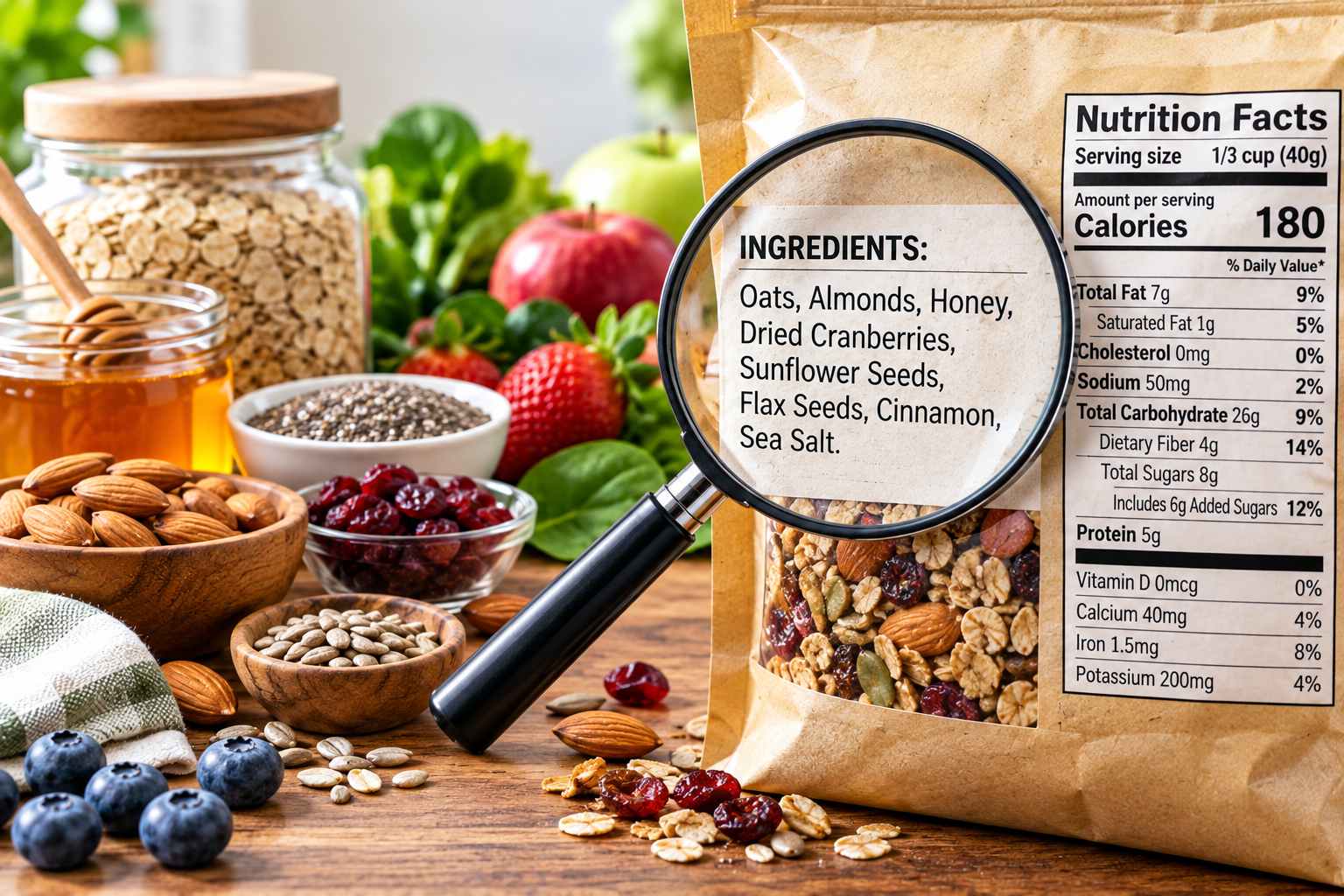
Look at the ingredient list, but also check the nutrition facts. Pay attention to added sugars, sodium, saturated fat, protein, fiber, and serving size.
Then look at the portion you are realistically going to eat.
For example, a cereal can have a short ingredient list and still contain a lot of added sugar. Another product might contain several ingredients because it needs them for preservation, texture, or stability while still fitting well into a balanced diet.
This is why I don’t judge a packaged food by the number of ingredients alone.
Read the whole label. The front of the package sells the product; the back helps you understand it.
4. When “Natural” Doesn’t Mean Healthier
“Natural” is another word that can make a food sound automatically better.
But natural and healthy are not the same thing.
A food can contain natural ingredients and still be high in sugar, calories, or saturated fat. On the other hand, a food containing a familiar food additive may be perfectly useful and safe when used appropriately.
Think about it like cooking in a professional kitchen. I don’t reject an ingredient simply because its name sounds technical. I ask what it does, why it is being used, and how it affects the finished food.
The same thinking works when you’re shopping.
Don’t let one attractive word on the front of a package make the entire decision for you. Look at the whole food, not just the marketing language.
5. Why Do Food Manufacturers Use Additives?
This is where food labels can become misleading.
An ingredient with a complicated name isn’t necessarily there to make a food “less healthy.” In many cases, it has a very specific job.
Food manufacturers may use ingredients to keep food fresh, control texture, prevent separation, protect flavor, maintain color or improve stability during processing and storage.
Think about mayonnaise. Without the right formulation, oil and water naturally want to separate. In a packaged product, certain ingredients help keep the texture consistent from the factory to your refrigerator.
The same principle applies to sauces, bread, dairy products, beverages and many other foods.
As a chef, I don’t look at an ingredient and immediately call it “good” or “bad.” I want to understand its function and the finished food as a whole.
That’s a much smarter way to read a food label than judging an ingredient simply because its name sounds unfamiliar.
6. Clean Label vs. Whole Food: They’re Not the Same Thing
This is an important distinction.
A whole food is generally close to its original form, such as fresh vegetables, fruit, eggs, grains, beans, or nuts.
A clean-label packaged food can still be a processed food. It may have a relatively simple ingredient list, but that doesn’t automatically make it nutritionally equivalent to a whole food.
For example, a packaged snack can use recognizable ingredients and still be high in calories, sodium, or added sugar.
There is nothing wrong with choosing packaged foods when they are convenient. The mistake is assuming that “clean label” and “whole food” mean the same thing.
As a chef, I use both. Fresh ingredients are the foundation of my cooking, while well-formulated packaged ingredients can have a practical place in a busy kitchen.
The smarter approach is balance, not fear.
7. The Front of the Package Can Influence Your Choice
The front of a package is designed to catch your attention.
Words such as “natural,” “high protein,” “light,” “made with whole grains” or “no artificial colors” can make a product look appealing before you have even looked at the ingredient list.
There is nothing wrong with these statements when they are accurate. The problem starts when one positive message becomes the entire reason you choose the product.
As a chef, I prefer to turn the package around and check the details before making a decision.
Look at the serving size, nutrition information, and ingredient list together.
A product can have one attractive claim on the front while having a very different nutritional profile on the back.
The front tells you what the brand wants you to notice. The back gives you more information to make your own decision.
8. Does a Short Ingredient List Mean Better Food?
Not necessarily.
A short ingredient list can be a good sign when it reflects a simple food made with familiar ingredients. But the number of ingredients alone doesn’t tell you whether a product is nutritious.
Imagine two packaged foods. One has: Does a Short Ingredient List Mean Better Food?
five ingredients but is high in added sugar and saturated fat. Another has twelve ingredients because it contains ingredients used for preservation, texture, and stability, while offering a more balanced nutritional profile.
Which one is better?
You can’t answer that from the ingredient count alone.
This is why I tell people not to fear a long ingredient list automatically. Understand the ingredients, then look at the nutrition information and serving size.
Good food isn’t always the food with the shortest label. Sometimes it’s simply the food that makes the most sense for your needs.
9. What Should You Look for First on a Food Label?
When I’m checking a packaged food, I don’t try to decode every word at once.
I start with a few basics:
Serving size: Is the amount listed realistic for what you are likely to eat?
Added sugar: Is sugar being added in a significant amount?
Sodium: Especially important in sauces, snacks, soups, and ready-to-eat foods.
Saturated fat: Check how much the product contributes to your daily intake.
Protein and fiber: These can help you understand whether the food offers useful nutritional value beyond calories.
Then I look at the ingredient list and ask a simple question:
Does this product make sense for what I actually need?
That’s a much more useful habit than simply searching for the words “clean” or “natural” on the front of the package.
10. Can Clean Label Foods Still Be Highly Processed?
Yes.
A product can have a relatively short ingredient list and still go through several stages of processing before it reaches your shopping cart.
Processing itself isn’t automatically a problem. Cooking, freezing, drying, pasteurizing, and other methods can make food safer, more convenient, or longer-lasting.
The important question is what happened to the food during processing and what the final product looks like nutritionally.
For example, a frozen vegetable may be processed but still be a practical way to add vegetables to a meal. A packaged snack may also have a simple ingredient list while being high in sodium, added sugar, or saturated fat.
So don’t use the word **”processed”** as a simple good-or-bad label either.
As a chef, I look at the complete picture: ingredients, preparation, nutrition, portion size, and how the food fits into the meal.
11. Are Food Additives Always Bad?
No. This is one of the biggest misconceptions I see around packaged food.
Food additives can serve very specific purposes. Some help preserve quality, others control acidity, improve texture, prevent ingredients from separating, or protect a product during storage.
That doesn’t mean every additive automatically makes a food a good choice. It simply means the word “additive” isn’t enough information to judge the food.
Think about it from a chef’s perspective. In a professional kitchen, every ingredient has a job. If an ingredient helps a sauce remain stable or keeps a product safe and consistent during its shelf life, there is a reason it is there.
The better question is not:
“Does this food contain additives?”
Ask:
“What are these ingredients doing, and what does the finished food offer nutritionally?”
That small change in thinking can make food labels much easier to understand.
12. The Clean Label Trap: When Marketing Looks Healthier Than the Food
The biggest problem with clean-label marketing isn’t the phrase itself. It’s when we allow one attractive claim to make the entire food look healthier than it really is.
A package might highlight “natural ingredients” while the product is still high in added sugar. Another might say “no artificial colors” while offering little fiber or protein.
Neither statement is necessarily false. They simply don’t tell you the whole story.
This is why I always recommend looking beyond the front of the package.
Marketing tells you what the brand wants you to notice. The nutrition panel and ingredient list help you understand what you’re actually buying.
Once you develop that habit, food labels become much less confusing.
You don’t have to fear packaged food. You just need to become a smarter reader.
13. My 30-Second Label Check
You don’t need to spend five minutes studying every packet in the supermarket.
I use a simple approach that takes about 30 seconds.
1. Check the serving size.
Don’t assume the whole packet equals one serving.
2. Look at added sugar and sodium.
These can change the nutritional picture quickly, especially in snacks, sauces and ready-to-eat foods.
3. Check protein and fiber.
They can tell you whether the food offers more than just calories.
4. Read the first few ingredients.
Ingredients are generally listed by weight, so what appears near the beginning can tell you a lot about the product.
5. Look at the whole product, not one claim.
“Natural,” “clean,” or “no artificial ingredients” is only one piece of information.
That’s my chef’s rule: don’t shop by the front of the package alone. Read enough of the back to understand what you’re actually buying.
14. The Bottom Line
Clean label can be useful, but it should never be your only reason for choosing a food.
A short ingredient list can be helpful. Familiar ingredients can make a product easier to understand. But neither tells you the complete nutritional story.
The better habit is simple: look past the marketing, read the label, understand the serving size, and consider the whole food.
As a chef, I don’t believe good food needs a complicated label or a perfect-looking package. I believe it needs the right ingredients, thoughtful preparation and a sensible place in your overall diet.
So next time you see “clean label”, don’t automatically put the product in your cart.
Turn the package around.
That’s where the real story begins.
15. Frequently Asked Questions
What does clean label mean?
Clean label generally describes food made with ingredients that consumers perceive as simple, familiar or recognizable. However, there is no single universal definition that makes a product automatically healthier.
Is clean-label food healthier?
Not necessarily. A clean-looking ingredient list does not tell you everything about a food’s sugar, sodium, saturated fat, protein, fiber or serving size.
Is a long ingredient list bad?
No. Some ingredients are used for legitimate purposes such as preservation, texture, stability or food safety. The number of ingredients alone isn’t enough to judge a product.
Are food additives unhealthy?
Not automatically. Additives can perform important technical functions in food. What matters is the specific ingredient, how it is used and the overall nutritional profile of the product.
What should I check first on a food label?
Start with the serving size and nutrition information, then look at added sugar, sodium, saturated fat, protein and fiber. After that, read the ingredient list to understand what is actually in the product.