Why Does Honey Crystallize? Is Crystallized Honey Still Safe?
Have you ever opened a jar of honey and found it looking thick, cloudy, or almost solid?
Don’t throw it away just yet.
As a chef, I’ve seen this happen many times. It can look like the honey has spoiled, but crystallization is actually a natural process that happens to many real honeys.
So why does honey crystallize? Is crystallized honey still safe to eat? And can you bring it back to that smooth, golden texture?
Let’s break it down simply.
1. Why Does Honey Crystallize?
The first thing I want you to know is this: crystallized honey is usually not spoiled honey.
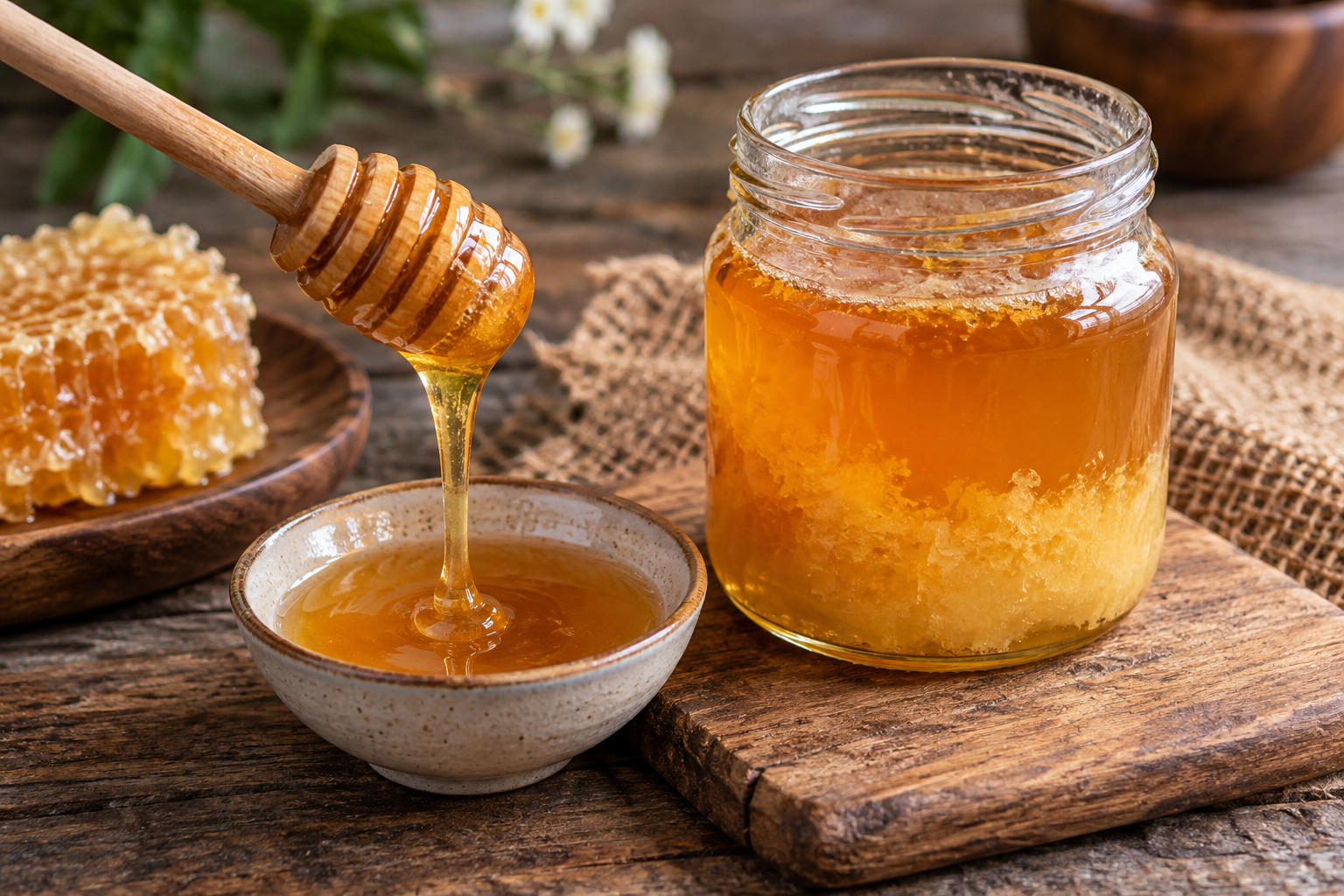
Honey naturally contains different sugars, mainly glucose and fructose. Over time, some of the glucose can separate from the water in honey and form tiny crystals.
The balance varies from one honey to another. That’s why one jar may stay beautifully liquid for months while another becomes thick and grainy much sooner.
Chef’s tip: Don’t judge honey by its appearance alone. If the honey has been stored properly and doesn’t show obvious signs of spoilage or contamination, crystallization by itself isn’t a reason to throw it away.
And honestly, I don’t mind crystallized honey. Its thicker texture can be fantastic on warm toast, yogurt, or oatmeal.
2. What Makes Honey Crystallize Faster?
Not all honey crystallizes at the same speed.
The glucose-to-fructose balance makes a big difference. Honey with more glucose tends to crystallize faster, while honey with more fructose can stay liquid for longer.
Temperature also matters. Honey often crystallizes more readily in a cool environment, especially around typical refrigerator temperatures.
There is another kitchen factor too: tiny particles such as pollen or other natural particles can give crystals a place to start forming.
Chef’s tip
If you prefer runny honey, keep the jar tightly closed at room temperature, away from unnecessary heat and moisture.
And don’t put your honey in the refrigerator just to keep it “fresh.” Cold storage can encourage crystallization.
3. Is Crystallized Honey Still Safe to Eat?
Yes. Crystallization by itself does not mean honey has gone bad.
In fact, crystallization is a natural change in texture. The honey may become pale, grainy or almost solid, but that doesn’t automatically make it unsafe.
What I look for as a chef is the bigger picture: How was it stored? Does it look contaminated? Does it have an unusual fermented smell or other obvious signs that something has gone wrong?
Chef’s tip
If your honey has simply turned cloudy and thick, don’t panic. You may actually be looking at perfectly good honey in a different form.
Texture changed. That doesn’t necessarily mean the honey did.
4. Can You Turn Crystallized Honey Back Into Liquid?
Absolutely. This is one of those simple kitchen fixes that doesn’t need complicated equipment.
Place the honey jar in warm water and let the gentle heat loosen the crystals. Stir occasionally, and give it time rather than trying to blast it with high heat.
Chef’s tip
I prefer gentle, controlled heat. Very high temperatures can affect some of honey’s delicate flavor and aroma.
Also, don’t microwave honey while it’s in a sealed jar. If you need to warm a small amount, transfer it to a suitable container first.
Once the crystals dissolve, the honey should become smooth and pourable again.
Slow heat works better than aggressive heat.
5. Does Heating Honey Ruin It?
This is where I would be careful.
Honey doesn’t need to be heated just because it has crystallized. If you want it liquid again, use gentle warming rather than high heat.
The idea that every heated honey suddenly becomes “bad” is too simplistic. But excessive heat can change some of honey’s natural characteristics, including its flavor, aroma and certain heat-sensitive compounds.
Chef’s tip
Treat honey like a delicate ingredient, not cooking oil.
Warm it gently when you need to, and don’t cook it unnecessarily.
That way, you get the smooth texture back without turning a simple kitchen fix into a high-heat process.
6. Can You Prevent Honey From Crystallizing?
You can slow crystallization down, but you usually can’t stop it forever.
Store honey in a tightly closed container at room temperature, away from moisture and large temperature changes. A stable cupboard is often a better home for honey than the refrigerator.
Chef’s tip
If you buy honey mainly for drizzling, choose a variety that naturally stays liquid longer. If you don’t mind a thicker texture, crystallization isn’t really a problem.
In my kitchen, I see it as a texture change, not automatically a quality failure.
And that’s the key point: good honey doesn’t have to stay perfectly liquid to be good honey.
7. A Chef’s Take
After years of working with honey in professional kitchens, my advice is simple: don’t judge honey by how clear or liquid it looks.
Crystallization is a natural change, and different honeys behave differently. Some stay fluid for a long time. Others can become thick and grainy relatively quickly.
If your honey has crystallized, taste it before deciding what to do with it. You may actually enjoy the texture.
And if you need it liquid again, warm it gently and patiently.
Good ingredients don’t always look perfect. Sometimes understanding the science helps you appreciate them more.
8. Frequently Asked Questions
Why does honey crystallize?
Honey crystallizes when some of its glucose separates from the water and forms tiny crystals. The speed depends on the type of honey, its sugar balance, temperature, and other natural particles present in the honey.
Is crystallized honey safe to eat?
Yes. Crystallization by itself does not mean honey has spoiled. If it has been stored properly and has no unusual smell, visible contamination, or signs of fermentation, crystallized honey can still be enjoyed.
How do you turn crystallized honey back into liquid?
Place the honey container in warm water and allow it to warm gradually. Stir occasionally until the crystals dissolve. Avoid excessive heat.
Does crystallized honey mean it is pure?
Not necessarily. Crystallization is a natural characteristic of honey, but it should not be used by itself as a test of purity or authenticity.
Should you refrigerate honey?
Generally, no. Honey is better stored tightly closed at room temperature in a cool, dry place. Refrigeration can encourage crystallization and make the honey harder to use.
Can babies eat honey?
No. Honey should not be given to children under 12 months because of the risk of infant botulism.