Mycoprotein Explained: How Fungi Can Become a Food Protein
Mycoprotein is a protein-rich food ingredient made by growing selected fungi through controlled fermentation. Unlike plant-based proteins from soy or peas, mycoprotein develops from fungal biomass, which can be processed into foods with a distinctive fibrous texture. This makes it useful for products designed to resemble meat. For chefs, food manufacturers, and curious consumers, understanding mycoprotein means exploring how fermentation works, what the ingredient offers nutritionally, and where its benefits and limitations lie.
Unlike plant-based proteins made from soy or peas, mycoprotein is produced by growing selected fungi under controlled conditions. The resulting fungal biomass can be processed into food ingredients with a distinctive fibrous texture, making it useful in products designed to resemble meat.
For food developers and chefs, the interesting part is not simply finding another protein source. It is understanding how fermentation, processing, and food formulation work together to create texture, flavor, and a consistent product.
Mycoprotein also raises practical questions. How nutritious is it? Is it suitable for everyone? How is it manufactured, and what should food businesses know before using it?
In this guide, we’ll explore the science behind mycoprotein, how it is produced, its potential benefits and limitations, and where it may fit into the changing food industry.
I. What Is Mycoprotein?
Mycoprotein is a protein-rich food ingredient made from the biomass of selected fungi. The fungi are grown under controlled conditions, usually through a process called fermentation, in which microorganisms grow using nutrients supplied in a managed environment.
Although fungi are often associated with mushrooms, mycoprotein is not necessarily made from the mushrooms we buy fresh. Commercial production can use specific fungal species grown to produce biomass with properties suitable for food.
How is mycoprotein different from plant protein?
Plant proteins such as soy, peas, and wheat come from plants. Mycoprotein comes from fungi, which belong to a separate biological group.
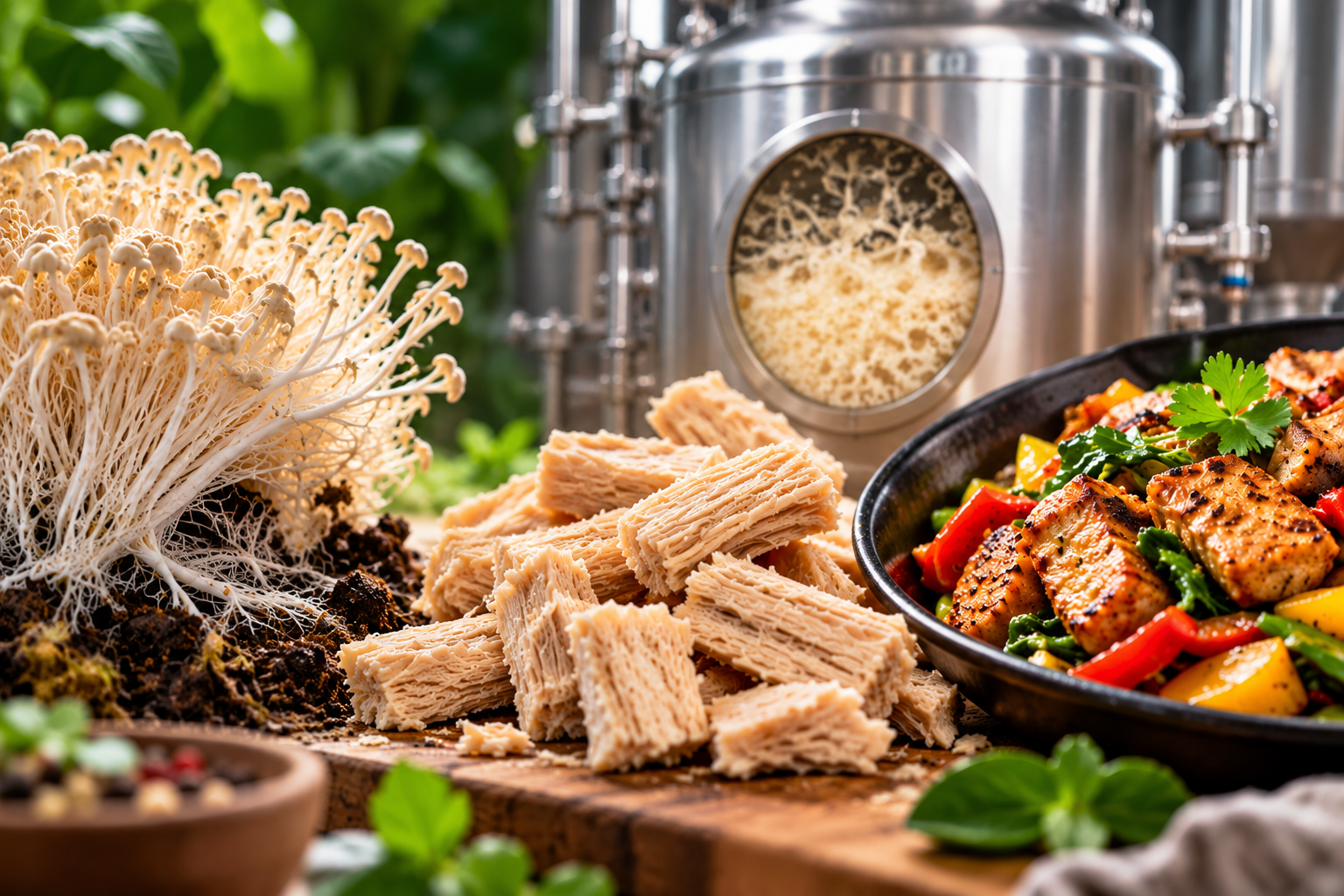
One important difference is texture. Fungal cells grow as thread-like structures called hyphae. When harvested and processed, these structures can contribute to a naturally fibrous texture, making mycoprotein useful in foods designed to resemble meat.
Where is mycoprotein used?
Mycoprotein can be used in products such as meat-free pieces, patties, mince-style ingredients, and other prepared foods. Its final texture and flavor depend on the fungal strain, production process, and ingredients added during formulation.
From a chef’s perspective, the ingredient is interesting because it offers more than protein alone. Its structure can help create a satisfying bite, while seasoning and cooking methods influence the final eating experience.
The key takeaway: Mycoprotein is a fungal food ingredient produced using fermentation. It is neither conventional mushroom meat nor plant protein, and its fibrous structure makes it useful for developing a range of meat-free foods.
II. How Is Mycoprotein Made? The Science of Fermentation
Mycoprotein production starts with a carefully selected fungal strain and a controlled growing environment. Instead of growing a crop in a field or raising livestock, manufacturers use fermentation to produce fungal biomass that can be processed into a food ingredient.
Step 1: Selecting the fungal strain
Manufacturers choose a suitable fungal species with characteristics that support food production. The strain must be appropriate for the intended use, and its production process must meet applicable food-safety requirements.
Step 2: Providing nutrients for growth
The selected fungus receives nutrients that support its growth, often including a carbohydrate source and other essential nutrients. The exact formulation depends on the organism and the manufacturing process.
Step 3: Growing the fungus through fermentation
In commercial production, the fungus can be cultivated in large fermentation vessels under monitored conditions. Factors such as temperature, oxygen supply, pH, and nutrient availability can influence growth and the properties of the resulting biomass.
The fungal cells grow and form thread-like structures called hyphae. As the biomass develops, these structures contribute to the fibrous texture that makes mycoprotein useful in food formulation.
Step 4: Harvesting and processing the biomass
Once sufficient biomass has been produced, it is separated from the fermentation medium and processed for food use. Depending on the product, processing may include heat treatment, moisture adjustment, blending, and texturization.
These steps help manufacturers develop ingredients with suitable texture, consistency, and functional properties.
Step 5: Formulating the final food
The processed mycoprotein can be combined with other ingredients, seasonings, fats, and binding agents to create products such as meat-free pieces, mince-style foods, and patties.
The final nutritional profile, flavor, and texture depend on the formulation, not just the fungal biomass itself.
The chef’s perspective: Fermentation produces the ingredient, but processing and formulation determine how it performs in the kitchen. For food developers, consistency, moisture retention, seasoning, and cooking behavior are just as important as the protein content.
III. Mycoprotein Nutrition: Protein, Fiber, and What to Check on the Label
Mycoprotein is interesting not only because of its meat-like texture but also because it can contribute protein and dietary fiber to the diet. However, its nutritional value varies with the fungal ingredient, manufacturing process, and final product formulation.
For consumers, the best approach is to look beyond the front of the package and check the nutrition information.
1. Protein content
Mycoprotein can be a useful protein source in meat-free foods. Protein helps the body build and maintain tissues and supports many essential functions.
However, protein content varies between products. A plain mycoprotein ingredient and a prepared meat-free nugget may have very different nutritional profiles because of added starches, oils, coatings, and other ingredients.
2. Dietary fiber
Fungal cell structures contain components that can contribute dietary fiber. Some mycoprotein products therefore provide fiber alongside protein.
The amount depends on the ingredient and processing method. Check the nutrition label rather than assuming that every mycoprotein product is high in fiber.
3. Fat, saturated fat, and sodium
A mycoprotein-based product is not automatically low in fat, saturated fat, or sodium. These values can be influenced by added oils, seasonings, sauces, breading, and cooking methods.
For example, a breaded product that is deep-fried may have a different nutritional profile from a simply seasoned product prepared with less added oil.
4. Vitamins and minerals
The vitamin and mineral content of mycoprotein products can vary. Some nutrients may be present naturally, while others may be added during formulation.
If you’re choosing mycoprotein as a regular protein source, check the label for the nutrients that matter to your overall diet instead of relying on broad claims such as “nutritious” or “high protein.”
5. Allergies and individual tolerance
Mycoprotein is not suitable for everyone. Some people have reported allergic reactions to mycoprotein products, so anyone with a history of relevant food allergies should check product information carefully and follow appropriate medical advice.
Always read the ingredient and allergen statements, particularly for prepared products that may contain wheat, soy, milk, egg, or other allergens in addition to the fungal ingredient.
The chef’s perspective: Treat mycoprotein like any other food ingredient. Evaluate its protein and fiber content, check the full ingredient list, and consider how the product is prepared. The name of the main ingredient alone cannot tell you whether the finished dish is nutritionally balanced.
IV. How Does Mycoprotein Compare With Meat and Plant-Based Protein?
Mycoprotein offers another option in the growing range of protein-rich foods, but how does it compare with chicken, beef, soy, and pea protein?
The answer depends on the specific product. Protein content, fiber, fat, sodium, processing, and preparation methods all influence the final nutritional profile.
Mycoprotein vs. meat
Chicken and beef provide complete protein, meaning they contain all nine essential amino acids. Mycoprotein can also provide high-quality protein, but its nutritional composition differs from animal protein.
Meat naturally provides nutrients such as vitamin B12, iron, and zinc, although the amounts vary by meat type. A mycoprotein product may provide some nutrients but should not automatically be assumed to replace every nutrient found in meat.
Mycoprotein vs. soy and pea protein
Soy and pea proteins are derived from plants, while mycoprotein comes from fungi. All three can be used in meat-free food products, but their texture and functional properties differ.
Soy protein is widely used in tofu, textured vegetable protein, and meat alternatives. Pea protein is common in plant-based burgers and protein formulations. Mycoprotein’s naturally fibrous structure can make it particularly useful when a product needs a meat-like bite.
A practical comparison
| Feature | Mycoprotein | Meat | Soy or pea protein |
|---|---|---|---|
| Source | Fungi | Animals | Plants |
| Protein content | Varies by product | Varies by meat and cut | Varies by ingredient and product |
| Dietary fiber | Can provide fiber | Contains no dietary fiber | Depends on the ingredient and processing |
| Texture | Can be naturally fibrous | Depends on the cut and cooking. | Depends on processing and formulation |
| Nutritional profile | Product-dependent | Product-dependent | Product-dependent |
Which option is best?
There is no single best protein source for everyone. The right choice depends on dietary needs, personal preferences, cost, availability, and how the food fits into the overall diet.
For food manufacturers, the decision also involves taste, texture, cooking performance, ingredient cost, and consumer acceptance.
The chef’s perspective: Don’t choose a protein ingredient based on its category alone. Compare the nutrition labels, understand its cooking behaviour and evaluate the finished dish. A well-formulated product should deliver on taste, texture and nutritional value, not just a headline protein claim.
For another look at emerging food and nutrition trends, explore our article on chia seeds and their nutritional uses: https://chefrbskitchen.com/chia-seeds-in-water-for-weight-loss/
V. How Chefs and Food Manufacturers Can Use Mycoprotein
Mycoprotein is more than a meat alternative. For chefs and food developers, it is an ingredient that can be shaped into different formats, seasoned for different cuisines and incorporated into products designed around texture, flavour and convenience.
The key is understanding how it behaves during preparation and cooking, rather than treating it exactly like chicken, beef or plant protein.
1. Build texture into the product
Mycoprotein’s naturally fibrous structure makes it useful for products such as meat-free strips, chunks, mince-style fillings and patties. However, the final bite depends on the fungal ingredient, processing method and other ingredients used in the formulation.
Food scientists have explored how heating, binding ingredients, pressing and freezing can influence the structure of mycoprotein-based foods. A detailed review in the Annual Review of Food Science and Technology explains how fungal fibres and processing work together to create meat-like textures. Read the scientific review of mycoprotein production and food applications.
2. Choose cooking methods that suit the product
Mycoprotein products do not all behave identically during cooking. Some are designed for pan-frying, baking or grilling, while others are formulated for sauces, fillings or ready meals.
For chefs, the important checks include:
- Moisture retention during cooking
- Browning and surface texture
- Seasoning absorption and flavour balance
- Shape retention and bite
- Cooking instructions and food-safety requirements
Always follow the manufacturer’s preparation instructions for commercial products. Do not assume that a mycoprotein product can be cooked exactly like a piece of chicken or beef.
3. Use seasoning to create different flavour profiles
Mycoprotein can be incorporated into dishes inspired by different cuisines. Garlic, herbs, spices, marinades and sauces can help build the intended flavour profile.
For example, seasoned mycoprotein pieces could be developed for wraps, grain bowls, curries or stir-fries. The result will depend on the product’s formulation and its ability to retain moisture and flavour during cooking.
4. Consider it for convenient food products
Food manufacturers can explore mycoprotein in frozen meals, prepared fillings, meat-free patties and other convenience foods. Its suitability depends on processing requirements, storage conditions, cost, consumer preferences and local regulatory approval.
Before launching a product, developers should evaluate sensory quality, nutritional composition, allergen information, shelf life and performance after storage and reheating.
5. Check food safety and allergens
Mycoprotein must be produced and handled under appropriate food-safety controls. The finished product also needs accurate ingredient and allergen information because formulations may contain additional ingredients, including potential allergens.
Research reviews identify allergenicity and other processing-related safety considerations as important areas for the mycoprotein industry. See this review of mycoprotein’s nutritional, sensory and technological properties.
The chef’s perspective: An innovative protein only works when the finished food delivers consistent flavour, texture, safety and value. Test it in the actual dish you plan to serve, rather than judging the ingredient on its own.
VI. Is Mycoprotein Sustainable, and What Are Its Limitations?
Mycoprotein is attracting attention as an alternative protein partly because it can be produced through fermentation in controlled facilities. But whether it is a more sustainable choice depends on how it is manufactured, what resources it uses and which food it replaces.
For food businesses, sustainability should be assessed alongside nutrition, cost, food safety and consumer acceptance.
1. Potential environmental advantages
Mycoprotein is produced through fermentation, which can produce substantial quantities of fungal biomass in controlled facilities. Depending on the production system, this approach may require less agricultural land than conventional livestock production.
A 2019 scientific review of mycoprotein’s environmental impact discussed its potential as a meat alternative while highlighting the need for further research and improved production methods.
More recent research comparing mycoprotein-based and plant-based meat alternatives has also found promising results for greenhouse gas emissions, although comparisons depend on the products and methods assessed. Read the 2024 systematic review of environmental impacts.
2. Energy and raw materials still matter
Fermentation requires suitable nutrients, controlled conditions and processing equipment. Industrial production may also require energy for aeration, temperature control, harvesting and downstream processing.
The choice of feedstock matters, too. Researchers are investigating whether suitable agricultural by-products and other lower-cost raw materials can help improve resource efficiency. However, these approaches must meet the quality and safety requirements for food production.
3. Cost and availability can be barriers
Mycoprotein production requires specialised facilities and controlled manufacturing processes. These requirements can affect product costs, particularly in markets where manufacturing capacity and distribution networks are limited.
For food businesses, the practical questions include ingredient price, minimum order quantities, cold-chain requirements, supplier reliability and customer willingness to pay.
4. Sustainability depends on the comparison
Mycoprotein should not automatically be described as the most sustainable protein in every situation. Environmental assessments depend on factors such as the production system, energy source, raw materials, product formulation and the food being replaced.
Comparing a mycoprotein product with beef may produce a different result from comparing it with beans, lentils or another plant-based food. A fair assessment should use comparable products and transparent life-cycle data.
5. Allergies and consumer acceptance remain important
Sustainability alone does not determine whether an ingredient is suitable for everyone. Mycoprotein can cause allergic reactions in some individuals, although reported reactions are uncommon in the available literature. People with relevant food allergies should check product labels and seek appropriate medical advice.
Texture, flavour, familiarity and price also influence consumer acceptance. Even a promising ingredient must deliver a satisfying eating experience if it is to become a regular part of people’s diets.
The chef’s perspective: Mycoprotein is a promising addition to the alternative-protein landscape, but it is not a magic solution. Its long-term value depends on efficient production, responsible sourcing, reliable food safety and products that people genuinely enjoy eating.
VII. The Future of Mycoprotein in the Food Industry
Mycoprotein could play a bigger role in the future of food as manufacturers look for new protein sources that offer good texture, nutritional value and efficient production. However, its success will depend on more than simply producing protein from fungi. Taste, affordability, food safety and consumer acceptance will all influence how widely it is used.
One promising area is fermentation technology. Improvements in fermentation equipment, strain selection and processing may help manufacturers produce mycoprotein more efficiently and develop ingredients with different textures and functional properties. Researchers are also exploring ways to use agricultural residues as fermentation feedstocks, although these approaches must meet strict food safety and quality requirements.
A 2024 review of mycoprotein production and nutritional aspects discusses the science behind this emerging food ingredient and the factors that influence its nutritional and technological properties.
Where could mycoprotein be used next?
- Ready-to-eat meals: Protein-rich fillings, prepared dishes and convenient meal components.
- Alternative meat products: Mince, strips, patties and other foods designed to deliver a fibrous texture.
- Hybrid foods: Products combining fungal protein with vegetables, legumes or other protein sources.
- Foodservice and catering: Ingredients that can be evaluated for consistency, cooking performance and portion control.
- New fermentation-based ingredients: Research into different fungal strains and production methods could broaden the range of available food ingredients.
From a chef’s perspective, the opportunity is exciting, but every new ingredient must prove itself in the kitchen. It needs to taste good, cook consistently, fit the menu’s price point and meet the nutritional and dietary needs of the intended customer.
Mycoprotein is not a replacement for every traditional protein source, nor is every mycoprotein product automatically healthier or more sustainable. Its long-term value will depend on how responsibly it is produced and how well it performs in real food applications.
The key takeaway: Mycoprotein demonstrates how fermentation can turn microorganisms into useful food ingredients. As research and manufacturing develop, it may become a more familiar option in the expanding alternative-protein market.
VIII. Frequently Asked Questions About Mycoprotein
Is mycoprotein a plant-based protein?
No. Mycoprotein is made from fungi through fermentation. Although it is commonly used in meat-free foods, it is biologically different from plant proteins such as soy and pea protein.
Is mycoprotein the same as mushrooms?
No. Mycoprotein is produced by growing selected fungi under controlled conditions. It is not simply made by chopping or processing ordinary edible mushrooms.
Is mycoprotein a good source of protein?
It can be a useful protein source, but the amount varies by product. Check the nutrition label for protein per serving, fibre, sodium, saturated fat and other ingredients.
Can mycoprotein cause allergies?
Yes, some people may experience allergic reactions or intolerance. Anyone with a known fungal or mould allergy should be cautious and seek appropriate medical advice. Always check the product’s allergen information, as other ingredients may also contain allergens.
Is mycoprotein healthier than chicken or soy?
Not automatically. Chicken, soy and mycoprotein have different nutritional profiles. The best comparison depends on protein content, fibre, fat, sodium, micronutrients, portion size and how the food is prepared.
Is mycoprotein sustainable?
It may offer environmental advantages in some production systems, but the impact depends on energy use, ingredients, processing and the food being replaced. A fair comparison requires life-cycle assessment rather than assumptions based on the protein source alone.
How can chefs use mycoprotein?
Depending on the product, chefs can use it in meat-free curries, wraps, stir-fries, grain bowls, patties and prepared meals. Follow the manufacturer’s cooking instructions and evaluate flavour, texture, moisture retention and allergen requirements before adding it to a menu.
IX. Conclusion: Is Mycoprotein Worth Watching?
Mycoprotein shows how food science can create new protein ingredients by using fungi and controlled fermentation. Its fibrous texture, protein content and versatility make it an interesting option for meat-free products and innovative food development.
However, understanding the ingredient is just as important as understanding its potential. Nutritional value varies between products, sustainability depends on production methods, and allergen considerations should never be overlooked.
From a chef’s perspective, mycoprotein deserves attention because it connects fermentation science with practical food applications. Its future will depend on whether manufacturers can deliver products that are safe, affordable, nutritious and enjoyable to eat.
As alternative proteins continue to evolve, mycoprotein offers a valuable example of how science and culinary creativity can work together to expand the possibilities of modern food.