Freeze-Dried Candy: Why Does Candy Suddenly Turn Crunchy?
Take a chewy piece of candy, remove most of its water, and something surprising can happen.
It can become light, airy, and incredibly crunchy.
That strange transformation is exactly why freeze-dried candy has become so popular. A familiar sweet suddenly gets a completely different texture, and sometimes the flavor feels more intense too.
But this isn’t just a social media trick.
There is some interesting food science behind that crunch.
Chef RBS Tip: Whenever a food changes dramatically in texture, look at what happened to its water. Water often has a much bigger role in food texture than we realize.
1. What Actually Happens to the Candy?
The big change happens when the candy is frozen and placed under a strong vacuum.
Instead of simply melting away, much of the frozen water changes directly from ice into vapor. This process is called sublimation.
As the water leaves, the candy’s original structure is left behind in a much drier form.
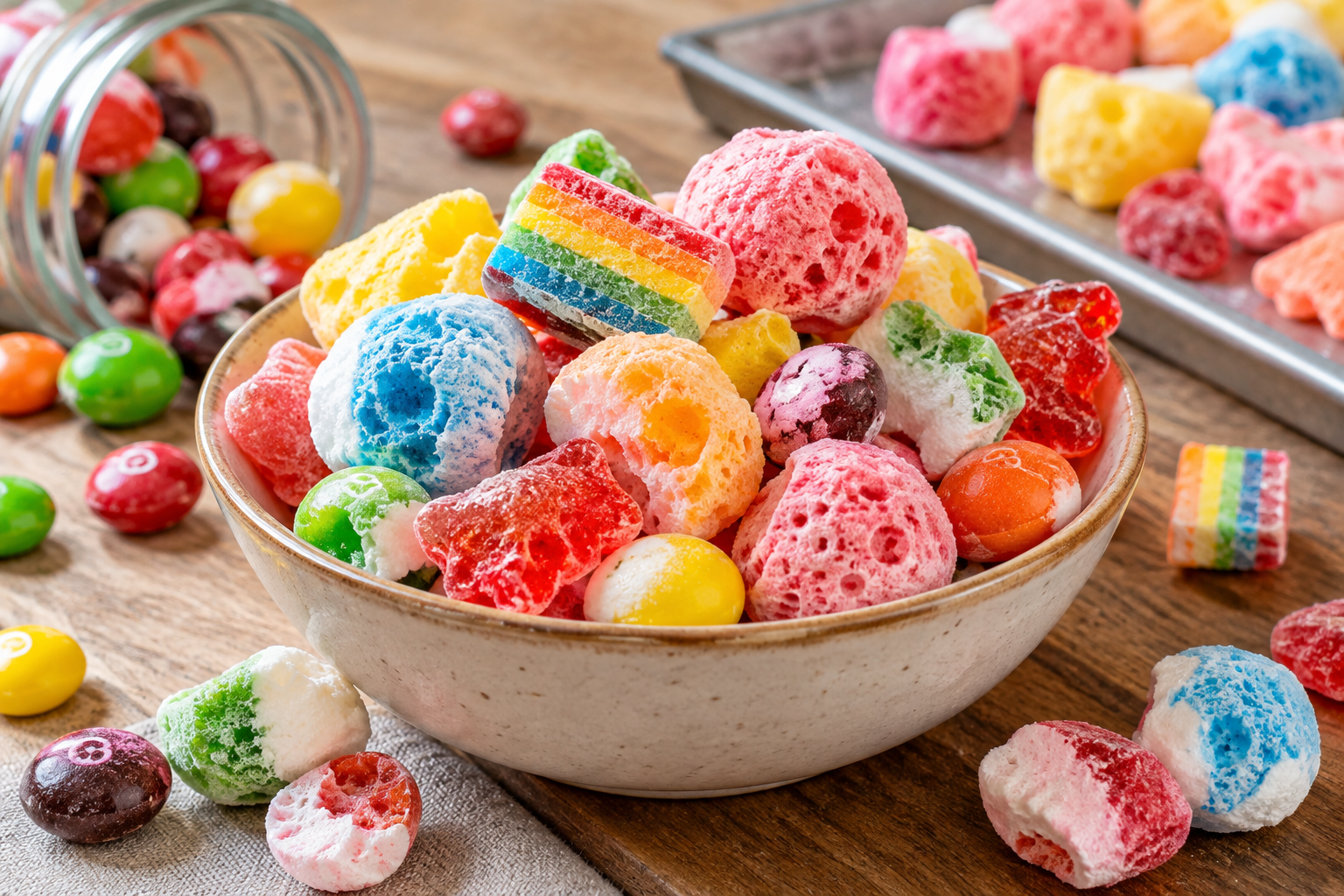
That can create tiny spaces and a lighter structure, which is why some candies become puffy, brittle, and easy to crush.
The candy hasn’t suddenly gained a new ingredient.
A lot of the change comes from taking something away: water.
Chef RBS Tip: When testing freeze-dried foods, compare the same candy before and after processing. The difference in weight, texture, and how quickly it breaks can tell you a lot about what water was doing inside the food.
2. Why Does It Become So Crunchy?
Think about the difference between a chewy candy and a cracker.
One holds more moisture. The other is much drier and breaks easily.
Freeze-drying pushes candy toward that second type of texture. As water is removed, the structure becomes dry, fragile, and brittle.
That is why the bite can change from soft or chewy to a sharp, satisfying crunch.
The interesting part is that the candy’s flavor doesn’t simply disappear with the water. Because much of the water is removed while the solids remain, the finished piece can taste surprisingly intense.
Chef RBS Tip: In food science, texture is often a story about water. Change the water, and you can completely change how the same ingredient feels in your mouth.
3. Why Does Freeze-Dried Candy Taste So Strong?
There is another reason freeze-dried candy feels different: the flavor can seem much more concentrated.
When water is removed, the sugars, acids, flavors, and other dissolved solids remain. You are eating roughly the same ingredients in a much drier, lighter structure.
That can make each bite feel more intense.
There is also a texture effect. A crunchy candy breaks apart quickly in your mouth, exposing more of its surface and changing how the flavor is released.
So the experience is not just about sweetness.
It is flavor + texture + the way the candy breaks down.
Chef RBS Tip: When tasting a freeze-dried product, don’t judge only the first bite. Notice how quickly it dissolves, how the flavor changes as it breaks, and how long the aftertaste stays.
4. Does Every Candy Freeze-Dry the Same Way?
Not at all.
This is one of the fun parts of freeze-dried candy. Different candies can react very differently to the same process.
Candies with different amounts of sugar, moisture, fats, and other ingredients can develop completely different textures.
Some may puff dramatically. Others may become light and crisp. Some can keep much of their original shape but turn brittle.
The final result depends on both the candy formulation and the freeze-drying process.
That is why freeze-drying candy is not simply a matter of putting any sweet into a machine and expecting the same result.
Chef RBS Tip: If you are experimenting with candy, test small batches first. Record the candy type, starting weight, and final weight. That simple record can help you understand how each formulation behaves.
5. Why Is Freeze-Dried Candy So Popular Right Now?
Part of the attraction is simple: people love seeing familiar food behave in an unfamiliar way.
A normal gummy or chewy candy is soft. Freeze-dry it, and suddenly it can become airy, brittle, and crunchy.
That transformation makes the process highly visual, which is one reason freeze-dried candy has found a natural home on short-form video and social media.
But the trend isn’t only about watching candy change.
People are also curious about the new texture and eating experience. A familiar sweet becomes something that feels almost like a completely different snack.
Chef RBS Tip: The strongest food trends often combine three things: something familiar, something surprising, and something people can easily share. Freeze-dried candy has all three.
6. Is Freeze-Dried Candy Still the Same Candy?
In terms of ingredients, often yes.
The candy’s basic sugars, flavors, and other solids are still there. What changes dramatically is the physical structure.
Removing much of the water can turn a soft, chewy sweet into something light and brittle.
That is an important idea in food science: the ingredients don’t always need to change for the eating experience to change.
The same candy can feel completely different simply because its moisture and structure have changed.
Chef RBS Tip: When you see a dramatic texture change in food, don’t immediately look for a new ingredient. Sometimes the biggest change comes from how the existing ingredients are processed.
7. Does Freeze-Drying Make Candy Healthier?
Here is where we need to separate texture from nutrition.
Freeze-drying can dramatically change how candy looks and feels, but it does not magically turn candy into a healthy food.
Most of the sugar and other solids are still present after the water is removed.
Because the finished candy is lighter, it can also be easy to forget how much candy you are actually eating.
So think of freeze-dried candy as a different way to experience candy, not a healthier version of it.
Chef RBS Tip: A new texture does not automatically mean a better nutritional profile. Always look at the ingredients and nutrition information, not just the processing method.
8. Chef RBS Kitchen Takeaway
Freeze-dried candy is a great example of how food science can completely change the eating experience.
The candy doesn’t need to become a different food.
Remove much of its water, change its structure, and suddenly a chewy sweet can become light, brittle, and crunchy.
That is what makes this trend more interesting to me than simply calling it a viral snack.
It shows how processing can transform texture without completely changing the ingredients.
Chef RBS Tip: Next time you see a food trend that looks unusual, ask one simple question: “What happened to the water?” You may be surprised by the answer.
9. The Crunch Behind the Trend
Freeze-dried candy looks like a completely different treat, but the science behind it is surprisingly simple.
Remove much of the water, change the structure, and the texture can change dramatically.
That is why a soft or chewy candy can become light, brittle, and crunchy.
For me, that’s the interesting part of this trend. It isn’t just about viral candy. It is a simple example of how food processing can change the way we experience familiar food.
And sometimes, the best food-science question is also the simplest:
What happened to the water?
10. Freeze-Dried Candy FAQ
What is freeze-dried candy?
It is candy that has been processed through freeze-drying, where frozen water is removed under vacuum, leaving a much drier structure.
Why does freeze-dried candy become crunchy?
Removing much of the water makes the candy lighter, drier, and more brittle, which can create a crunchy texture.
Does freeze-dried candy taste stronger?
It can seem more intense because much of the water is removed while many of the sugars, acids, and flavor compounds remain.
Can every candy be freeze-dried?
Different candies behave differently. Their sugar, moisture, fat, and other ingredients can affect the final texture and appearance.
Is freeze-dried candy healthier than regular candy?
Not automatically. Freeze-drying changes texture and moisture, but it does not remove the sugar already present in the candy.
Why is freeze-dried candy trending?
Its dramatic transformation makes it highly visual and interesting for short-form video, while the unusual crunchy texture gives people a new way to experience familiar candy.