PFAS in Food Packaging: What Chefs and Consumers Need to Know
Think about the last time you bought a burger, takeaway pizza, or a bag of fries. The food may have been wrapped in paper designed to resist grease, keeping oil from soaking through your hands or the packaging. It seems like a small detail, but the materials that touch our food deserve more attention than they usually get.
One group of chemicals behind this discussion is PFAS, often called forever chemicals because many of them break down very slowly in the environment. Certain PFAS have been used in products that need resistance to grease, water, or stains, including some food-contact packaging.
As a chef, I look at packaging from more than one angle. It must protect the food, maintain quality, work during service, and meet food-safety requirements. But convenience alone is not enough. We also need to understand what materials are used and what the scientific evidence tells us about potential risks.
The situation is changing, too. In the United States, the FDA announced that PFAS-containing grease-proofing agents are no longer being sold for food-contact use in the U.S. market, following the industry’s phase-out and the end of the relevant authorizations in 2025. That is an important development, but it does not mean every food package everywhere is PFAS-free.
In this guide, we’ll break down what PFAS are, why they have been used in food packaging, what scientists know about possible exposure, and how consumers and food businesses can make more informed choices without unnecessary fear.
I. What Are PFAS, and Why Have They Been Used in Food Packaging?
PFAS stands for per- and polyfluoroalkyl substances, a large group of human-made chemicals used in various industrial and consumer applications. Many PFAS are valued for their ability to resist heat, water, oil, and grease. However, some can persist in the environment for a long time, which is why they are often called forever chemicals.
Why are PFAS used in food packaging?
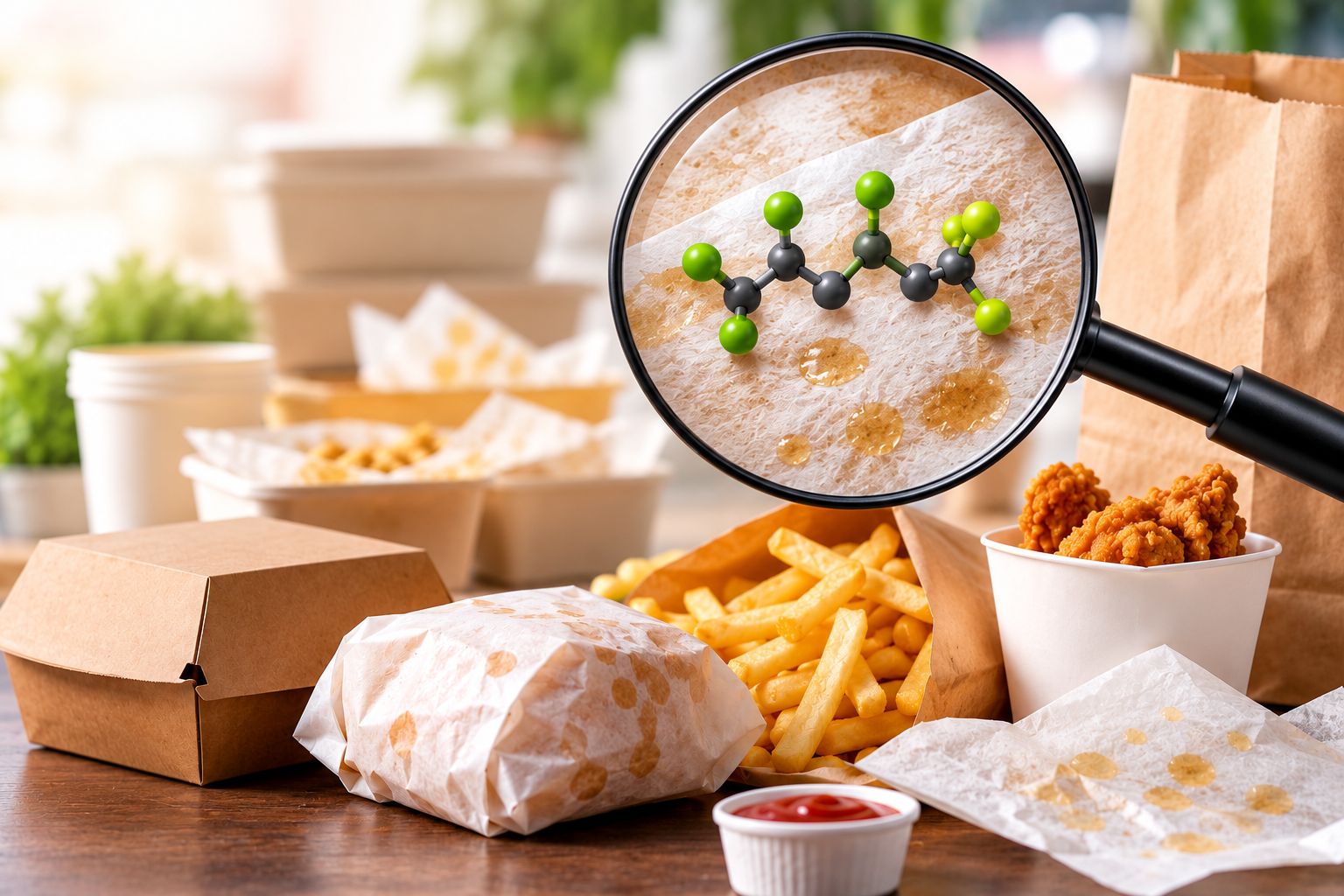
Certain PFAS have been used to make food-contact materials more resistant to grease and oil. This property can be useful when packaging foods such as burgers, fried chicken, French fries, pastries, and other oily takeaway items.
Common examples of packaging where grease resistance matters include:
- Fast-food wrappers: designed to help prevent oil from soaking through.
- Paper bags and food liners: used for fried foods and greasy snacks.
- Grease-resistant paperboard: used in some food boxes and containers.
However, not every wrapper, paper bag, or takeaway box contains PFAS. Packaging materials and treatments vary by manufacturer, product, and market.
What makes PFAS a concern?
The main concern is that certain PFAS can remain in the environment for extended periods. Some have also been associated with health effects, depending on the specific chemical and the level and duration of exposure. Scientists continue to study this broad chemical group, and different PFAS should not automatically be treated as having identical risks.
For food businesses, this creates an important responsibility: packaging must do its job without overlooking chemical safety, supplier transparency, or applicable regulations.
The chef’s perspective: Grease resistance is useful, but it should never be the only factor when choosing food packaging. Material specifications, food-contact compliance, and reliable supplier information matter just as much.
II. How Can PFAS Enter Food, and What Does the Science Say About Exposure?
PFAS exposure can happen through several routes, including food, drinking water, and the environment. Food packaging is one potential source, but it is important to understand that not all food packaged in grease-resistant paper contains PFAS, and packaging is not the only source of exposure.
For more information, explore our guide to food preservation and the role it plays in maintaining food quality and safety.
Can PFAS migrate from packaging into food?
Under certain conditions, chemicals in food-contact materials can transfer into the food they touch. This process is known as migration. Whether migration occurs and how much may transfer depends on factors such as the chemical involved, the packaging material, contact time and temperature, and the type of food.
For PFAS-treated packaging, the possibility of transfer has been an area of scientific and regulatory attention. However, the presence of a chemical in a material does not automatically tell us how much reaches the food or what risk that exposure creates.
What are scientists concerned about?
Research on certain PFAS has linked exposure to possible health effects, including changes in cholesterol levels, reduced antibody responses to some vaccines, and effects on the liver. Evidence varies by specific PFAS, exposure level, and the health outcome being studied.
It is also important to separate hazard from risk. A hazard is a substance’s potential to cause harm; risk considers the likelihood of harm under particular exposure conditions. Understanding real-world risk requires evidence about the chemical, the amount of exposure, and how long exposure occurs.
What does this mean for consumers?
There is no need to panic over a single takeaway meal. A more useful approach is to stay informed, follow reliable food-safety guidance, and support businesses that choose packaging carefully.
For food operators, the practical priority is to obtain clear food-contact material specifications from suppliers and check that packaging complies with the regulations in the market where it is sold.
The chef’s perspective: Food safety is about managing risks using evidence, not creating fear. We should take chemical exposure seriously while being careful not to claim that every food wrapper is dangerous.
III. How U.S. Regulations on PFAS in Food Packaging Are Changing
The United States has taken an important step to reduce PFAS exposure from certain types of food packaging. The U.S. Food and Drug Administration (FDA) worked with manufacturers to phase out PFAS-containing grease-proofing substances used on paper and paperboard food packaging.
What changed, and when?
- February 2024: The FDA announced that manufacturers were no longer selling PFAS-containing grease-proofing substances for food-contact use in the U.S. market. This followed the completion of a voluntary industry phase-out.
- January 2025: The FDA determined that 35 food-contact notifications covering these PFAS uses were no longer effective.
- June 30, 2025: The FDA set a compliance date for certain existing food packaging stocks produced, supplied, or used before the authorizations became ineffective.
These steps addressed a specific use of PFAS in grease-resistant paper and paperboard packaging. They should not be interpreted as a ban on every PFAS chemical in every food-contact application. <Entity value=”U.S. Food and Drug Administration” category=”organization”/> provides the regulatory details in its official PFAS food-packaging update.
Does this mean all food packaging in the U.S. is PFAS-free?
No. The phase-out eliminated a major source of potential dietary exposure from authorized food-contact uses, but it does not prove that every package on the market is free from PFAS. Packaging can vary, and PFAS may enter the environment through other sources.
The FDA continues to evaluate food chemicals and monitor relevant food-contact materials. Its regulatory actions also distinguish between different PFAS substances and uses, rather than treating every chemical in the group as identical.
What should food businesses do?
For restaurants, takeaway outlets, and food manufacturers, the practical approach is to:
- Ask packaging suppliers for current food-contact compliance documentation.
- Request information about grease-resistant coatings and whether PFAS are intentionally added.
- Review packaging specifications when changing suppliers or products.
- Check the regulations that apply in every market where the business operates.
Businesses serving customers outside the United States should not assume that U.S. regulatory changes automatically apply in their own country.
The chef’s perspective: Good packaging decisions should balance food protection, service performance, environmental responsibility, and chemical safety. Clear supplier documentation is more useful than relying on a package’s appearance or marketing claims alone.
IV. How to Choose Food Packaging With PFAS in Mind
Choosing food packaging is not just about price, appearance, or convenience. For restaurants, takeaway businesses, and food manufacturers, the material must protect the food, perform reliably during service, and meet applicable food-contact requirements.
Consumers can also make more informed choices by looking beyond labels and marketing claims.
1. Ask suppliers clear questions.
If you operate a restaurant, café, or takeaway business, ask your packaging supplier whether PFAS are intentionally added to the product, particularly when buying grease-resistant paper or paperboard.
Request written specifications and food-contact compliance documentation. A supplier’s clear, verifiable answer is more useful than a general claim that the packaging is safe or environmentally friendly.
2. Be careful with vague packaging claims.
Words such as “natural,” “eco-friendly,” and “sustainable” do not automatically mean that a product is PFAS-free.
If PFAS avoidance is a purchasing requirement, look for specific supporting documentation rather than relying on promotional language alone. Also remember that “PFAS-free” claims may have different meanings depending on the test method, substances covered, and applicable standards.
3. Consider the food and the way it will be served.
Hot, oily foods place particular demands on packaging. A material that works well for a dry pastry may not perform equally well with freshly fried food.
Choose packaging designed for the intended food and its service conditions. Confirm that it is suitable for the expected temperature, contact time, and food type. Do not replace a suitable food-contact material with an unverified alternative simply because it is marketed as chemical-free.
4. Evaluate alternatives before making a switch
Paper, cardboard, reusable containers and other packaging options each have advantages and limitations. Their suitability depends on the coating, construction, intended use, cleaning requirements and local waste-management systems.
For food businesses, test alternatives for grease resistance, leakage, heat tolerance, product quality and service practicality. Environmental benefits should also be assessed in context rather than assumed from the material’s appearance.
5. Follow the rules in your market
Food-contact requirements differ between countries and can change over time. A package that meets one market’s requirements may not automatically satisfy another market’s rules.
For businesses operating internationally, review local regulations and maintain updated supplier records. For U.S. requirements, consult the FDA’s official information on PFAS in food packaging.
The chef’s perspective: The best packaging is one that protects the food, performs consistently and meets food-contact requirements, while reducing avoidable chemical and environmental concerns. Smart purchasing starts with evidence, not assumptions.
V. Common Myths About PFAS and Food Packaging
PFAS can be a complicated topic because the chemicals, their uses and the available evidence vary. Let’s separate some common misconceptions from what we can reasonably conclude.
Myth 1: All takeaway food packaging contains PFAS
Fact: Not all food packaging contains PFAS. Their use has depended on the material, product and intended function. Some grease-resistant paper and paperboard products were made using PFAS-containing substances, but packaging should not be judged by appearance alone.
Myth 2: Every PFAS chemical has the same health effects
Fact: PFAS is a broad group of chemicals with different properties and levels of scientific evidence. Some specific PFAS have been associated with adverse health effects, but those findings should not automatically be applied identically to every substance in the group.
Myth 3: One takeaway meal means you have been harmed
Fact: A single meal does not establish that harmful exposure occurred or that health effects will follow. Risk depends on factors such as the chemical involved, the amount of exposure and its duration. The more useful approach is to reduce avoidable exposure where practical rather than panic over individual meals.
Myth 4: Paper packaging is always safer than plastic
Fact: The material alone does not tell the whole story. Paper may contain coatings or treatments, while different plastics have their own food-contact requirements. Safety depends on the specific material, its composition and whether it is suitable for the food and conditions of use.
Myth 5: The U.S. phase-out means PFAS no longer exist in food packaging
Fact: The U.S. FDA’s action addressed particular PFAS-containing grease-proofing substances used in paper and paperboard food packaging. It does not establish that every food package worldwide is PFAS-free or that all possible sources of exposure have disappeared.
Myth 6: If packaging says “eco-friendly,” it must be PFAS-free
Fact: Environmental marketing claims do not necessarily confirm a product’s chemical composition. If avoiding PFAS is important, ask for specific supplier documentation and check what a product’s claims actually cover.
The chef’s perspective: Good food-safety decisions begin with accurate information. Understand the material, ask questions and follow reliable guidance instead of treating every package as either completely safe or automatically dangerous.
VI. The Bottom Line for Consumers and Food Businesses
PFAS in food packaging is an important food-safety and environmental topic, but it deserves a balanced approach. Certain PFAS have been used to make paper and paperboard packaging resistant to grease, and some PFAS have been linked to health concerns. At the same time, not every food wrapper contains these chemicals, and packaging-related exposure is only one possible source.
In the United States, the phase-out of specific PFAS-containing grease-proofing substances for food-contact use was an important step. However, consumers should not assume that every package everywhere is PFAS-free. Food-contact materials, regulations and supplier practices can vary between markets.
What can you do today?
- As a consumer: Stay informed, avoid relying on vague marketing claims and support businesses that take packaging safety seriously.
- As a chef or restaurant owner: Ask suppliers for clear material specifications, verify food-contact compliance and review packaging choices regularly.
- As a food manufacturer: Maintain supplier documentation, assess packaging for its intended use and monitor relevant regulatory changes.
The goal is not to fear every takeaway wrapper. It is to make informed choices, reduce avoidable exposure where practical and keep food safety at the centre of every decision.
At Chef RBS Kitchen, I believe good food knowledge should help people make better decisions, whether they are cooking at home, running a restaurant or developing food products. Understanding what touches our food is one small but meaningful part of that responsibility.
Because food safety doesn’t stop at the plate. It starts with every decision we make along the way.
Frequently Asked Questions About PFAS in Food Packaging
1. What does PFAS mean in food packaging?
PFAS stands for per- and polyfluoroalkyl substances, a large group of human-made chemicals. Certain PFAS have been used in food packaging to help paper and paperboard resist grease and oil.
2. Is PFAS in food packaging dangerous?
Some PFAS have been associated with adverse health effects, but risk depends on the specific chemical, the level of exposure and its duration. The presence of PFAS in a material does not automatically mean that a person has received a harmful dose.
3. Does all fast-food packaging contain PFAS?
No. Not all fast-food packaging contains PFAS. Materials and treatments vary by product and manufacturer, so appearance alone cannot confirm whether PFAS are present.
4. Has the United States banned PFAS in food packaging?
The U.S. FDA announced the phase-out of specific PFAS-containing grease-proofing substances used in paper and paperboard food packaging. This action does not mean that every PFAS chemical has been banned from every food-contact application.
5. How can I avoid PFAS in food packaging?
Ask manufacturers or suppliers for specific information about packaging materials and whether PFAS are intentionally added. Look for reliable documentation rather than relying solely on general claims such as “eco-friendly” or “chemical-free.”
6. Is paper packaging safer than plastic packaging?
Not automatically. Safety depends on the material’s composition, coatings, intended food contact and conditions of use. Both paper and plastic packaging should meet the applicable food-contact requirements.
7. Can PFAS move from packaging into food?
Under certain conditions, substances in food-contact materials can migrate into food. The extent of potential migration depends on factors such as the chemical, packaging material, food type, temperature and contact time.
8. Where can I find reliable information about PFAS in food packaging?
For U.S. regulatory information, consult the U.S. Food and Drug Administration’s official PFAS food-packaging update. It explains the phase-out of certain PFAS-containing grease-proofing substances used in food-contact packaging.