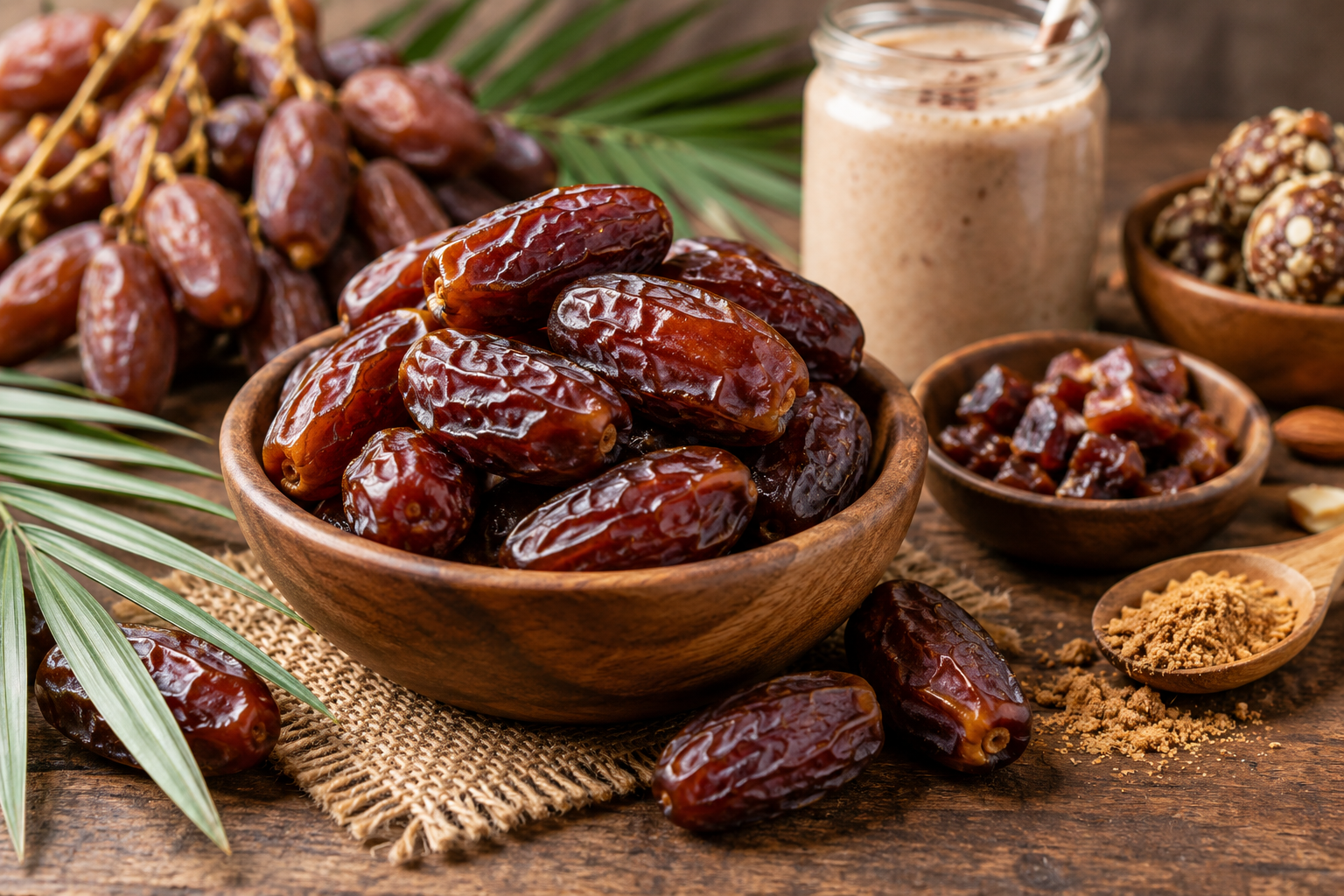
Why Dates Are Suddenly Everywhere in America in 2026
“The dates trend in 2026 is one of the most interesting food stories happening in America right now.”
Dates are showing up everywhere.
Not just in the dried-fruit section anymore. They are appearing in snack bars, candies, syrups, spreads, beverages, bakery products, and even chocolate treats.
And this is more than another social media food craze.
Dates are having a real moment in the U.S. food market. Recent industry reporting shows strong growth in date-based products, while food companies are finding new ways to use the fruit as a sweet ingredient, a snack, and even a functional part of a recipe.
But here is the interesting part:
Dates are not new at all.
They have been eaten for thousands of years.
What is changing is the way America is using them.
Instead of simply eating a date as a dried fruit, food makers are turning it into pastes, powders, fillings, syrups, snack bars, candies, and new-style desserts.
So why are dates suddenly having such a big moment in 2026?
And are they really a better choice than refined sugar?
Let’s look at what is happening from a chef’s point of view, not just a food trend perspective.
Why are dates suddenly trending in America?
The interesting thing about the 2026 date trend is that it isn’t really about people suddenly discovering dates.
It is about what food companies are doing with them.
For years, most Americans knew dates mainly as a dried fruit. Now food makers are treating them more like an ingredient that can do several jobs at once.
A date can bring sweetness, texture, body, and fiber to a product. That makes it useful in everything from snack bars and chocolate treats to syrups, spreads, beverages, and baked goods. Industry observers saw this shift clearly at Natural Products Expo West 2026, where dates appeared across many different product categories.
There is another reason dates fit the current food market so well.
Consumers are increasingly looking for foods that feel simple and recognizable, while food companies are looking for ways to reduce or replace refined sugar in certain products without giving up sweetness.
That creates an interesting opportunity for the humble date.
Instead of asking:
“What artificial or highly processed sweetener can we add?”
A product developer can ask:
“Can we use the whole fruit instead?”
That doesn’t automatically make a product healthy. A date still contains sugar and calories. But it gives food manufacturers something refined sugar alone does not provide: the fruit itself, along with its fiber and other naturally occurring components.
And the numbers suggest this isn’t just a social media trend. Bon Appétit reported that date-related products were up 24.1% in conventional U.S. grocery channels through June 2026, citing SPINS point-of-sale data.
That is what makes the 2026 date trend interesting: the date isn’t changing. The way America uses it is.
What Are Food Companies Actually Making With Dates?
This is where the trend gets interesting.
Food companies are taking the same humble fruit and giving it completely different jobs.
1. Date Paste
Dates can be softened and blended into a thick paste. This gives food makers a naturally sweet ingredient that can also add body and moisture.
It can be used in energy bars, baked goods, fillings, and desserts.
2. Date Syrup
Dates can also be processed into a pourable syrup.
It works well in products where manufacturers want a sweet, caramel-like flavor and a recognizable fruit ingredient.
But there is an important point: date syrup is still a concentrated source of sugar. Calling it “natural” does not make it sugar-free.
3. Date-Based Snacks
This is probably the most visible part of the trend.
Dates are being combined with ingredients such as nuts, seeds, chocolate, coconut, and grains to create snack bites and bars.
The result can feel more like a treat than traditional dried fruit.
4. Date Confections
One of the biggest changes is happening in the candy aisle.
Dates are being used as the base for products designed to look and taste like familiar sweets, including chocolate-covered date snacks and date-based caramel-style treats.
This is clever food development.
The goal isn’t necessarily to make a date taste like a date.
The goal is to make the date work inside a completely new food experience.
5. Bakery and Dessert Ingredients
For chefs, dates are especially interesting because they bring more than sweetness.
They can contribute moisture, chewiness, color, flavor and texture.
That makes them useful in cakes, cookies, puddings, sauces and dessert fillings.
And this is an important lesson behind the entire trend:
A food trend becomes powerful when an ingredient can solve a problem for both consumers and food manufacturers.
Dates can do exactly that in many different applications.
Why Do Chefs and Food Developers Love Dates?
From a chef’s point of view, dates are interesting because they are not just a sweetener.
They can change several things in a recipe at the same time.
Sweetness
Dates contain naturally occurring sugars, which give them a strong sweetness that works especially well in desserts, snacks, and sauces.
Texture
This is one of their biggest advantages.
A soft date has a thick, sticky texture. When blended, it can help give a recipe body and chewiness without needing to rely entirely on syrups or other liquid sweeteners.
That is why date paste works so well in energy bites, bars, and fillings.
Moisture
Dates hold moisture, which can be useful in baked products.
A chef can use them to help create a softer, denser texture in certain recipes.
Flavor
Dates have their own character.
Depending on the variety and how they are processed, they can bring notes that remind people of caramel, brown sugar, honey, or dried fruit.
That gives a food developer another layer of flavor rather than simply adding sweetness.
Fiber
Unlike refined table sugar, a whole date naturally contains dietary fibre.
That distinction matters.
Whole dates and refined sugar are not nutritionally identical ingredients.
However, once dates are heavily processed or concentrated into products such as syrups, the nutritional picture can change. So we should look at the actual product rather than assuming that anything containing the word “date” is automatically healthier.
And this is perhaps the biggest reason I find the trend fascinating as a chef:
One ingredient can influence sweetness, texture, moisture, and flavor at the same time.
That is exactly the kind of ingredient food developers love.
Are Dates Actually Healthier Than Sugar?
This is where we need to be careful.
You will often see dates described as a “healthy alternative to sugar.” That sounds simple, but food science is a little more complicated.
A whole date is a fruit. It naturally contains sugars, but it also contains dietary fiber and other nutrients. USDA data lists Medjool dates as a source of dietary fiber.
Table sugar is different. It is essentially a refined sweetener without the fiber and other components found in the whole fruit.
So if you eat a whole date, you’re eating the whole food.
But there is an important catch.
Date syrup is not the same as eating a whole date.
When dates are turned into syrup, the ingredient becomes more concentrated and is used primarily for sweetness.
That means we shouldn’t automatically assume:
“Made with dates” = “healthy.”
A date-based cookie can still contain plenty of calories, sugar, and saturated fat. A chocolate snack made with dates is still a chocolate snack.
The better question is
What is the complete food made from, and how much are you eating?
This fits with the current U.S. Dietary Guidelines, which emphasize whole, nutritious foods while limiting added sugars and highly processed foods.
So, as a chef, I would put it this way:
Dates can be a valuable ingredient. They are not a magic health food.
The real advantage is that when you use the whole fruit, you get sweetness together with the fruit’s natural fiber and other components.
That is a much more useful way to understand the date trend than simply calling dates a “healthy sugar.”
Why Do Dates Work So Well With Chocolate and Caramel?
There is a simple reason dates fit so naturally into modern desserts:
Their flavor already feels familiar.
A good date has a deep sweetness with caramel-like and fruity notes. When you combine it with chocolate, nuts, or spices, those flavors can become even more pronounced.
Think about a chocolate-covered date.
The chocolate brings bitterness and richness.
The date brings sweetness and chewiness.
The combination creates contrast.
That contrast is something chefs use all the time.
Dates can also mimic the role of caramel.
When dates are blended with ingredients such as nut butter, a little salt, and other flavorings, they can create a thick, rich mixture with a caramel-like character.
It isn’t actually caramel.
Traditional caramel is made by heating sugar and developing new flavor compounds through caramelization. A blended date mixture gets its character from the fruit itself.
Same idea of indulgence. Completely different ingredient.
That’s one reason dates have become so interesting to modern food developers.
They can take an ingredient that consumers traditionally associate with dried fruit and turn it into something that feels like a dessert, candy or premium snack.
And from a chef’s perspective, that is a powerful food trend:
Take something familiar, change its format, and give people a completely new reason to eat it.
Which Dates Are Americans Actually Eating?
Not all dates are the same.
There are hundreds of date varieties grown around the world, but when you look at modern food products in the U.S., one name appears again and again:
Medjool dates
Medjool dates are large, soft, and naturally very sweet. Their soft texture makes them particularly easy to eat, stuff, blend, and process into pastes.
That matters to food companies.
A firm, dry ingredient can be difficult to turn into a smooth filling or snack base. A soft Medjool date can often be worked much more easily.
Deglet Noor is different.
Another familiar variety is Deglet Noor.
These dates are generally smaller and firmer, with a lighter texture and a more delicate sweetness.
They can work beautifully in cooking and baking, but they don’t have exactly the same soft, almost caramel-like eating experience that makes Medjool dates so popular in modern snack products.
Why does variety matter?
Imagine two apples.
Both are apples, but one might be crisp and tart while another is soft and sweet.
Dates are similar.
The variety changes the texture, sweetness, moisture and the way the fruit behaves in a recipe.
For food developers, that can make a big difference.
And as dates move from the dried-fruit aisle into snacks, desserts, beverages and packaged foods, choosing the right variety becomes part of product development rather than simply choosing a fruit.
That is another sign that this trend is becoming more sophisticated.
How Could the Date Trend Change Restaurants and Food Businesses?
This is where the trend becomes more than a grocery-store story.
For restaurants and food businesses, dates offer something valuable: one ingredient can be used across several parts of a menu.
A chef could use dates in:
- Breakfast bowls and oatmeal
- Smoothies and beverages
- Energy bites and snack bars
- Salad dressings and sauces
- Bakery products
- Desserts
- Stuffed dates as appetizers
- Date-based chutneys and glazes
That gives a food business an opportunity to create multiple menu items from one core ingredient.
And there is another advantage.
Dates have a flavor profile that can work in both sweet and savory cooking.
A date can be paired with nuts and chocolate in a dessert, but it can also work with spices, vinegar, chilies, and savory ingredients in a sauce or chutney.
For a chef, that versatility is important.
Instead of buying a special ingredient for one dish that sits in storage, a versatile ingredient can potentially be used in several preparations.
The bigger opportunity
The real opportunity may not be selling customers a bowl of dates.
It may be using dates to create new food experiences.
A restaurant could develop a date glaze for grilled foods, a date-based dessert, a breakfast product and a signature beverage.
One ingredient.
Several applications.
That is how a food trend can turn into a business opportunity.
And I think that is the part of the 2026 date trend that food businesses should pay attention to.
What Does the Date Trend Mean for Consumers?
For consumers, the date trend can be useful, but it is worth looking beyond the marketing.
A date can be a convenient way to add sweetness to food while also bringing fiber and the natural components of the fruit.
That makes whole dates quite different from simply adding table sugar.
But the form matters.
A whole date, a date paste, a date bar, and a date syrup are not nutritionally interchangeable.
For example, a snack made with dates may also contain chocolate, nuts, oils, or other ingredients. The fact that dates are on the ingredient list doesn’t tell you the whole nutritional story.
So what should you look for?
When buying a date-based product, look beyond the front of the package.
Check:
1. The ingredient list
See what else has been added.
2. Added sugars
Dates naturally contain sugar, but a product can also contain additional sweeteners.
3. Fiber
Compare the fiber content with similar products.
4. Portion size
Even nutritious foods can contribute significant calories when eaten in large amounts.
The simplest rule
If you enjoy dates, whole dates are the simplest place to start.
You don’t need to turn them into a trendy product to enjoy what they offer.
And you don’t need to fear them simply because they are sweet.
The more useful approach is to understand what form you’re eating, what else is in the product, and how much you’re consuming.
That is the difference between following a food trend and actually understanding it.
A “New” Trend That Is Thousands of Years Old
There is something almost funny about calling dates a new food trend.
Dates are ancient.
People have been growing and eating dates for thousands of years, particularly across the Middle East and North Africa. The fruit has long been part of everyday food traditions, celebrations and cooking.
So America hasn’t discovered dates in 2026.
What America is discovering is new ways to use them.
For generations, dates were often treated simply as dried fruit. Today, food companies are turning them into ingredients for modern snacks, desserts, beverages, and packaged foods.
That difference is important.
Food trends often work this way.
The ingredient itself isn’t new. The format is new.
Think about oats. Coffee. Fermented foods. Cottage cheese. Chia seeds.
The food may have existed for centuries, but a new generation can take it and create a completely different product around it.
Dates are going through the same transformation.
And that may explain why the trend has caught attention so quickly.
The fruit stayed the same. The food culture around it changed.
Is a Date Really a “Healthy Sugar Alternative”?
This is probably the most important part of the conversation.
You may see food brands describe dates as a natural alternative to sugar. There is some truth behind that idea, but it can also be misleading if we don’t look at the whole food.
A whole date is more than sugar.
When you eat a whole date, you are eating the fruit itself.
Along with its naturally occurring sugars, you get dietary fiber and other nutrients that are naturally present in the fruit.
Refined table sugar doesn’t contain that same combination.
So from a chef’s perspective, replacing some refined sugar with whole dates or date paste can change more than just sweetness. It can also change the texture, moisture, and flavor of a recipe.
But “natural” doesn’t mean unlimited
This is where food marketing can get confusing.
Dates are sweet because they contain a significant amount of naturally occurring sugar.
Eating ten dates is not the same nutritional situation as eating one date simply because the sweetness came from fruit.
And a packaged snack made with dates can still contain plenty of calories, added sugar or fat depending on the recipe.
So I would never tell someone:
“Dates are healthy, so you can eat as much as you want.”
That isn’t how nutrition works.
The better way to think about dates
Don’t think of dates as a magic replacement for sugar.
Think of them as a whole-food ingredient that brings sweetness plus other characteristics to a recipe.
That distinction is much more useful.
And it explains why chefs and food developers are paying attention to dates in 2026.
They aren’t just looking for a sweeter ingredient. They’re looking for an ingredient that can do several jobs at once.
What Does the Dates Trend 2026 Tell Us About American Food?
The date trend tells us something bigger than just “dates are popular.”
It shows how quickly an old ingredient can become relevant again when food companies change the way people experience it.
For years, dates were easy to overlook. Now they are appearing in products designed for modern eating habits: convenient snacks, indulgent treats, bakery products, beverages, and ingredient-focused foods. Industry data and 2026 trade-show observations both point to growing interest in date-based products.
And I think there is a useful lesson here for chefs and food businesses.
The next food trend may already be sitting in the pantry.
It doesn’t always have to be a completely new ingredient.
Sometimes the opportunity is to take a familiar ingredient and ask:
Can we use it differently?
Can a traditional ingredient become a modern snack?
Can an old recipe become a convenient packaged product?
Can one ingredient work across breakfast, snacks, beverages, and desserts?
That is exactly what is happening with dates.
The ingredient is ancient.
The innovation is in the application.
And that is why I don’t think the 2026 date trend is simply about eating more dates.
It is about how American food culture continues to repackage traditional ingredients for a new generation.
Chef RBS Takeaways
After looking at the date trend from a food and business perspective, here are the points I would take away.
For consumers
Don’t buy a date product simply because the package says “natural.”
Look at the ingredients, nutrition information, and portion size.
If you enjoy dates, whole dates are a simple way to include the fruit in your diet. Date-based snacks can also be convenient, but their overall nutritional value depends on everything else that goes into the product.
For chefs
Dates deserve more attention than they usually get.
They can bring sweetness, moisture, texture, and depth of flavor to both sweet and savory preparations.
A chef can use the same ingredient in a dessert, sauce, dressing, filling, or snack, then build completely different dishes around it.
For food businesses
The bigger opportunity is product innovation.
Instead of simply selling another dried-fruit product, businesses can explore new formats such as:
- Date and nut snack bites
- Date-filled bakery products
- Date chocolate treats
- Date beverages
- Date sauces and glazes
- Date-based breakfast products
The key is not to follow the trend blindly.
Find a real food application where the ingredient makes the product better, more interesting, or more convenient.
That is where a food trend becomes a business opportunity.
The Bigger Lesson
The 2026 date trend is a good reminder that food innovation doesn’t always begin with a new ingredient.
Sometimes it begins with an old ingredient and a new question:
“What else can we do with this?”
Dates have been around for thousands of years.
But the way Americans are using them is changing.
And when an ancient ingredient meets modern food technology, new product ideas can emerge very quickly.
That may be the real story behind America’s sudden obsession with dates.
Conclusion
Dates may be one of the most interesting food trends of 2026 because the ingredient itself isn’t new at all.
What is new is the way food companies and chefs are using it.
A traditional fruit is becoming a modern ingredient for snacks, desserts, beverages, bakery products and more. The growth of date-based products shows how consumers can rediscover familiar foods when they are presented in new and convenient formats.
But there is an important lesson for consumers:
Don’t judge a food by the marketing on the front of the package.
And there is an equally important lesson for chefs and food businesses:
Don’t always search for the next new ingredient. Sometimes the next big idea is already in your pantry.
Dates have been around for thousands of years.
In 2026, America is simply finding new ways to use them.
Frequently Asked Questions
1. Why are dates trending in America in 2026?
Dates are appearing in more U.S. food products, including snacks, confections, beverages, and bakery products. Industry data reported in 2026 showed strong growth in date-based products, helping bring the ingredient into the mainstream.
2. Are dates healthier than table sugar?
A whole date contains naturally occurring sugar along with dietary fiber and other nutrients. Table sugar is a refined sweetener. However, dates are still a source of sugar and calories, so they should not be treated as a food that can be eaten without considering portion size.
3. Is date syrup the same as eating whole dates?
No. Date syrup is a processed, concentrated form of the fruit and is primarily used as a sweetener. Its nutritional profile is not the same as eating a whole date.
4. What are Medjool dates used for?
Medjool dates are large, soft, and sweet, making them particularly useful for snacking, stuffing, blending into pastes, and incorporating into desserts and snack products.
5. Can dates be used in savory cooking?
Yes. Dates can work in sauces, glazes, chutneys, dressings, and other savory preparations. Their sweetness can create a useful contrast with ingredients such as chilies, vinegar, spices, and salty foods.
6. Is every date-based snack healthy?
No. A product containing dates can still contain significant amounts of added sugar, fat, calories, or other ingredients. The complete ingredient list and nutrition information matter more than the word “date” on the front of the package.