What Is Umami? The Science Behind the Fifth Taste
What Is Umami?
Some of the most satisfying foods I cook do not necessarily taste salty, spicy, or sweet. They have something else.
A good mushroom sauce. A slow-cooked stock. A piece of aged Parmesan. Ripe tomatoes cooked down until they become rich and concentrated. Soy sauce added to a broth.
There is a depth in these foods that makes you want another bite.
That taste is umami.
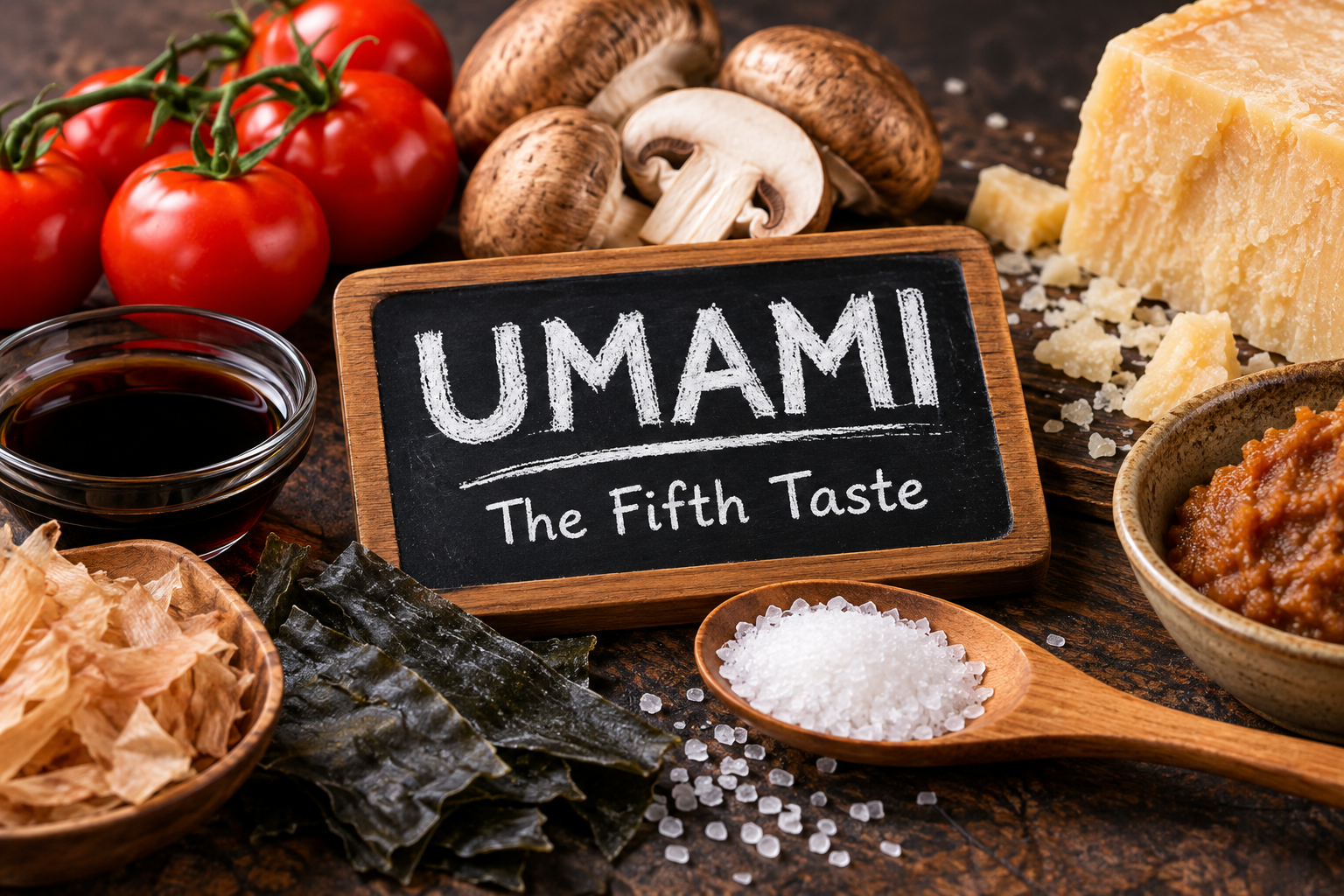
Umami is commonly described as the fifth basic taste, alongside sweet, sour, salty, and bitter. The word comes from Japanese and is often associated with a savory or broth-like taste. Scientists have identified taste receptors that respond to glutamate, one of the key compounds responsible for umami.
As a chef, I find umami more interesting when I stop thinking about it as a scientific definition and start thinking about what happens in the pan.
Why does a mushroom become so satisfying after cooking?
Why can a little Parmesan make a sauce taste deeper?
Why does a good stock seem to have more flavor than the ingredients you started with?
And why can combining ingredients such as tomatoes, mushrooms, aged cheese, or fermented sauces create a much fuller taste?
The answer is not simply “add MSG.”
Umami is already present naturally in many foods, and cooking, aging, drying, and fermentation can change the concentration and availability of compounds that contribute to umami. Glutamate can also work together with compounds such as inosinate and guanylate, creating what food scientists describe as umami synergy.
That is where umami becomes especially interesting for a chef.
It is not just about making food taste stronger.
It is about creating depth, continuity, and balance.
In this article, let’s look at what umami really is, where it comes from, why certain foods are naturally rich in it, how cooking and fermentation affect it, and how chefs can build more satisfying flavor without simply adding more salt.
1. What Is Umami?
Umami is one of the five basic tastes, along with sweet, sour, salty, and bitter.
The word “umami” comes from Japanese and is often translated as “pleasant savory taste.” Unlike saltiness, which is mainly associated with sodium ions, umami is strongly linked with glutamate, an amino acid that naturally occurs in many foods.
You may already be eating umami every day without thinking about it.
Tomatoes contain naturally occurring glutamate. So do mushrooms, Parmesan cheese, meat, fish and some fermented foods. Certain ingredients also contain other compounds that can work with glutamate and make the overall umami sensation stronger.
This is why a bowl of mushroom soup can taste deeply satisfying even when it is not particularly salty.
From a chef’s point of view, I think of umami as depth rather than intensity.
A dish with good umami does not necessarily hit your tongue immediately. Instead, the flavour can feel fuller and more complete, particularly after you swallow.
There is also an interesting scientific reason for this.
Our taste system has specific receptors that respond to glutamate and other compounds associated with umami. When these compounds are present together in the right way, the brain receives a stronger savory signal.
That helps explain something chefs have known through cooking for a long time:
Sometimes combining several modest sources of flavor can create a much deeper result than relying on one ingredient alone.
And this is where umami becomes much more than simply a word for “savory.”
It is a useful piece of food science that can help us understand why certain ingredients, cooking methods, and flavor combinations work so well.
2. Why Does Umami Taste Different From Saltiness?
It is easy to confuse umami with saltiness because both can make food feel more satisfying. But they are actually different taste sensations.
When you taste salt, the main signal comes from sodium ions. Umami is different. It is primarily associated with L-glutamate, the naturally occurring form of glutamate found in many foods. Different taste mechanisms detect these compounds.
This is something you can notice quite easily in the kitchen.
Imagine a bowl of clear broth.
Add salt and the broth becomes saltier.
But if the broth already has enough salt and you add an ingredient rich in umami, such as mushrooms, Parmesan, tomato concentrate, or a fermented sauce, the result can feel deeper and more rounded rather than simply saltier.
That difference is important.
As a chef, I often think of salt as something that helps bring flavors forward, while umami can help give a dish more body and depth.
There is also an interesting interaction between the two. Research has found that umami compounds such as MSG can influence the perception of saltiness, which helps explain why some savory foods can taste fuller without needing to rely entirely on salt.
And umami gets even more interesting when different compounds meet.
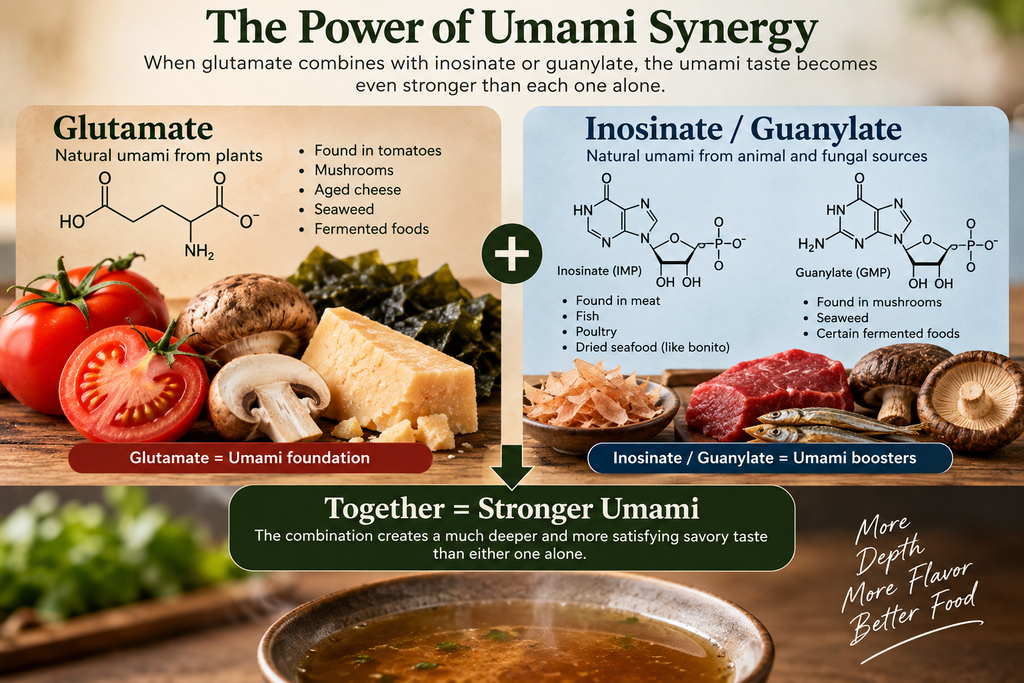
Glutamate can interact with compounds such as inosinate (IMP) and guanylate (GMP), which can strongly enhance the perception of umami. This is one reason combinations such as meat with mushrooms, or a rich broth with certain fermented ingredients, can taste much more complex than either ingredient might suggest on its own.
So the next time someone says a dish needs “more flavor,” the answer isn’t automatically more salt.
Sometimes the missing piece is umami.
3. Where Does Umami Come From?
One of the interesting things about umami is that you don’t have to create it from scratch.
It is already present in many foods.
Tomatoes, mushrooms, Parmesan cheese, meat, fish, and seaweed can all contribute naturally occurring glutamate or other compounds associated with umami. Fermented foods such as soy sauce and miso can also develop significant umami characteristics as proteins are broken down during fermentation.
But the amount and type of umami compounds can vary considerably from one food to another.
Take a tomato.
A fresh ripe tomato has natural glutamate, but when you cook it slowly and remove some of its water, the flavor becomes more concentrated. Tomato paste can therefore bring a very different level of savory depth to a sauce than a few slices of fresh tomato.
Mushrooms offer another example.
Fresh mushrooms already have savory characteristics, but drying can change their flavor dramatically. Rehydrated dried mushrooms can bring an intense depth to stocks, sauces, and gravies.
Then there is aged Parmesan.
As cheese matures, proteins are broken down into smaller compounds, including free amino acids such as glutamate. That is one reason aged cheese can have such a powerful savory character.
Fermentation and aging are especially interesting because they can transform the flavor of an ingredient without changing its basic identity.
This is something I find particularly useful in cooking.
Instead of asking only, “What ingredient should I add?”
I also ask:
“What can I do to the ingredient I already have?”
Roast it.
Reduce it.
Dry it.
Age it.
Ferment it.
The ingredient may become a completely different flavor tool.
And that is why umami is found across so many cuisines. From Japanese dashi and soy sauce to Italian Parmesan and tomatoes, slow-cooked meat stocks, and fermented foods, different culinary traditions have developed their own ways of building savory depth.
4. What Does Umami Actually Taste Like?
Umami is one of those flavors that can be difficult to describe until you experience it.
It is not exactly salty.
It is not sweet.
It is not sour.
And it is not bitter.
Instead, umami is often described as savory, brothy, meaty, or mouth-filling.
But those words still don’t completely explain it.
For me, the easiest way to understand umami is to compare a few foods.
Think about a fresh tomato versus tomato paste. A light vegetable broth versus a slowly reduced stock. A young cheese versus aged Parmesan. Fresh mushrooms versus dried mushrooms that have been rehydrated.
The ingredients are related, but the eating experience can be very different.
Foods rich in umami can create a sensation that seems to linger in the mouth. The flavor can feel fuller and more rounded, rather than simply becoming stronger in one particular direction.
This is also why umami can be difficult to identify when you are eating a finished dish.
You might not say:
“This tastes like umami.”
You might simply say:
“This tastes really good.”
That is one reason I think chefs should understand umami as a cooking tool rather than just a definition from a food science textbook.
A tomato sauce may need acidity for brightness, salt for seasoning, sweetness for balance, and umami for depth.
A soup may need herbs and spices for aroma, but a good stock can give it a savory foundation.
A vegetarian dish can also have plenty of umami. Mushrooms, tomatoes, seaweed, fermented ingredients, aged cheese, and certain legumes can all contribute to a satisfying savory character.
So umami isn’t about making everything taste “meaty.”
It is about giving food a deeper and more complete savory character.
And once you start recognizing it, you begin noticing it everywhere.
5. Why Does Cooking Make Food More Umami?
Cooking does not automatically make every food more umami. What it does is change the chemistry of food, and some cooking and processing methods can increase the availability or concentration of compounds that contribute to umami.
One important example is protein.
Proteins themselves generally do not give us the same umami sensation as free glutamate. When proteins are broken down through processes such as fermentation, aging, or certain forms of heat treatment, smaller compounds, including free amino acids, can be released. Glutamate is one of them.
This helps explain why several traditional cooking techniques create such deep flavors.
Think about a long-cooked stock.
As ingredients cook, water-soluble flavor compounds move into the liquid. Meat and other ingredients also undergo chemical and structural changes that affect amino acids, nucleotides, and aroma compounds. The final stock can therefore taste much more complex than the raw ingredients did at the beginning.
Drying can have a similar effect, although the chemistry is more complicated than simply “removing water.”
Dried mushrooms, for example, are well known for their strong savory character. Drying changes their flavor compounds and can alter the levels and availability of compounds associated with umami.
Roasting can change things again.
Recent research on air-dried beef found that roasting increased protein degradation, free amino acids, and certain nucleotides, with the measured umami potential increasing during the roasting process.
But there is an important chef’s lesson here:
More cooking does not always mean more umami.
Temperature, time, moisture, and the ingredient itself all matter. Excessive heat can also degrade or change some flavor compounds. Research on dried oysters, for example, found that a gentler drying condition produced stronger measured umami, while higher-temperature drying reduced the umami effect.
This is why I don’t think of cooking as simply “adding flavor.”
Cooking is more like transforming the flavor that is already inside the ingredient.
A tomato can become concentrated tomato paste.
A mushroom can become a powerful dried ingredient.
Meat can develop deeper savory characteristics through cooking and aging.
And fermentation can unlock glutamate that was previously part of larger proteins.
That is one of the reasons traditional cooking techniques remain so valuable even in modern kitchens.
6. Why Do Tomatoes, Parmesan, and Mushrooms Work So Well Together?
One of my favorite things about umami is that you don’t always need an expensive ingredient to create a deep flavor.
Sometimes, the combination is more important than the individual ingredient.
Take tomatoes, Parmesan, and mushrooms.
Each brings its own flavor, but they also contribute compounds associated with umami. Glutamate is naturally present in tomatoes and aged cheese, while mushrooms can provide glutamate as well as guanylate, another compound involved in umami perception.
This becomes especially interesting when different umami compounds interact.
Food scientists call this umami synergy.
Glutamate can work together with nucleotides such as inosinate and guanylate to produce a much stronger umami sensation than either component would create alone. This same principle is found in Japanese dashi, but it also appears in familiar Western combinations such as meat with tomatoes or vegetables and cheese with meat.
That gives us a useful way to think about cooking.
Imagine a tomato sauce.
Fresh tomato gives you acidity, sweetness, and natural glutamate. Reduce it, and you concentrate its flavor. Add mushrooms, and you introduce another layer of savory compounds. Finish with aged Parmesan, and you add another concentrated source of glutamate along with the characteristic flavors created during cheese aging.
The result isn’t simply three times more flavor.
The ingredients interact.
This is one reason a simple mushroom and tomato pasta finished with Parmesan can taste surprisingly deep without needing a long list of ingredients.
And there is a bigger lesson here.
Umami is often built through relationships between ingredients, not just individual ingredients.
As a chef, this changes the way I look at recipe development.
Instead of asking, “What is my strongest flavor ingredient?”
I ask:
“Which ingredients can support each other?”
That approach can work in vegetarian cooking, meat dishes, soups, sauces, stocks, and even modern plant-based food.
Once you understand that principle, your pantry starts looking very different.
7. What Is the Connection Between Umami and Fermentation?
Fermentation is one of the most interesting ways food develops umami.
Think about soy sauce, miso, fermented bean pastes, and some aged cheeses. These foods don’t simply start with a strong savory flavor. Fermentation changes the ingredients over time and creates a much more complex mixture of taste compounds.
A big part of the process happens to proteins.
Microorganisms and the enzymes they produce break proteins into smaller peptides and amino acids. During soy sauce fermentation, for example, enzymes from Aspergillus koji molds help break down soybean and wheat proteins. Glutaminase also helps convert glutamine into glutamate, which contributes to the characteristic umami taste.
This is why fermentation can be thought of as a kind of flavor transformation system.
The raw ingredient goes in one way.
Microorganisms and enzymes work on it.
And months later, you can have an ingredient with an entirely different aroma, texture, and taste.
Miso is a good example. Studies of fermented soybean products show that glutamate can become one of the most abundant free amino acids during fermentation, contributing to their umami character.
Soy sauce is even more fascinating because its flavor isn’t coming from glutamate alone. Free amino acids, nucleotides, peptides, and many aroma compounds contribute to the final sensory experience. Fermentation and aging create a complex mixture rather than a single “umami ingredient.”
As a chef, this is one reason I respect fermentation so much.
You are not simply adding another seasoning to food.
You are allowing time and microorganisms to develop flavor inside the ingredient itself.
And that principle appears across food cultures.
Different countries developed different fermented foods, but many of them arrived at a similar culinary idea: take a basic ingredient, transform it over time, and create something deeper and more complex.
That is one of the reasons fermentation and umami are so closely connected.
8. Why Does Meat and Seafood Add So Much Umami?
Meat and seafood can bring a different kind of savoury depth to a dish because they contain not only glutamate, but also other compounds that can interact with glutamate and strengthen the perception of umami.
One of the important compounds is inosinate, also known as IMP. It is naturally present in many animal foods and can contribute strongly to umami, particularly when combined with glutamate. Another important compound is guanylate, which is more commonly associated with certain mushrooms and plant foods.
This helps explain why some combinations taste so powerful.
A simple example is meat cooked with mushrooms.
The meat contributes compounds such as inosinate, while mushrooms can contribute glutamate and guanylate. When these compounds interact, the perceived umami can become much stronger than you might expect from either ingredient alone.
Seafood offers another interesting example.
Fish and shellfish contain naturally occurring amino acids and nucleotides, although their levels vary considerably between species and depending on freshness, processing and cooking. Some seafood also develops additional flavour compounds during drying, curing or fermentation.
This is one reason traditional stocks and broths can become so deeply savoury.
Bones, meat, fish, vegetables and aromatics are cooked together, allowing different flavour compounds to move into the liquid and interact.
But there is something important to remember.
Umami is not the same thing as “meaty.”
A vegetarian dish can have a powerful umami character too. Mushrooms, tomatoes, seaweed, fermented soy products and aged cheeses can provide significant sources of umami-related compounds.
For me, this is where understanding food science becomes useful in menu development.
If you know which ingredients contribute glutamate and which contribute inosinate or guanylate, you can build depth deliberately rather than simply adding more seasoning.
And that brings us to one of the most useful concepts in umami science:
umami synergy.
9. What Is Umami Synergy?
This is where umami gets especially interesting.
Imagine tasting a food that contains glutamate. You notice a savory taste, but it may not seem particularly powerful.
Now introduce another compound associated with umami, such as inosinate (IMP) or guanylate (GMP).
The perception can change dramatically.
This interaction is called umami synergy. Research has shown that 5′-ribonucleotides such as IMP and GMP can strongly enhance the umami response produced by glutamate. This is considered one of the defining characteristics of umami taste.
There is a fascinating biological reason behind it.
The human umami receptor includes a receptor complex called T1R1/T1R3. Glutamate and these nucleotide compounds interact with the receptor in a cooperative way, helping produce a stronger umami signal.
You don’t need to understand the receptor structure to use the principle in a kitchen.
Think about these combinations:
Tomato + meat
Mushroom + meat
Parmesan + tomato
Seaweed + fermented soy
Mushroom + fermented ingredients
These combinations can work so well because foods may contribute different umami-related compounds that complement one another.
This is one reason traditional food cultures have developed so many powerful combinations without necessarily using the language of food science.
The cooks discovered the effect through experience.
Science later helped explain part of what was happening.
As a chef, I find that connection fascinating.
A recipe does not always need a single ingredient with an enormous flavor impact.
Sometimes the smarter approach is to combine ingredients that support each other.
That can create depth while keeping the dish balanced.
And this is perhaps the most useful lesson from umami science:
Great flavor is often about interaction, not just intensity.
10. Is MSG the Same as Umami?
Not exactly.
MSG and umami are related, but they are not the same thing.
Umami is a taste sensation. MSG, or monosodium glutamate, is an ingredient that can produce that sensation because it provides glutamate. FDA describes MSG as the sodium salt of glutamic acid, an amino acid that also occurs naturally in many foods.
This distinction is important.
Think about salt.
Salt can create a salty taste, but saltiness is not the same thing as salt.
The same idea applies here.
MSG provides glutamate in a form that can activate the taste receptors associated with umami. But glutamate is not exclusive to MSG. It occurs naturally in foods such as tomatoes and cheeses, and free glutamate can also develop during processes such as fermentation and protein breakdown.
There is another interesting point that often gets missed.
Your body does not treat glutamate from MSG as a completely different type of glutamate from the glutamate found naturally in food. FDA notes that when proteins are digested, they release free glutamate that is chemically the same as the glutamate in MSG.
MSG is also not something that was invented simply as a modern food additive.
In 1908, Japanese chemist Kikunae Ikeda identified glutamate as the source of the savory taste in a seaweed broth and subsequently developed a method for producing MSG. Today, commercial MSG is produced through fermentation of carbohydrate sources.
From a food-science perspective, there is also an important safety point.
The U.S. FDA considers added MSG to be generally recognized as safe (GRAS) when used as intended. FDA also notes that some people report sensitivity to MSG, although controlled studies have not consistently reproduced those reactions.
So I would not describe MSG simply as “good” or “bad.”
It is better understood as one tool for delivering umami.
A chef can build umami from tomatoes, mushrooms, aged cheese, meat, seafood, fermented ingredients, or other naturally glutamate-rich foods.
MSG is simply another way to add glutamate and, therefore, enhance the savory character of a dish.
The important part is understanding the ingredient rather than fearing the word.
11. How Can Chefs Add More Umami Without Simply Adding More Salt?
If a dish tastes flat, the first reaction in many kitchens is to reach for the salt.
Sometimes that is exactly what the dish needs.
But sometimes the problem isn’t a lack of salt. It is a lack of depth.
This is where umami becomes useful.
One of the simplest ways to build umami is to combine ingredients that naturally contain glutamate or other umami-related compounds. Tomatoes, mushrooms, aged cheeses, seaweed, meat, fish, and fermented foods can all play a role.
Start with concentration.
Cooking can concentrate flavors.
A fresh tomato can become a rich tomato reduction. Mushrooms can be roasted or dried. A stock can be slowly reduced.
The goal is not simply to cook something for as long as possible.
It is to concentrate the right flavors without destroying them.
Use fermentation.
Soy sauce, miso, and other fermented ingredients can add a small amount of powerful savory character.
You don’t necessarily need a large quantity.
Sometimes a spoonful of a well-made fermented ingredient can change the character of an entire sauce.
Use aged ingredients.
Aged Parmesan and other mature cheeses can contribute significant savory depth because protein breakdown during aging produces free amino acids, including glutamate.
Build combinations.
This is where I think chefs can have the most fun.
Instead of relying on one ingredient, combine complementary sources.
Tomato + mushroom
Mushroom + Parmesan
Tomato + aged cheese
Seaweed + fermented soy
Meat + mushroom
These combinations can take advantage of umami. synergy between glutamate and compounds such as inosinate and guanylate.
Don’t forget browning.
Browning does not simply “create umami,” but it creates many aroma and flavor compounds that make cooked food taste deeper and more complex.
That is why properly browned mushrooms, roasted vegetables, seared meat, and caramelized ingredients can transform a dish.
For me, this is one of the most important lessons in cooking:
If food tastes flat, don’t automatically add more salt.
First ask whether it needs concentration, browning, acidity, aroma, texture, or umami.
Sometimes the answer is not another seasoning.
It is a better cooking process.
12. Why Is Umami Becoming More Important in Modern Food?
Umami has been part of traditional cooking for a very long time, but it is becoming increasingly interesting in modern food because chefs are looking for ways to create more depth without simply making food saltier.
That matters in both restaurants and packaged food.
Modern chefs are working with ingredients such as fermented sauces, aged cheeses, mushrooms, seaweed, concentrated stocks, and other flavor-rich ingredients to build complexity. Michelin’s 2026 food-trend reporting specifically highlights growing interest among chefs in umami, fermentation, aging, seaweed, and concentrated stocks.
I think there is another reason umami fits modern cooking so well.
It works across cuisines.
A Japanese dashi, an Italian Parmesan and tomato sauce, a French-style stock, a Korean fermented sauce, or an Indian preparation built around roasted ingredients may look completely different on the plate.
But the underlying idea can be similar:
Build depth by layering flavor.
For food developers, umami also creates interesting opportunities.
A product does not necessarily need to become extremely salty or heavily spiced to taste satisfying. Ingredients and processing techniques can be selected to create a fuller flavour profile.
This is particularly useful when developing:
- Plant-based foods
- Soups and stocks
- Sauces and gravies
- Snacks
- Frozen meals
- Ready-to-eat foods
- Fermented products
But I think there is a danger in turning umami into another food buzzword.
Adding an umami ingredient to everything does not automatically make food better.
The goal should still be balance.
A good dish needs contrast. Acidity can brighten it. Salt can season it. Sweetness can balance bitterness or acidity. Aromatic ingredients create another layer. Texture changes how the food is experienced.
Umami is one part of that system.
For me, that is why it remains so useful.
It is not a shortcut to good cooking.
It is another way of understanding why good cooking tastes deep and satisfying.
13. The Chef RBS Umami Rule
After working with different cuisines and kitchen styles, I have learned that building flavor is rarely about adding more of everything.
It is about understanding what each ingredient is doing.
When I build a dish, I usually think about five things:
Salt for seasoning.
Acidity for brightness.
Aroma for the first impression.
Texture for contrast.
Umami for depth.
But these elements should not compete with each other.
They should support each other.
If a tomato sauce tastes flat, I don’t immediately add more salt. I taste it again and ask what is missing.
Maybe the tomatoes need more concentration.
Maybe the sauce needs better browning.
Maybe a little Parmesan or mushroom could add depth.
Maybe it actually needs acidity to wake everything up.
That small pause before adding another ingredient can make a big difference.
I also like thinking about layers of umami rather than one dominant source.
For example, a sauce might start with slowly cooked onion and tomato, gain depth from mushrooms, develop more savouriness from a fermented ingredient, and finish with aged cheese.
No single ingredient has to do all the work.
The ingredients build on one another.
This approach is particularly useful when developing new recipes or menus because it gives you more control over the final flavor.
And there is one rule I always come back to:
Don’t use umami to hide poor cooking. Use it to support good cooking.
A perfectly balanced dish should still taste like its main ingredients.
Umami should make the food feel more complete, not make you wonder what you are actually eating.
That, for me, is the real value of understanding umami.
It gives a chef another way to think about flavor.
Final Thoughts
Umami is one of those food science concepts that becomes much easier to understand once you start noticing it in everyday cooking.
It is in the richness of a good stock.
The depth of a slow-cooked tomato sauce.
The savory character of mushrooms.
The complexity of aged cheese.
The flavor is created by fermentation.
And the satisfying taste that can appear when different ingredients work together.
What I find most interesting is that umami is not about making food simply stronger.
It is about making food feel more complete.
A chef can build that depth through ingredient selection, cooking, roasting, drying, aging, and fermentation. Sometimes a small amount of one ingredient can make a much bigger difference when it is combined with another ingredient that complements it.
That is the beauty of understanding the science behind cooking.
Once you know why something works, you have more freedom to create.
You don’t have to follow a recipe exactly.
You can taste, think, adjust, and build.
For me, that is what umami represents.
Not just the fifth taste.
A way of thinking about flavor.
And perhaps the next time you taste a deeply satisfying soup, a mushroom dish, a tomato sauce or a piece of aged cheese, you might stop for a moment and ask:
“Is that umami?”
Very often, the answer will be yes.