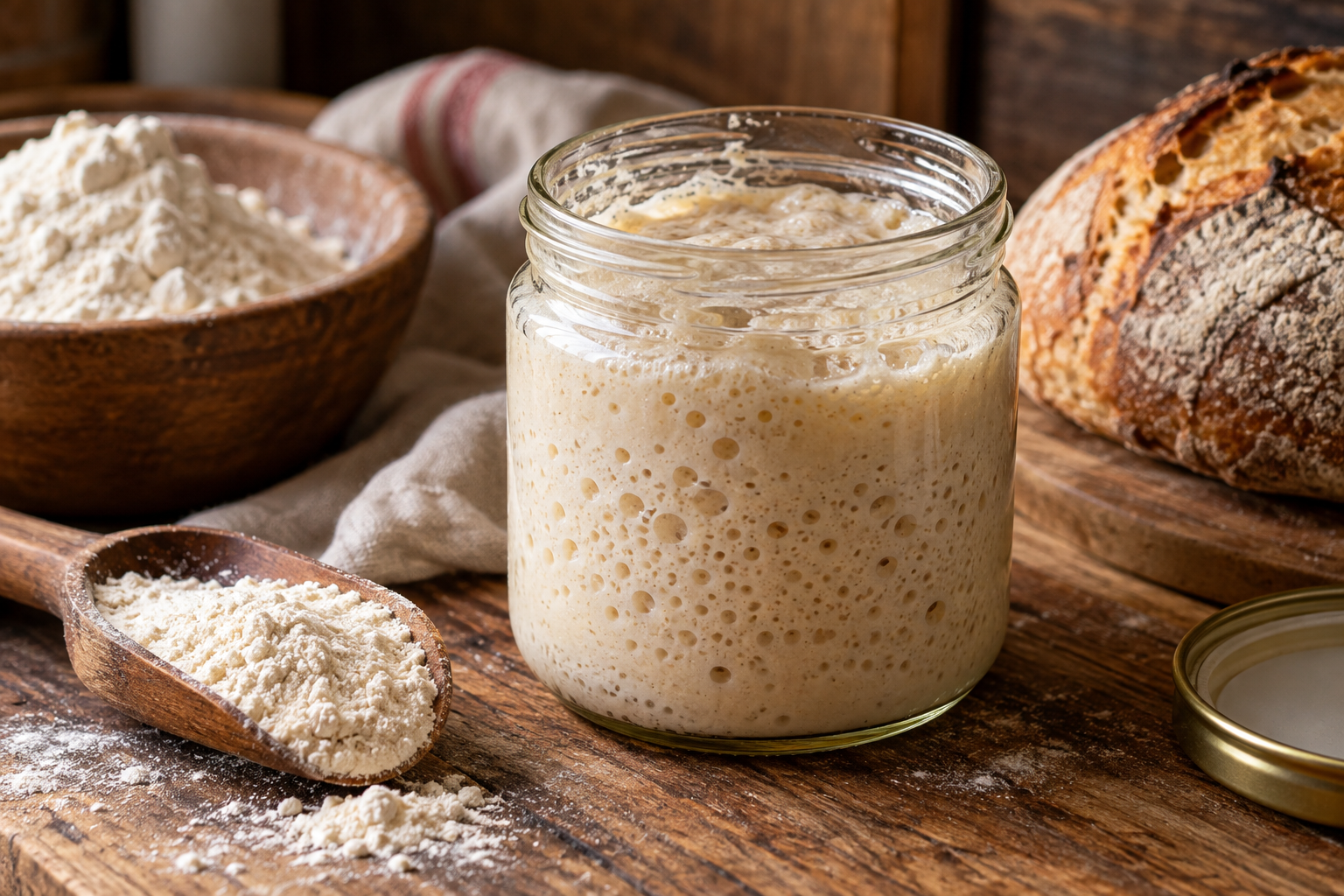
Sourdough Starter: What the Bubbles Are Really Telling You
A sourdough starter can look almost dead one moment and suddenly come alive a few hours later.
The bubbles are the obvious sign, but they are telling you more than that.
Inside that jar, yeast and bacteria are working together, using the flour as their food and producing acids and gases along the way.
That is what gives sourdough its rise, aroma, and characteristic tang.
As a chef, I don’t judge a starter by bubbles alone. The smell, texture, rise, and timing all tell part of the story.
Once you learn to read those signs, feeding a sourdough starter becomes much less confusing.
Let’s look at what your starter is actually trying to tell you.
2. What Is Actually Happening Inside the Jar?
A sourdough starter is a small fermentation system made from flour and water.
Once mixed, naturally occurring microorganisms from the flour and environment begin using available nutrients. Yeasts produce carbon dioxide, while lactic acid bacteria produce acids and other compounds.
The carbon dioxide gets trapped in the developing mixture.
Those little pockets of gas are the bubbles you see.
The longer you watch a starter, the more interesting it becomes. It can rise, reach its peak, fall back down, and change its smell as fermentation continues.
Chef RBS Tip: Mark the level of your starter on the jar after feeding. Watching how far it rises can tell you more about its activity than simply counting bubbles.
3. Why Your Starter Rises and Then Falls
One of the easiest ways to understand a sourdough starter is to watch its rise and fall.
After feeding, the microorganisms have fresh food available. Fermentation becomes active, gases build up, and the starter expands.
Eventually, it reaches a point where the activity slows and the structure can no longer hold all that gas. The starter begins to fall.
That doesn’t automatically mean something is wrong.
In fact, a starter that rises and falls is showing you that fermentation is happening.
The timing can change with temperature, flour, hydration, and feeding routine, so your starter may not follow the same schedule as someone else’s.
Chef RBS Tip: Take a quick photo or mark the jar after feeding. After a few days, you’ll start recognizing your starter’s own rhythm instead of relying only on a clock.
4. What Those Bubbles Really Mean
Bubbles are a good sign, but more bubbles do not always mean a better starter.
The bubbles are mainly a result of carbon dioxide produced during fermentation. Some starters hold that gas better than others, so the surface can look very active while the starter itself is not rising much.
Look at the whole picture.
Is the starter expanding?
Does it have a pleasant fermented smell?
Is the texture becoming lighter and more aerated?
These clues together give you a much better idea of what is happening.
A quiet starter is not necessarily a dead starter, either. Cooler temperatures can simply slow fermentation.
Chef RBS Tip: Don’t judge your starter from the surface alone. Check the sides of the jar. The rise line often tells the real story.
5. The Smell Can Tell You a Lot
Before you feed a sourdough starter, give it a quick smell.
A healthy, active starter can smell pleasantly tangy, fruity, yeasty, or mildly acidic. The aroma can change as fermentation progresses, so don’t expect it to smell exactly the same every day.
A sharp alcohol-like smell can appear when the starter has been sitting for a while without fresh food. It can be a sign that the available food has been largely used.
Smell is useful, but it should never be your only check. Look at the starter’s activity, texture, and appearance as well.
Chef RBS Tip: Get into the habit of smelling your starter before feeding it. After a few days, you’ll learn its normal aroma and notice changes much faster.
6. Temperature Changes Everything
If your sourdough starter suddenly becomes slow, don’t blame the flour straight away.
Temperature can change the speed of fermentation dramatically.
In a warmer kitchen, yeast and bacteria generally become more active. In a cooler kitchen, fermentation slows down. That means two starters made with the same flour and water can behave very differently in different kitchens.
This is also why feeding your starter by the clock can sometimes be misleading.
Your starter has its own rhythm, and temperature is one of the biggest reasons.
Chef RBS Tip: Instead of asking, “Has it been six hours?” look at the starter first. Its rise, bubbles, smell, and texture are better clues than the clock alone.
7. When Your Starter Needs Feeding
A sourdough starter doesn’t really follow a fixed meal schedule.
It needs fresh flour and water because fermentation gradually uses the available food. If you keep feeding it without paying attention to its activity, you can easily lose track of what the starter is actually doing.
Look for a pattern.
Feed it, watch it rise, notice when it reaches its peak, and see how it changes afterward.
That rhythm becomes more useful than following someone else’s exact feeding timetable.
For a starter kept at room temperature, feeding frequency will also depend on temperature, flour, and your feeding ratio.
Chef RBS Tip: Write down the feeding time and the time your starter reaches its highest point. After a few cycles, you’ll have a much better guide for your own kitchen.
8. How to Know When Your Starter Is Ready to Bake
A starter is usually most useful for baking when it is active and near its peak.
Look for a starter that has risen noticeably after feeding, shows plenty of fermentation activity, and has an airy texture. The exact timing will depend on your flour, temperature, hydration, and feeding routine.
One simple mistake is waiting for a starter to look identical to a photo online.
Don’t.
Your starter may have a different texture, rise pattern, or aroma and still be perfectly active.
Chef RBS Tip: Mark the starter level after feeding. When you learn how high it normally rises before beginning to fall, you have a much more reliable signal for your own baking.
9. When Something Looks Wrong
Not every change means your starter has failed.
Maybe it stopped rising as much. Maybe the smell became stronger. Maybe it looks thinner than usual.
Before throwing it away, look at the full picture.
Temperature, feeding ratio, flour, hydration, and timing can all change how a starter behaves.
What you don’t want to ignore is clear spoilage. Unusual colored growth or an obviously rotten smell is a different situation from normal sour fermentation.
When in doubt, don’t taste a starter that looks spoiled.
Chef RBS Tip: Take a photo whenever your starter looks healthy. It gives you a simple visual reference when something changes later.
10. Chef RBS Kitchen Takeaway
The more you work with sourdough, the less you need to depend on a fixed schedule.
Your starter will tell you a lot.
Watch how high it rises. Notice the bubbles, smell, and texture. Keep an eye on the temperature and remember what happened after each feeding.
For me, that is one of the best parts of fermentation. You stop simply following a recipe and start understanding the ingredient.
A sourdough starter is not just flour and water sitting in a jar. It is a living fermentation process that changes with its environment.
Chef RBS Tip: Keep simple notes for your first few weeks. Your own starter’s pattern will eventually become more useful than any generic feeding chart.
The Takeaway
You don’t need to become a fermentation expert to understand your starter.
Just learn to read it.
The rise, bubbles, aroma, and texture all give you clues. Once you start paying attention to those small changes, sourdough becomes much less mysterious and much more predictable.
11. Sourdough Starter FAQ
What is a sourdough starter?
A sourdough starter is a mixture of flour and water that develops a community of yeasts and bacteria through fermentation.
Why does my sourdough starter have bubbles?
The bubbles are mainly carbon dioxide produced during fermentation. They are one sign that microorganisms in the starter are active.
How do I know when my starter is ready?
Look for a noticeable rise, active bubbling, an airy texture, and a pleasant fermented aroma. Your starter’s timing will depend on temperature, flour, and feeding routine.
Why does my sourdough starter smell like alcohol?
A strong alcohol-like smell can develop when the starter has been sitting for some time and its available food has been largely used. It does not automatically mean the starter is spoiled.
Does temperature affect sourdough starter?
Yes. Warmer conditions generally speed up fermentation, while cooler conditions slow it down.
Can I judge a starter just by its bubbles?
Not reliably. Check the rise, texture, smell, and timing as well. Looking at the side of the jar can be especially useful.
When should I throw away a sourdough starter?
If you see unusual colored growth or obvious spoilage, don’t taste it. When you are unsure whether something is normal fermentation or spoilage, it is safer not to use it.