Why Are Chinese Food Brands Expanding Into America?
Something interesting is happening with Chinese food brands in America.
For many years, American restaurant brands expanded into other countries. Now we are seeing the opposite direction too. Chinese food and beverage brands are opening stores in America.
Names such as Mixue, Heytea, and Luckin Coffee are getting attention as they enter the U.S. market. But what interests me most is not simply the fact that they are opening stores.
It is how they are doing it.
Many of these brands are not starting with large traditional restaurants. They are bringing smaller formats, drinks, coffee, desserts, and snacks. They are also using technology, simple menus, and pricing strategies that are designed for today’s customers.
As a chef and someone who has worked in different food markets, I find this part much more interesting.
Taking a food concept from one country to another is not easy.
The food has to make sense to local customers. The price has to make sense. The portion, menu, service, and even the way people order can be different.
So why are Chinese food brands expanding into America now?
And what can chefs and food business owners learn from the way these brands are entering the U.S.?
Let’s look at what is really happening behind this new food business movement.
1. Why Are Chinese Food Brands Expanding Into America?
The first question is simple: why are Chinese food brands in America becoming such an interesting food business story?
The U.S. is already a huge restaurant and beverage market. For a Chinese brand that has grown quickly at home and in other Asian markets, America offers a completely different customer base.
But there is another reason.
Some Chinese food and beverage companies have already learned how to operate at a very large scale. Mixue, for example, had about 64,000 stores worldwide by June 2026, including about 4,400 outside mainland China. Its first U.S. store opened in Los Angeles in December 2025.
Now these companies are testing whether the same model can work with American customers.
Recent reporting shows that at least nine mainland Chinese food and beverage chains have entered the U.S. since 2023. Most of them are focused on drinks and snacks rather than large restaurant menus. Heytea and Luckin Coffee are already operating in the U.S., while Mixue has announced more locations.
That tells me something important.
They are not simply bringing Chinese food to America.
They are bringing Chinese food business models to America.
And that is where the story becomes much more interesting for chefs, restaurant owners and food businesses.
2. Which Chinese Food Brands Are Entering the U.S.?
It is not just one company.
A number of Chinese food and beverage brands are now testing the American market. Some are already operating stores, while others are planning a larger expansion.
Mixue is one of the biggest names. The brand sells ice cream, fruit tea, milk tea, and other affordable drinks and snacks. It opened its first U.S. stores in December 2025 and has announced more locations. By June 2026, Mixue had more than 64,000 stores globally, according to Di Intelligence.
Heytea is taking a different approach. Its stores focus more on premium tea, fruit drinks, and visually interesting beverages. It has already built a presence in several U.S. states.
Then there is Luckin Coffee.
Luckin is especially interesting to me because its model is strongly connected to mobile ordering and fast service. The brand opened its first U.S. stores in New York and is now building its American presence.
Other Chinese brands are also entering the market, including Chagee, Molly Tea, and Wallace, showing that this is becoming a wider movement rather than a story about only one or two companies.
What I find interesting is the common pattern.
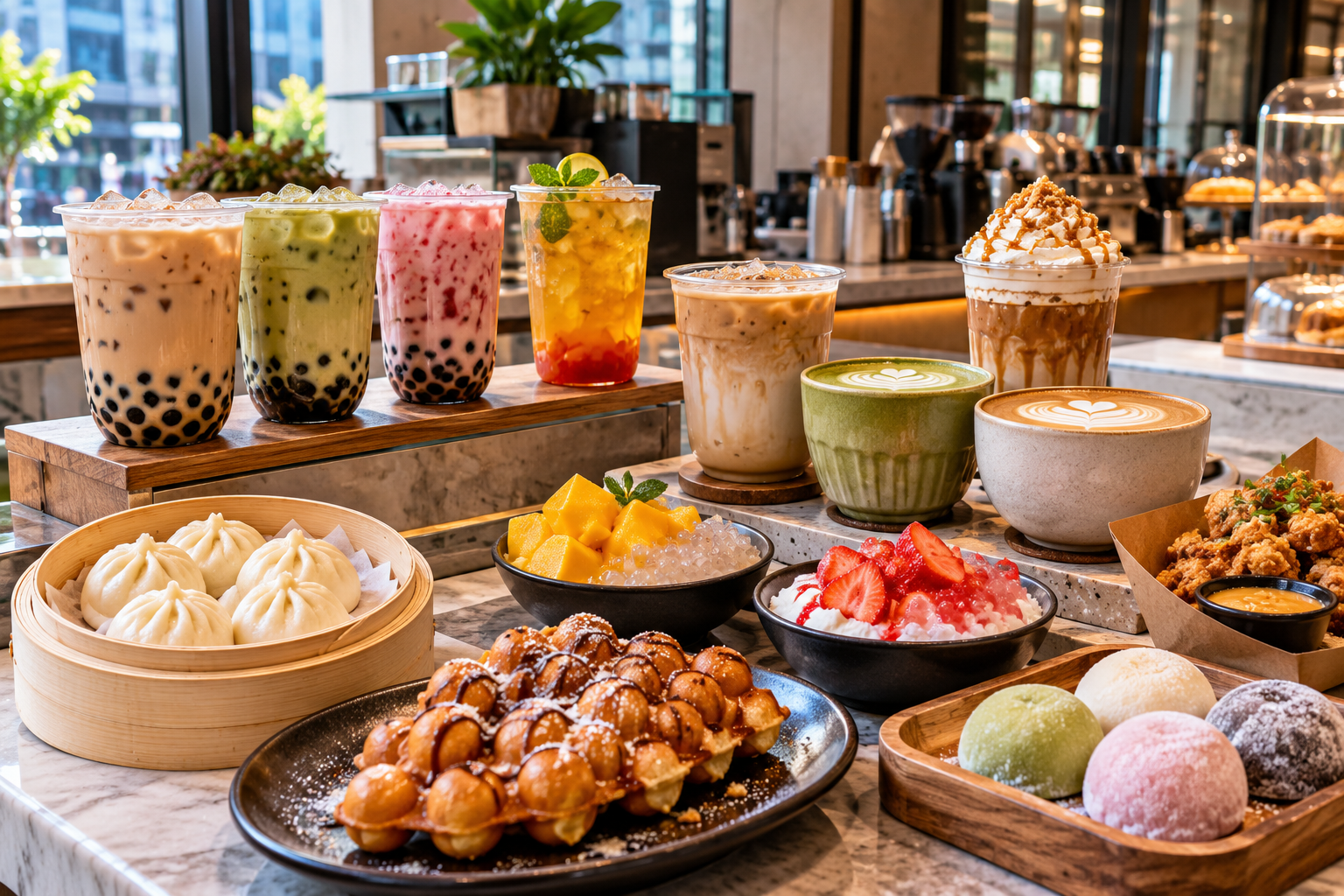
Many of these companies are starting with coffee, tea, ice cream, desserts, and snacks.
They are choosing categories that can be served quickly, adapted easily, and promoted strongly through social media.
For a new international food brand, that can be a much simpler way to enter a market than opening a large full-service restaurant.
3. Why Are Drinks and Snacks Leading the Expansion?
There is a reason many of these brands are starting with drinks, desserts, and snacks.
These products are easier to serve quickly. They also work well in smaller stores.
A drink can be customized. Customers can choose the sweetness, ice level, and toppings. A tea or coffee can also be changed without changing the whole kitchen setup.
That makes the operation easier to control.
Restaurant Dive reported in 2026 that non-alcoholic beverages and desserts are among the fastest-growing restaurant categories in the U.S., with strong interest in specialty coffee, tea, matcha, and desserts. It also noted that international brands are entering categories where there is still room for new concepts.
I think there is another reason.
Drinks are very easy to share on social media.
A colorful tea, a new topping, or an unusual dessert can make people curious before they even visit the store.
For a new international brand, that curiosity is valuable.
Mixue is a good example. Its menu includes ice cream, fruit tea, milk tea, coffee, and other drinks. The company also built a low-price model around a large supply chain and franchising system.
As a chef, I see this as a useful lesson.
When entering a new country, you don’t always need a huge menu.
Sometimes one simple product category, done consistently and presented well, can open the door to a much bigger food business.
4. What Makes Mixue Different?
When I look at Mixue, the first thing I notice is not the ice cream or the drinks.
It is the business model behind them.
Mixue built its brand around products that are relatively simple to produce, easy to standardize, and sold at an accessible price. The company has also grown through franchising and a large supply network. Its U.S. entry follows the same broad idea, although the American market will require local adaptation.
This is important.
A food brand can have a great product, but if the operation is complicated, expansion becomes difficult.
Think about a small beverage shop.
You need a limited number of ingredients. You need reliable equipment. Staff need to learn the recipes quickly. The final drink should taste almost the same whether it is made in one store or another.
That is where standardization becomes powerful.
Mixue has also built strong recognition around its low-price positioning and distinctive branding. But bringing that model into America is not simply a matter of copying what worked in China.
Ingredient costs are different.
Labor costs are different.
Rent is different.
Customer expectations are different.
Even the way people discover and order food can be different.
So the real test is not whether Mixue can open American stores.
The more interesting question is whether its operating model can remain efficient while adapting to the American market.
As a chef, this is the part I would watch closely.
A successful food business needs more than a good recipe.
It needs a recipe that can survive volume, staff changes, ingredient costs, and everyday service.
5. Why Is Luckin Coffee’s Model Interesting?
Luckin Coffee is interesting for a different reason.
It was built around speed, technology, and convenience.
The company has used digital ordering as an important part of its business. Customers can order through the app, choose their drink, and pick it up without spending much time in the store. That model fits well with people who want coffee quickly.
Now Luckin is taking that approach into America.
The company opened stores in New York and has said that the U.S. is an important long-term opportunity. Recent reporting also says Luckin had about 20 New York stores by September 2026.
What I find interesting as a chef is the connection between technology and kitchen operations.
When an order comes through an app, the kitchen or beverage station already knows what needs to be prepared. There is less time spent taking the order manually.
But this only works when the operation behind it is strong.
Recipes have to be standardized.
Ingredients have to be ready.
Equipment has to handle the volume.
Staff need clear procedures.
And the drink has to taste the same every time.
Restaurant Dive has also reported that digital-first operations are becoming an important part of the international brands entering the U.S. market.
For me, this is an important lesson.
Technology cannot fix a badly designed food operation.
It can make a good operation faster.
That difference is very important when a brand starts growing.
6. How Are These Brands Adapting to American Customers?
Opening in America does not mean simply taking the same menu from China and putting it on an American street.
The customer is different.
The price expectation can be different. The preferred sweetness can be different. Portion sizes, store locations, and even ordering habits can change.
This is why localization matters.
Recent reporting shows that brands such as Mixue, Heytea, and Luckin are entering a U.S. market where customers are already familiar with bubble tea, specialty coffee, matcha, and frozen desserts. Social media has also helped American customers discover these products before the brands even arrive.
For example, Mixue allows customers to customize things such as sugar and toppings. That gives customers some control while keeping the basic products standardized.
I think this is a smart part of the food business.
You don’t always need to change the whole product.
Sometimes you only need to change how the customer can experience it.
A food brand entering another country has to find that balance.
Keep enough of the original identity so people know what the brand stands for.
At the same time, make the product comfortable for the local customer.
We have seen the same idea work in many international food businesses.
The recipe travels.
But the experience around the recipe often has to change.
That is one of the biggest challenges for any food brand trying to become international.
7. Why Price and Value Matter in the U.S. Market
Price matters a lot when a new food brand enters America.
Customers may be curious about a new drink or dessert, but curiosity alone may not bring them back. The product also has to feel worth the money.
This is where some Chinese brands are trying something interesting.
Mixue has built much of its business around value. Recent reporting found that a medium matcha latte at a Mixue location in Hollywood was about $6.83, compared with almost $1 more at a nearby Starbucks.
That difference may look small.
But in a regular food business, small price differences can matter.
A customer who buys coffee or tea several times a week starts thinking about value very quickly.
The challenge is that low pricing does not automatically mean low cost.
A brand needs to control purchasing, recipes, portion sizes, equipment, packaging, labor, and waste. It also needs enough sales volume to make the model work.
This is one reason I find Mixue’s model interesting as a chef.
The price on the menu is only the final number.
Behind that number is a complete food operation.
If the kitchen or beverage station is poorly controlled, a low selling price can quickly become a problem.
If the operation is well designed, a simple product can potentially be sold at an attractive price while still supporting the business.
For international brands entering America, this balance between price, quality, and operating cost will be very important.
8. Why Technology Is Part of the Food Business
When I look at these brands, I don’t see technology as something separate from the food.
It is part of the operation.
Luckin Coffee is a good example. Its U.S. business uses a mobile app for ordering and payment, with pickup designed around the app. The company describes its stores as cashier-less and focuses on quick takeaway.
That changes the way the store works.
The customer orders before reaching the counter.
The staff can see the order.
The drink can be prepared.
The customer picks it up.
Less time is spent taking orders and handling payments.
This does not mean technology makes the food better.
The coffee still has to taste good.
The recipe still has to be right.
The staff still have to work properly.
But technology can make the process around the food faster and more organized.
That is something I have always found important in food operations.
A good recipe is only one part of a successful food business.
You also need the right equipment, preparation system, storage, staff training and service flow.
Then technology can connect all those parts.
Luckin is also exploring AI and digital systems across areas such as supply chain, production and customer experience, according to the company.
For me, this is where the Chinese brands entering America become interesting beyond the food itself.
They are bringing products and operating systems together.
And American food businesses will be watching how customers respond.
9. What Can American Restaurant Operators Learn From This?
I think there are a few simple lessons here.
The first is to keep the operation simple.
A menu does not need 50 products to attract customers. A smaller menu can make purchasing, preparation, training, and quality control easier.
The second is to build the product around a clear idea.
A customer should understand what the brand is selling. Tea. Coffee. Ice cream. Fruit drinks. Snacks. The concept should be easy to explain.
The third is to make the product consistent.
If a customer likes a drink today, they should get almost the same experience the next time. That requires standard recipes, measured ingredients, and proper staff training.
The fourth is to think about the whole customer journey.
How does the customer find the brand?
How do they order?
How long do they wait?
How do they receive the product?
Will they come back?
These questions are just as important as the recipe.
And there is one more lesson that I think is very important.
Don’t copy another country’s food business model blindly.
A system that works in China may need changes in America.
The ingredients, labor, rent, regulations, customer habits, and competition are different.
The better approach is to understand why the original model works and then build a version that makes sense locally.
That is how I would approach any international food concept.
10. The Challenge: Opening a Store Is Easier Than Building a Brand
Opening the first store can create a lot of excitement.
But one store does not make a successful international brand.
The difficult part starts after the opening.
Can the company maintain the same quality?
Can it control costs?
Can it find the right locations?
Can it train enough staff?
Can it understand local customers without losing its original identity?
These questions become even more important when a brand moves into a market as competitive as America.
A product can become popular on social media very quickly. But social media attention does not always become repeat business.
For a food brand, repeat customers are important.
That means the product has to deliver more than a first impression.
The drink has to taste good again.
The service has to be reliable again.
The price has to feel reasonable again.
And the customer needs a reason to return.
This is where I think international food expansion becomes a real test of the business.
It is easy to bring a recipe to another country.
It is much harder to build a repeatable food operation around that recipe.
As a chef, I would always look at what happens behind the counter.
Not just the Instagram photo.
Not just the store design.
Not just the opening-day crowd.
I want to know whether the food can be produced properly on a busy Tuesday afternoon when there is no excitement around it.
That is when a food business really proves itself.
11. My Chef RBS View: What I Would Watch
As a chef, I don’t look at these brands only as competitors or international companies.
I look at them as food systems.
If I were watching their expansion in America, I would pay attention to five things.
First, the menu.
Can they keep it simple while still giving American customers enough choice?
Second, consistency.
Can the same drink, dessert, or snack taste the same across different locations?
Third, pricing.
Can they maintain their value proposition when American labor, rent, and ingredient costs are taken into account?
Fourth, localization.
How much will they change their products for American customers without losing the identity that made the brand successful?
Fifth, the supply chain.
A small menu can still become complicated when a company operates hundreds or thousands of stores. Ingredients, packaging, and equipment all have to move reliably.
For me, this is the most interesting part of the story.
A food brand may start with one great product.
But international growth requires much more than that.
You need a recipe system, a purchasing system, a training system, a quality system, and a customer experience that can work together.
That is what I would watch as these Chinese food brands continue building their presence in America.
12. What Could Happen Next?
I think this is only the beginning.
Chinese food and beverage brands have already shown that they can build large businesses at home and expand into other countries. Now America is becoming another market where those models are being tested.
But I don’t think every brand will follow the same path.
Some may focus on major cities.
Some may adapt their menus more strongly for American customers.
Others may keep their original products and build a loyal audience around them.
We may also see more Chinese brands entering America through smaller food concepts rather than traditional large restaurants.
Coffee shops.
Tea stores.
Dessert counters.
Quick-service food.
Snacks.
These formats can be easier to test before making a much larger investment.
There is also an interesting opportunity in the other direction.
As Chinese brands enter America, American customers are getting more exposure to products and food experiences that may not have been familiar to them before.
That can create new food trends.
It can also encourage American chefs and food businesses to look more closely at Asian ingredients, preparation methods, flavors, and service models.
For me, that is the most exciting part.
Food has always travelled.
But today, it travels faster than ever.
A product can become popular in one country, appear on social media, and reach customers on the other side of the world within a very short time.
The real question is not simply which Chinese brands will succeed in America.
It is what these brands will teach the wider food industry about price, technology, simplicity, localization, and building a food business that can scale.
Final Thoughts
Chinese food brands entering America are not just bringing new food and drinks.
They are bringing new ideas about how a food business can operate.
Simple menus.
Fast service.
Digital ordering.
Strong supply chains.
Affordable products.
And a clear brand identity.
But the American market will decide which ideas actually work here.
For me, the most interesting part is not where these brands come from.
It is what happens when a food idea crosses a border and meets a completely different customer.
That is how food changes.
And sometimes, that is how the next food trend begins.