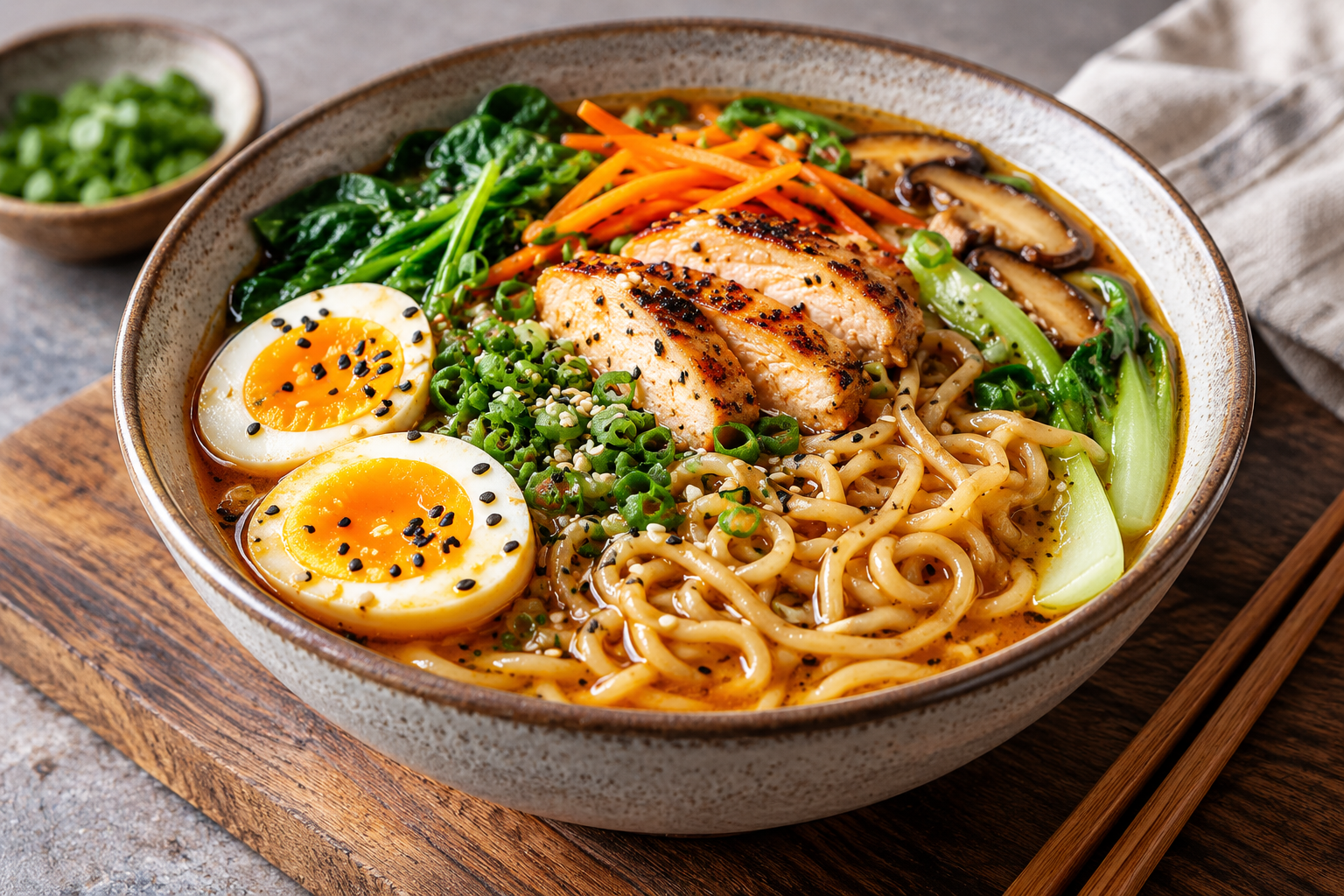
Protein Ramen Noodles: What Makes Them Different From Regular Ramen?
Ramen has always been about more than the noodles.
The noodles need to have the right bite, the broth needs depth, and every ingredient in the bowl has to work together. So when protein ramen noodles started appearing as a higher-protein alternative to traditional ramen, I had the same question many chefs would have:
What happens to the noodle when you change its protein structure?
Adding more protein sounds simple on a nutrition label. In an actual noodle, however, it can change the way the dough behaves, how the noodle feels between your teeth, how quickly it cooks, and even how well it holds up in a hot broth.
That is what makes protein ramen interesting.
It isn’t simply regular ramen with a bigger number beside “protein”. The ingredients and the way the dough is formulated can change the entire eating experience.
As a chef, I look at noodles from both sides: what they provide nutritionally and what happens on the plate.
In this article, we’ll look at what protein ramen noodles are, how they differ from regular ramen, why their texture can be different, and what to actually look for when choosing one.
No complicated food science lecture. Just the useful part of the science, explained the way I would explain it in a professional kitchen.
2. What Are Protein Ramen Noodles?
At the simplest level, protein ramen noodles are noodles formulated to provide more protein than a conventional ramen noodle.
The interesting part is how manufacturers achieve that increase.
Traditional ramen noodles are commonly made from wheat flour, water, and other ingredients that help create their familiar structure and springy bite. When additional protein ingredients are introduced, the balance of the dough changes.
That can affect the noodle in ways you notice immediately.
It may become firmer, chewier, or more substantial, depending on the ingredients and formulation. Some products are designed to stay close to the texture of ordinary ramen, while others deliberately have a more pronounced bite.
This is why I wouldn’t judge a protein ramen simply by looking at its protein number.
For a chef, the real test is what happens after cooking.
Does the noodle stay firm? Does it become soft too quickly? Does it hold the broth properly? And most importantly, does it still give you that satisfying ramen bite?
Those details tell us much more about the noodle than the front of the package.
3. Why Does Adding Protein Change the Noodle?
This is where the food science becomes useful.
A noodle gets its familiar structure from the way its ingredients interact during mixing and cooking. Wheat proteins, particularly gluten-forming proteins, help create the elastic network that gives wheat noodles their characteristic stretch and bite.
When a product is formulated with additional protein ingredients, that balance can change.
The added protein may compete for water or alter the way the dough develops. The result can be a noodle that feels noticeably different from ordinary ramen.
Sometimes that difference is exactly what the manufacturer wants.
A firmer, chewier noodle can make a high-protein bowl feel more substantial. But if the formulation isn’t well balanced, the texture can become too dense or lose the springy quality that makes ramen enjoyable.
This is one of those places where nutrition and cooking have to agree.
A higher protein number is useful only if the noodle still works in the bowl.
4. Why Protein Ramen Can Feel More Chewy
If you’ve ever cooked different brands of ramen, you’ve probably noticed that noodles don’t all have the same bite.
Some are soft and delicate. Others have a firm, springy texture that makes you chew a little longer.
Protein ramen can lean toward that firmer side because changing the protein balance also changes the structure of the noodle. The exact result depends on the type and amount of protein used, along with the rest of the formulation and cooking process.
For me, texture is where a noodle earns its place in a bowl.
A good ramen noodle should have enough strength to hold its shape in hot broth without becoming hard or rubbery. It should give you some resistance when you bite through it, then finish cleanly.
That is why two noodles with similar protein numbers can still be eaten completely differently.
The nutrition label tells you how much protein there is.
Your bite tells you how well the noodle was made.
5. Protein Ramen vs. Regular Ramen
The easiest way to understand protein ramen is to put it next to a regular ramen noodle.
| Regular ramen | Protein ramen | |
|---|---|---|
| Main purpose | Texture, flavor, and convenience | Texture plus higher protein |
| Protein | Usually lower | Usually higher |
| Texture | Depends on the noodle style | Often firmer or chewier |
| Formulation | Built mainly around wheat and noodle texture | May include additional protein ingredients |
| Cooking experience | Familiar ramen bite | Can require more attention to cooking time |
But there is an important point here: protein ramen isn’t one single type of noodle.
Different products use different ingredients and formulations. Some may still feel very close to traditional ramen, while others have a noticeably different texture.
So I wouldn’t say that protein ramen is automatically better or worse than regular ramen.
They are simply designed with different priorities.
If I am cooking a bowl for a guest, I care about whether the noodle suits the broth, holds its texture, and gives the right bite. Protein content is one part of that decision, not the whole decision.
6. What Makes a Good Protein Ramen Noodle?
For me, a good protein ramen noodle has to pass two tests.
The first is nutritional: it should provide a meaningful amount of protein for the serving.
The second is culinary: it still needs to be a good noodle.
I look for a noodle that cooks evenly, keeps its shape in hot broth, and has a pleasant bite. It shouldn’t become mushy after a few minutes, but it also shouldn’t feel hard or rubbery.
The ingredient list can give you some clues, but cooking tells the real story.
Try the noodles once according to the package directions. Then, the next time, taste them a little earlier. You’ll quickly notice how the texture changes with just a small difference in cooking time.
That’s a simple chef’s test, but it tells you something a nutrition panel can’t:
how the noodle actually performs in a bowl.
7. Why Cooking Time Matters With Protein Ramen
Protein ramen can be less forgiving if you simply cook it on autopilot.
With ordinary ramen, a small difference in cooking time may already change the texture. With a higher-protein noodle, that difference can be even more noticeable because the formulation may have a firmer structure.
My approach is simple: start tasting before the maximum cooking time is reached.
Pick up a noodle, cool it for a second, and bite through it.
If it has a little resistance but still feels tender, you’re close. If it feels too firm, give it another short interval. If it is already soft and losing its structure, don’t wait for the timer to tell you what your palate already knows.
And remember that the noodle will continue to soften slightly when it sits in a bowl of hot broth.
That small detail can make a surprisingly big difference.
Chef RBS Tip: For ramen, the timer is a guide. Your bite is the final judge.
8. What Ingredients Increase Protein in Ramen?
There isn’t one universal recipe for protein ramen.
Some products rely mainly on wheat-based ingredients, while others add concentrated protein ingredients to raise the protein content without making the noodle much larger.
That difference matters because each protein behaves differently.
Wheat proteins can contribute to the structure and elasticity of the noodle. Other added proteins may increase the protein content but can also change the way the dough handles, how much water it needs, and how the finished noodle feels.
This is why the ingredient list is worth reading.
Don’t assume that every noodle labeled “high protein” will cook or taste the same. The protein source is part of the story, but the complete formulation determines what eventually ends up in your bowl.
For a chef, that is the interesting part: changing one ingredient can change the entire personality of a noodle.
9. Is Protein Ramen Healthier Than Regular Ramen?
This is where I would be careful with the word “healthier.”
More protein does not automatically make a food healthier in every situation.
A protein ramen may help someone increase their protein intake, but the overall nutritional picture still matters. Look at the serving size, calories, sodium, saturated fat, fiber, and the rest of the ingredient list alongside the protein.
There is also a simple practical point: what you add to the bowl matters.
A noodle with a good protein profile can become a very different meal once you add broth, vegetables, eggs, meat, sauces, or toppings.
So instead of asking only:
“Is protein ramen healthier?”
I prefer a more useful question:
“Does this noodle help me build a better-balanced bowl?”
That’s a question a chef can actually work with.
10. How to Build a Better Protein Ramen Bowl
This is where I would stop thinking about the noodle as a standalone product.
A good ramen bowl should have balance.
If the noodles already provide a useful amount of protein, you can build around them rather than simply adding more protein everywhere. Add vegetables for color, texture, and fiber, then choose a protein topping that suits the dish instead of overwhelming it.
I also like contrast.
A firm noodle works beautifully with a rich broth. Fresh vegetables can cut through a heavier sauce. A little acidity can brighten the whole bowl. Even a handful of herbs or spring onion can make the finished dish feel fresher.
That’s the difference between adding ingredients and composing a bowl.
The noodle may be the foundation, but the final experience comes from how everything works together.
Chef RBS Tip: Don’t chase the highest protein number on the package. Build a bowl that tastes good, feels balanced and gives you something useful nutritionally.
11. What Should You Look for When Buying Protein Ramen?
The front of the package is designed to catch your eye. The back is where I would spend my time.
Start with the Nutrition Facts label, serving size and protein amount. Then look at sodium, calories, saturated fat, fiber and the ingredient list. This gives you a much clearer picture than a large “HIGH PROTEIN” claim on the front.
I would also check how the noodle is meant to be cooked.
If you prefer a firm ramen texture, a noodle that holds its bite well may be more important to you than a small difference in protein content.
And don’t forget the broth.
A noodle with a good protein profile can still end up in a very salty or heavy bowl if the seasoning and toppings aren’t balanced.
For me, choosing a protein ramen comes down to three things:
What is in it? How does it cook? And does it make a good bowl?
That’s a much better starting point than simply choosing the packet with the biggest protein number.
12. The Chef RBS Takeaway
Protein ramen noodles are an interesting example of how nutrition and culinary technique have to work together.
Increasing the protein can change the structure, texture and cooking behavior of a noodle. But a higher number on the nutrition label doesn’t automatically make a better ramen.
The real test is what happens in the bowl.
Does the noodle hold its bite? Does it work with the broth? Does it taste good? And does the finished meal fit your nutritional needs?
That’s how I would judge any new food trend.
Don’t judge the noodle only by the label. Judge it by what it becomes when you cook it.
FAQ
What are protein ramen noodles?
How are protein ramen noodles different from regular ramen?
Why are protein ramen noodles more chewy?
What ingredients are used to increase protein in ramen?
Does protein ramen take longer to cook?
Is protein ramen healthier than regular ramen?
How much protein is in protein ramen?
What should you look for when buying protein ramen?
Can protein ramen be part of a balanced meal?
How do you cook protein ramen noodles?